Sit-in Protest in Front of Refiners like Hyundai Oilbank and SK Energy
Increase in Returning Truck Drivers
Port Logistics Showing Signs of Normalization
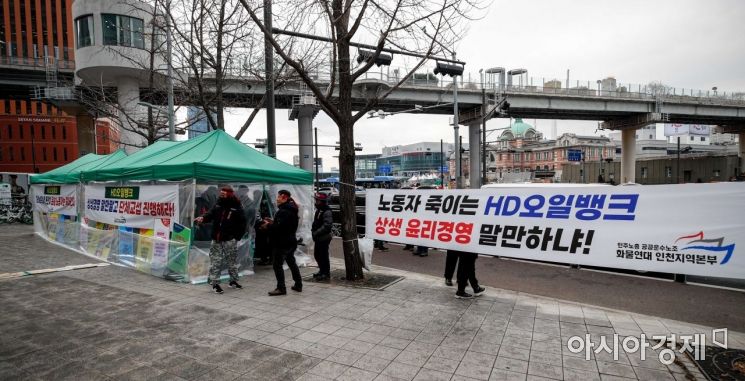 On the 6th, workers belonging to the Cargo Solidarity Incheon Regional Headquarters of the Korean Public Service and Transport Workers' Union under the Korean Confederation of Trade Unions continued their strike in front of the Hyundai Oilbank Seoul Office in Jung-gu, Seoul. Photo by Jinhyung Kang aymsdream@
[Asia Economy Reporter Kim Min-young] The Cargo Solidarity, which has been on strike for two weeks, has now turned its pressure towards oil refineries. As cement transportation began to normalize due to the government's strong measures such as the work commencement order, it is interpreted that they intend to strengthen the strike momentum by making oil transportation difficult this time. On the 7th, Won Hee-ryong, Minister of Land, Infrastructure and Transport, visited POSCO Pohang Steelworks to encourage the return of steel transport vehicles to work and reiterated that acts obstructing transportation refusal are 'illegal.'
According to the National Public Transport and Social Service Union, about 200 members held rallies, publicity campaigns, and sit-ins in front of major domestic oil companies such as the Seoul Station Yonsei Building (Hyundai Oilbank), Jongno SK Building (SK Energy), and GS Tower (GS Caltex) starting from 9 a.m. that day.
Lee Eung-joo, Director of Advanced Education at Cargo Solidarity, said, "The reason for gathering at oil refineries like Hyundai Oilbank is to promote the total strike victory," adding, "There is no 'return first, then dialogue' as proposed by Kim Moon-soo, Chairman of the Economic, Social and Labor Council (ESLC). The strike line is firm."
Having concentrated their efforts on cement transportation, Cargo Solidarity now appears to be focusing their strike power on oil. Due to the strike, the number of gas stations running out of fuel has increased, causing ongoing inconvenience to the public. As of the 6th, there are 96 gas stations registered as having insufficient stock: 56 in the metropolitan area and 40 in other regions.
On the other hand, cement transportation volume is on the rise. Since the government issued work commencement orders to cement truck owners, more truck drivers have returned to work. According to the Ministry of Land, Infrastructure and Transport, as of the 6th, seven transport companies and 45 truck owners who received work commencement orders have resumed transportation. As the number of truck drivers returning to work gradually increases, port logistics are showing signs of normalization. As of 5 p.m. on the 6th, the daily container throughput at 12 major ports nationwide reached 72,428 TEU, about 99% of normal levels. One TEU refers to one 20-foot container.
Gwangyang Port, where container throughput had dropped to 0-3% due to collective transportation refusal, has also recovered to 21% of normal levels. About 80% of the truck drivers responsible for transportation at Gwangyang Port belong to Cargo Solidarity, making it a stronghold of the union's influence.
As truck drivers began to leave the ranks, causing signs of cracks in the solidarity, Cargo Solidarity has increased pressure on truck drivers. They have thrown steel balls at cement transport truck owners who resumed transportation, sent threatening messages, and hung banners with chilling phrases. While Cargo Solidarity advocates for the permanent implementation of the 'Safe Freight Rate System' to ensure the safe operation of truck drivers, they are engaging in contradictory behavior by threatening the safety of workers in the same industry.
The steel industry continues to suffer damage as well. Steel shipments were carried out at 53% of normal levels the previous day. Due to a lack of loading space, the steel and petrochemical industries may have to consider production cuts as early as this week. Regarding the expansion of work commencement orders, Minister Won emphasized, "We are closely reviewing the current industrial damage and transportation return status," adding, "A Cabinet meeting could be held as soon as tomorrow."
Meanwhile, on the 6th, Cargo Solidarity held a press conference with senior social figures and representatives from various sectors urging a proper resolution to the freight strike related to the Safe Freight Rate System. They criticized, "The government broke its promise made last June to discuss the continuation and expansion of the Safe Freight Rate System and has been consistently responding harshly by labeling the freight workers' strike as 'illegal.' Both the government and the National Assembly have wasted over five months without any alternatives, shifting all responsibility for the strike onto the freight workers alone."
© The Asia Business Daily(www.asiae.co.kr). All rights reserved.
![Clutching a Stolen Dior Bag, Saying "I Hate Being Poor but Real"... The Grotesque Con of a "Human Knockoff" [Slate]](https://cwcontent.asiae.co.kr/asiaresize/183/2026021902243444107_1771435474.jpg)















