Excluding VAT in Fee Calculation... Resolving Overcharging Issues
Maintaining Prices Despite Exchange Rate Fluctuations with KRW Pricing
Price Tiers Expanded from 94 to 900 Levels
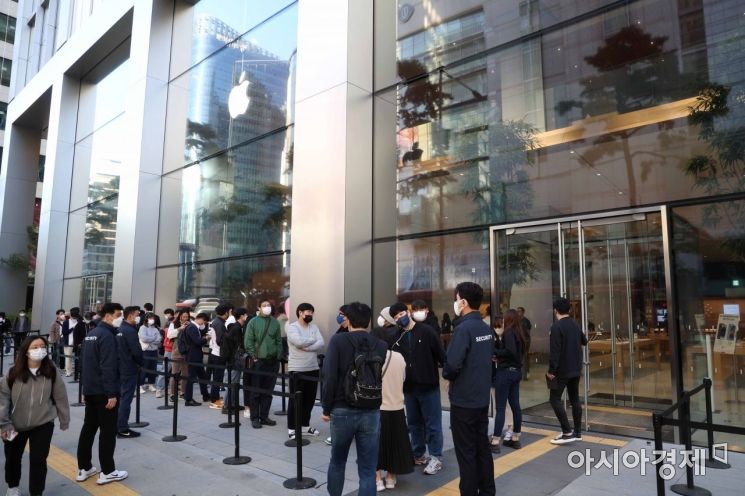 On the 7th, when Apple's new iPhone 14 series was officially released in Korea, citizens lined up to purchase the product at the Apple Store in Myeongdong, Jung-gu, Seoul. Photo by Moon Honam munonam@
[Asia Economy Reporter Oh Su-yeon] Apple recently decided to reduce the App Store developer commission rate by 3 percentage points in South Korea, following controversy over excessive charges.
On the 6th (local time), Apple announced the largest pricing model change since the launch of the App Store. The revision mainly consists of three key points: ▲ excluding value-added tax (VAT) when calculating commissions ▲ pricing in currencies other than the dollar, such as Korean won ▲ and more detailed price tiers.
The biggest change is that the commission burden for domestic developers on the App Store will decrease by 3 percentage points. This follows an investigation by the Korea Fair Trade Commission (KFTC) into claims that Apple excessively charged in-app payment commissions.
Until now, Apple charged domestic app developers a 30% app market commission based on the final consumer price including VAT (10%), while overseas app developers serving Korean consumers were charged commissions based on the supply price excluding VAT from the final consumer price. Overseas developers paid a 30% commission, but domestic developers paid 33%. The Korea Mobile Game Association reported to the KFTC that Apple collected approximately 340 billion KRW in commissions through this process.
The KFTC conducted an on-site investigation of Apple Korea and held interviews with executives at Apple's U.S. headquarters. Apple expressed its intention to correct the issue by revising its terms and updating its system to charge commissions based on the supply price for domestic developers by the end of January next year.
On the same day, Apple announced that it would allow seven countries, including South Korea, to decide whether to include taxes when calculating commissions.
Previously, prices were set based on the dollar, but with this update, prices can be set in a total of 45 currencies, including the Korean won. In October, due to a sharp rise in exchange rates, in-app payment prices jumped from 1,200 KRW to 1,500 KRW per $0.99, leading some domestic developers to adjust their prices. However, going forward, once a price is set based on one country, prices will be automatically generated for the other 174 stores and 44 currencies. This allows developers to maintain consistent sales prices in the store of the country they choose, even amid volatile exchange rates. For example, an app developer whose sales mostly come from Korea can set the base price in Korean won in the Korean store. It is also possible to set different prices by country or to have prices automatically fluctuate based on dollar exchange rates as before.
Price tiers have also been further subdivided. Apple had previously set 94 price tiers based on $0.99. With this revision, developers can set up to 900 tiers ranging from 400 KRW to a maximum of 16 million KRW, about ten times the previous range. Previously, developers had to set prices within the limited range Apple provided, but now they have greater freedom in price selection.
This new pricing model will be applied to auto-renewable subscription (recurring payment) apps starting today, and to other apps from the first half of next year.
© The Asia Business Daily(www.asiae.co.kr). All rights reserved.
![Clutching a Stolen Dior Bag, Saying "I Hate Being Poor but Real"... The Grotesque Con of a "Human Knockoff" [Slate]](https://cwcontent.asiae.co.kr/asiaresize/183/2026021902243444107_1771435474.jpg)















