Minister Cho Kyu-hong Reports at 3rd National Assembly Pension Reform Special Committee on 6th
Concerns Over Pension Fund Depletion Due to Low Birthrate and Aging Population
"Inadequate Adequate Old-Age Income Security" Pointed Out
Basic Pension Financial Burden Also Tripled
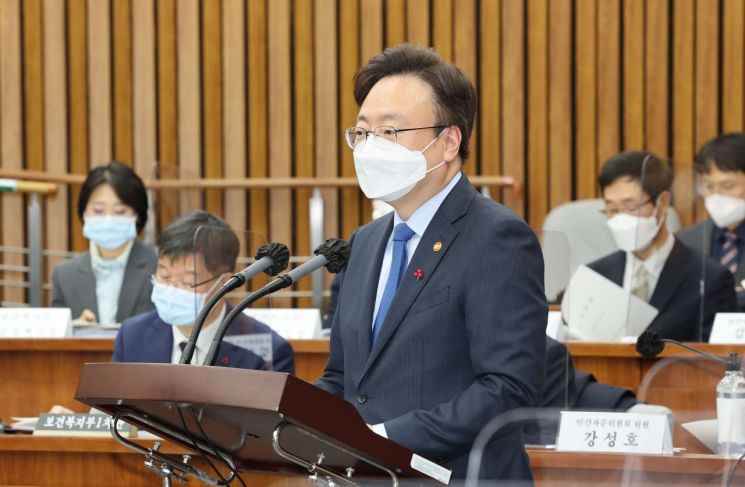
[Asia Economy Reporter Jo In-kyung] Cho Kyu-hong, Minister of Health and Welfare (photo), reiterated the necessity of pension reform, stating, "Concerns about the depletion of the National Pension Fund and the increasing financial burden of the Basic Pension have raised sustainability crises." Regarding public concerns that pensions may not be received if the fund is exhausted, he said, "If necessary, we will actively consider explicitly guaranteeing payments."
Minister Cho appeared at the 3rd meeting of the National Assembly's Special Committee on Pension Reform on the afternoon of the 6th and stated, "Pension reform is an urgent task that can no longer be postponed, and now, when social interest in pension reform is higher than ever, is the right time for pension reform."
He evaluated the National Pension by saying, "There are several difficulties, such as people not being able to join the public pension or having low pension benefits, resulting in inadequate proper old-age income security functions, and issues of intergenerational equity and fairness being raised."
According to the Ministry of Health and Welfare, as of June, the National Pension Fund reserves amounted to 882.7 trillion won. The '4th National Pension Financial Calculation' results predict that the reserves will exceed 700 trillion won in 2019 and reach a maximum of 1,778 trillion won by 2041, but if the current system is maintained, the fund could be depleted by 2057.
In the case of the Basic Pension, if the current system of paying 70% of the elderly is maintained, by 2050, one in three citizens will be a recipient, and the resulting financial burden is estimated to increase more than threefold by 2070.
At the meeting, in response to a ruling party lawmaker's question that "the current 2040 generation is anxious about whether they will receive the National Pension when they reach the eligible age," Minister Cho replied, "For pension reform, it is natural that the state guarantees payment," adding, "I believe payment guarantees are possible under current law provisions, but if more explicit wording is needed during discussions, we will actively consider it."
"Adjustment of Contribution Rate and Income Replacement Rate Needed"
The Ministry of Health and Welfare presented key issues and tasks for pension reform in the report submitted to the National Assembly, including ▲ adjustment of contribution rates ▲ adjustment of pension eligibility age ▲ adjustment of the National Pension's income replacement rate ▲ linking discussions on National Pension reform and Basic Pension.
In particular, citing the shortening of the fund depletion timeline due to changes in the economic environment and demographic structure such as low growth, low birthrate and aging population, and rising elderly dependency ratio, the ministry emphasized the need to discuss adjusting the contribution rate to enhance the financial sustainability of the National Pension. South Korea's National Pension contribution rate started at 3% in 1988, the first year of implementation, and rose to 9% by 1998 but has remained unchanged for 24 years since then. This is about half the OECD average of 18.2%.
Adjustment of the income replacement rate is also a key issue. Currently, the income replacement rate for an average income earner who has contributed to the National Pension for 40 years is set at 40%, but the actual average contribution period is only 18.7 years, resulting in an effective income replacement rate of 22.4% as of 2020. However, the ministry showed a cautious stance, stating, "There are conflicting views between those who argue for raising the income replacement rate to ensure an appropriate benefit level and those who believe it should be maintained or reduced considering fiscal stability."
With increasing life expectancy extending the pension benefit period, the need to raise the pension eligibility age has also been raised. The ministry pointed out, "When raising the pension eligibility age, it is necessary to consider extending the retirement age, improving the labor market, and institutional acceptability, as a gap may occur between the retirement age, currently 60, and the pension eligibility age."
Meanwhile, the ministry recently completed the formation of three committees for the 5th National Pension financial calculation and has begun full-scale discussions. By March next year, long-term financial projections for the National Pension will be derived, and based on discussions by the National Assembly's Pension Special Committee and the Financial Calculation Committee, a comprehensive operational plan will be established by October.
© The Asia Business Daily(www.asiae.co.kr). All rights reserved.
![Clutching a Stolen Dior Bag, Saying "I Hate Being Poor but Real"... The Grotesque Con of a "Human Knockoff" [Slate]](https://cwcontent.asiae.co.kr/asiaresize/183/2026021902243444107_1771435474.jpg)















