Detailed Results of Large-Scale Global Phase 3 Clinical Trial Released
In EGFR-Mutated Non-Small Cell Lung Cancer Patients
Demonstrating Progression-Free Survival of 20.6 Months
Confirmed Efficacy Despite Poor Prognosis Mutations and Metastasis
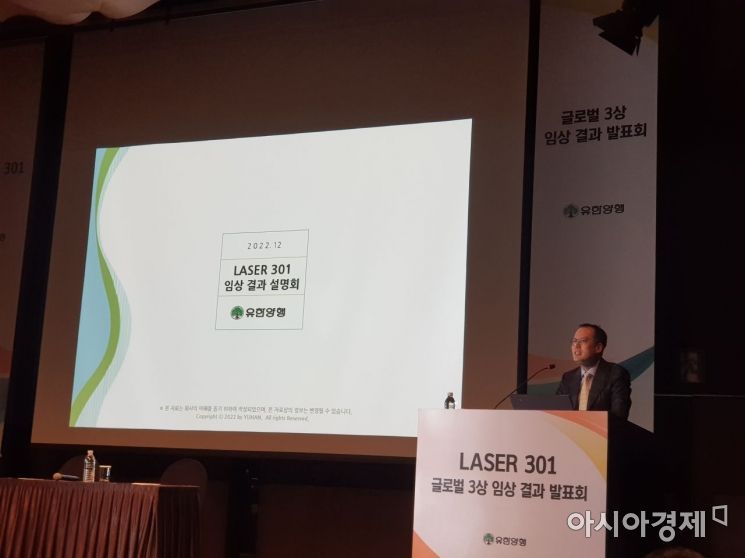 Cho Byung-chul, head of the Lung Cancer Center at Yonsei Cancer Hospital, is explaining the results at the Phase 3 clinical trial presentation of Yuhan Corporation's non-small cell lung cancer treatment 'Reclaza' on the 6th. Photo by Lee Kwan-joo
[Asia Economy Reporter Lee Gwan-joo] The detailed results of the large-scale global Phase 3 clinical trial (LASER301) for Yuhan Corporation’s “Reclaza” (generic name: Lazertinib), the 31st domestic new drug and a third-generation epidermal growth factor receptor (EGFR) mutation-positive non-small cell lung cancer (NSCLC) treatment, have been disclosed. It demonstrated superior efficacy compared to the existing first-line treatments, showing potential for use as a first-line therapy in the future.
On the 6th, Yuhan Corporation held a “Global Phase 3 Clinical Trial Results Presentation” for Reclaza at The Plaza Hotel in Seoul. The presentation was delivered directly by Cho Byung-chul, Director of the Lung Cancer Center at Yonsei Cancer Hospital, who led the clinical trial. The Phase 3 trial was a randomized, double-blind, multinational study conducted on 393 patients with previously untreated active EGFR mutation-positive locally advanced or metastatic NSCLC (258 Asians and 135 non-Asians). It aimed to evaluate the efficacy and safety of Lazertinib compared to the current first-line treatment, Gefitinib.
First, the analysis of the primary endpoint, progression-free survival (PFS), showed that the Lazertinib group had a median PFS of 20.6 months, while the Gefitinib group had 9.7 months (hazard ratio 0.45, 95% confidence interval 0.34?0.58, p<0.001), indicating a statistically significant improvement. PFS is a measure used to evaluate the efficacy of anticancer drugs, defined as the time from randomization to objective tumor progression or death. Subgroup analysis by ethnicity also demonstrated superior antitumor effects in Asian patients, with the Lazertinib group showing 20.6 months and the Gefitinib group 9.7 months.
Notably, Lazertinib showed outstanding efficacy in NSCLC, which is known to have a poor prognosis. Subgroup analysis by EGFR mutation type revealed that patients with exon 19 deletion mutation (Ex19del) had a median PFS of 20.7 months in the Lazertinib group versus 10.9 months in the Gefitinib group. For patients with exon 21 L858R substitution mutation (L858R), which generally has a poorer prognosis compared to Ex19del, the median PFS was 17.8 months for Lazertinib and 9.6 months for Gefitinib. Additionally, in patients with central nervous system (CNS) metastases, the Lazertinib group showed a median PFS of 16.4 months compared to 9.5 months in the Gefitinib group. Regarding this, Director Cho stated, “This is important data showing that Lazertinib provides consistent efficacy.”

Secondary endpoints were also disclosed. The objective response rate (ORR) of Lazertinib was 76%, similar to that of the Gefitinib group, but the duration of response (DOR) was significantly longer at 19.4 months for Lazertinib compared to 8.3 months for Gefitinib, exceeding 10 months. An interim analysis of overall survival (OS) (data maturity 29%) showed a hazard ratio for death of 0.74, with survival rates at 18 months post-enrollment of 80% for the Lazertinib group and 72% for the Gefitinib group. Director Cho commented, “Although the data maturity is still low, this can be interpreted as showing the potential of Lazertinib.”
The safety profile of Lazertinib was also confirmed. The most frequently reported adverse events in the Lazertinib group were sensory abnormalities (39%), rash (36%), and pruritus (26%). Most reported adverse events were mild, graded 1 to 2. The incidence rates of serious adverse events such as interstitial lung disease and grade 3 or higher QTc prolongation were low, at 2.5% and 1%, respectively.
This clinical success is highly significant as it offers a new treatment option for patients with EGFR mutation-positive NSCLC. Director Cho explained, “EGFR mutation-positive NSCLC occurs in more patients than any other metastatic cancer combined,” adding, “The fact that the second third-generation targeted therapy has shown successful Phase 3 results in collaboration with researchers worldwide is a meaningful outcome for patients.”
Based on these clinical results, Yuhan Corporation plans to submit an application to the Ministry of Food and Drug Safety early next year to add Reclaza as a first-line treatment indication and will proceed with regulatory approval processes with the U.S. Food and Drug Administration (FDA), European Medicines Agency (EMA), and others. Yuhan CEO Cho Wook-je said, “We conducted the clinical trial with the determination that Reclaza alone could be competitive, and the results have sufficiently proven this,” adding, “We expect it to become a first-line treatment option not only domestically but also for patients worldwide.”
© The Asia Business Daily(www.asiae.co.kr). All rights reserved.


















