Chemical Research Institute Unveils Paper Straws Coated with Biodegradable Plastic
100% Biodegradable Yet Resistant to Sogginess for Long-lasting Use
[Asia Economy Reporter Kim Bong-su] An alternative to plastic straws, which will be banned in cafes and restaurants starting next year, has been developed. Unlike existing paper straws, this new straw does not easily become soggy and can be used for a long time, and it is 100% biodegradable, making it environmentally friendly.
The Korea Research Institute of Chemical Technology announced on the 6th that it has developed an eco-friendly paper straw that is 100% biodegradable in marine and soil environments and does not easily become soggy. It is also easy to mass-produce, so it is expected to respond well to the upcoming regulations on plastic straws in restaurants and cafes. The Ministry of Environment has enforced the enforcement rules of the "Act on the Promotion of Saving and Recycling of Resources" since the 24th of last month, and after a one-year grace period, the use of plastic straws and stirring straws inside restaurants and cafes will be banned starting next year.
Some cafes have been using paper straws as an alternative. However, these are not made entirely of paper. Since 100% paper straws become too soggy when in contact with liquids and cannot function as straws, their surfaces must be coated. The coating materials are mainly polyethylene (PE) or acrylic resin, substances similar to plastic bags or adhesives. The problem is that the coating on paper cups and paper straws can shed small particles, which may cause microplastic pollution. Recycling is also difficult. Paper straws become soggy after prolonged exposure to beverages, and when drinking carbonated drinks, the surface characteristics of paper straws cause excessive foaming. Alternative straws include polylactic acid (PLA) straws and rice straws, but they have drawbacks such as poor biodegradability in marine environments, difficulty in mass production, high cost, and sharp cross-sections.
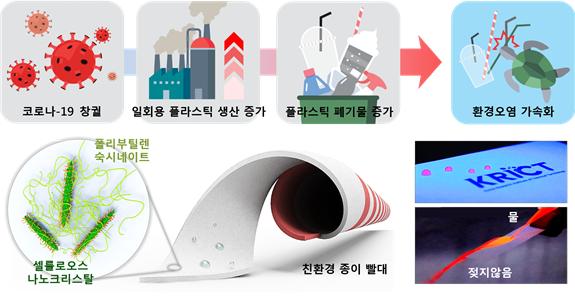
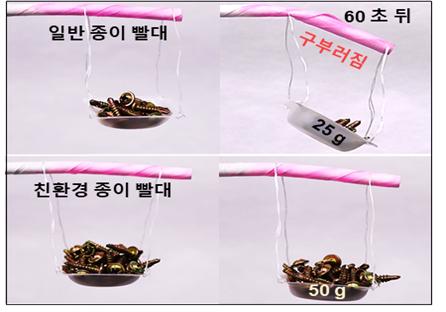
The Korea Research Institute of Chemical Technology, in collaboration with Sogang University, has developed an eco-friendly paper straw that could serve as an alternative. They synthesized polybutylene succinate (PBS), a representative biodegradable plastic, using their own technology, and added a small amount of cellulose nanocrystals to create a coating material. This coating adheres uniformly and firmly to the paper, preventing the straw from becoming soggy or producing excessive foam. Moreover, as a biodegradable plastic, it decomposes completely. It maintains consistent performance not only in cold drinks but also in hot beverages. It does not become soggy or bend even when stirring various drinks such as water, tea, milk, oil-containing beverages, or carbonated drinks for extended periods. In tests measuring sogginess, conventional paper straws bent severely when a 25g weight was hung after being soaked in 5°C cold water for one minute. In contrast, the paper straws developed by the research team did not bend easily even when a weight exceeding 50g was applied under the same conditions.
The straws also showed excellent biodegradability in marine environments. Generally, the sea has low temperatures and salinity levels that inhibit microbial growth, making the decomposition of paper or plastic much slower than in soil. The research team tested decomposition by submerging straw samples at a depth of 1.5 to 2 meters near the coast of Odori, Heungae-eup, Buk-gu, Pohang City. Conventional plastic straws and corn-based plastic straws did not decompose at all over 120 days. Existing paper straws maintained their shape and lost only about 5% of their total weight. In contrast, the straws developed by the research team lost more than 50% of their weight within 60 days and completely disappeared after 120 days.
The research results were published on the 21st of last month in the international journal Advanced Science (IF: 17.52).
Dr. Oh Dong-yeop, the lead researcher at the Korea Research Institute of Chemical Technology, said, "This is a small example that suggests the direction we should take living in the plastic era," adding, "Switching the plastic straws we frequently use to paper straws will not have an immediate effect, but over time, the difference will be significant."
© The Asia Business Daily(www.asiae.co.kr). All rights reserved.
![Clutching a Stolen Dior Bag, Saying "I Hate Being Poor but Real"... The Grotesque Con of a "Human Knockoff" [Slate]](https://cwcontent.asiae.co.kr/asiaresize/183/2026021902243444107_1771435474.jpg)
















