Approval of Post-Retirement Work 'Senior Judge System'... Rejection of Expansion of 'Criminal Video Trials'
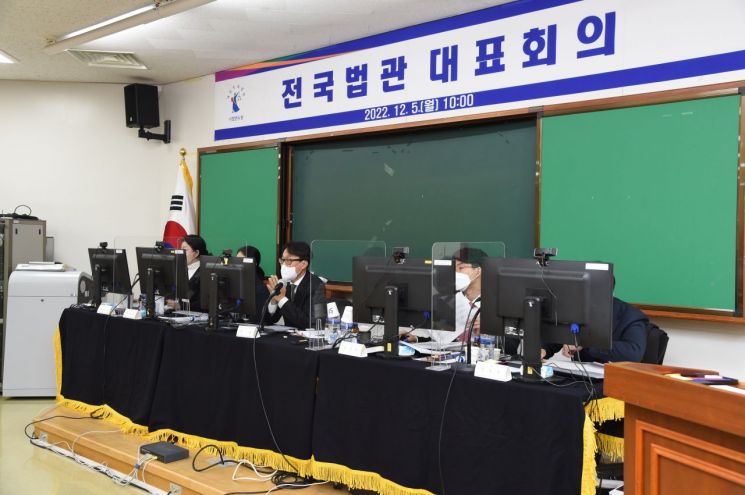 On the 5th, the National Judges' Representative Meeting was held at the Judicial Research and Training Institute in Goyang-si, Gyeonggi-do.
 [Photo by National Judges' Representative Meeting]
[Asia Economy Reporter Heo Kyung-jun] The National Judges' Representative Meeting (hereinafter referred to as the Representative Meeting) demanded that the opinions of frontline judges be reflected as much as possible regarding the ‘Court Chief Candidate Recommendation System’ promoted by Chief Justice Kim Myung-soo. However, the meeting did not discuss the continuation or abolition of the Court Chief Candidate Recommendation System.
The Representative Meeting held its regular meeting for the second half of 2022 at the Judicial Research and Training Institute in Goyang, Gyeonggi Province, and discussed seven agenda items including the Court Chief Candidate Recommendation System, the meeting announced on the 6th. A total of 110 judges participated both online and offline.
The Representative Meeting passed a resolution with 59 votes in favor, 26 against, and 6 abstentions stating that "the Chief Justice shall, in appointing court chiefs according to the Court Chief Candidate Recommendation System, respect the recommendation results of the recommendation committees of each court level as much as possible, unless there are objective reasons such as prior misconduct, criminal or disciplinary procedures."
The original draft included the principle of appointing the candidate with the highest votes, but during the discussion, it was revised to "respect the recommendation results as much as possible."
A Representative Meeting official explained, "There was an opinion that if the election system is followed entirely, the election enthusiasm could become overheated, and there is also a need to respect the Chief Justice’s personnel authority, so the principle of appointing the candidate with the most votes was deleted in the revised draft."
Additionally, the agenda that "since the senior deputy chief is in a more advantageous position than other candidates and the system could be distorted, the Chief Justice should take measures to resolve the issue" was also raised at the meeting but was rejected with 43 votes in favor, 44 against, and 6 abstentions.
The Court Chief Candidate Recommendation System was introduced by Chief Justice Kim to realize horizontal judicial administration and to establish a dual system for judicial personnel management, and it will be expanded to 20 district courts nationwide next year.
Court chief candidates must have ▲ over 22 years of legal experience ▲ over 10 years of service as a judge ▲ and be judges who have received recommendations from three or more judges among district court chief judges. Recommended judges become court chief candidates, and the judges in the court decide through voting. The candidate with the most votes does not automatically assume the court chief position; the Chief Justice refers to the voting results when appointing court chiefs. However, there have been many cases where judges with the highest votes through the court chief candidate vote have become court chiefs.
The Representative Meeting also discussed the introduction of the ‘Senior Judge System’ and resolved that the introduction of the senior judge system (judges guaranteed employment after retirement age) is necessary to establish a lifetime judge system and unify the legal profession, resolve the shortage of judicial personnel, improve satisfaction and trust in trials, enhance judicial independence, and reduce social costs.
Furthermore, to strengthen democracy within the judiciary and gather opinions from all judges, the Representative Meeting decided to conduct surveys targeting all judges at least once every two years by each subcommittee and to disclose the results.
An agenda titled ‘Expression of Judges’ Collective Opinion on the Composition of the Supreme Court Justices’ was proposed to inform judge representatives participating in the Supreme Court Justice Candidate Recommendation Committee about the criteria for presenting opinions and to establish specific procedures and systems in regulations to collect diverse opinions from judge representatives, but it was not put to a vote.
In addition, to improve the court’s work allocation system, it was proposed that each court establish specific procedures within the internal regulations of the judges’ work allocation committee to collect and reflect judges’ opinions and objections regarding work allocation, and that each court set basic principles of work allocation in internal regulations.
There was also a proposal to expand video trials as a way to increase accessibility to criminal trials, but it was rejected.
The Representative Meeting plans to convey the conclusions reached to Chief Justice Kim.
© The Asia Business Daily(www.asiae.co.kr). All rights reserved.
![Clutching a Stolen Dior Bag, Saying "I Hate Being Poor but Real"... The Grotesque Con of a "Human Knockoff" [Slate]](https://cwcontent.asiae.co.kr/asiaresize/183/2026021902243444107_1771435474.jpg)















