[Asia Economy Sejong=Reporter Kim Hyewon] The decline in wholesale prices of Hanwoo is expected to continue until 2024. Although the number of slaughtered cattle is approaching a record high of 1 million heads, consumption is decreasing due to economic slowdown caused by interest rate hikes and rising prices. On the supply side, securing the effectiveness of preemptive supply-demand control policies such as culling low-productivity cows, and on the demand side, simultaneously seeking demand stimulation measures are being pointed out as necessary.
According to the report "Recent Causes and Outlook of Hanwoo Price Decline" published on the 5th by the Korea Rural Economic Institute (KREI), the average wholesale price of Hanwoo in October was recorded at 18,898 KRW/kg, down 11% compared to the previous year. Grades 1++ and 1+ fell by 8-10%, grade 1 by 12.5%, and grades 2-3 by 16-22%, respectively, compared to the previous year.
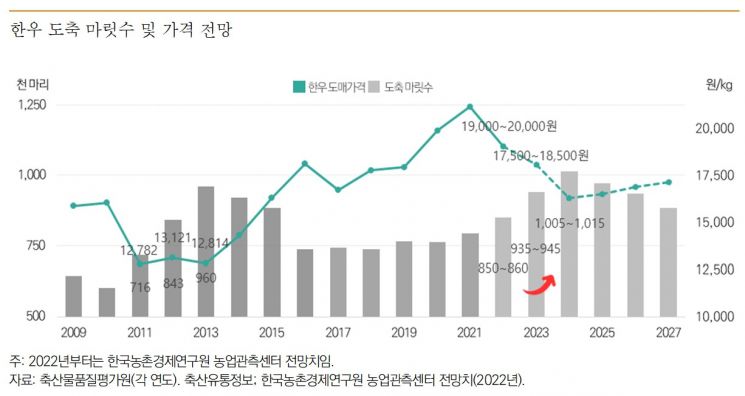
The increase in the number of raised cattle has entered its seventh year. This means that the volume of shipments will also increase in the future, which is highly likely to act as a factor in price decline. This year, the number of raised cattle is expected to reach a record high of 3,557,000 heads. As the number of raised cattle increases, the number of cattle waiting for shipment also rises, with the number of graded cattle from January to October increasing by 7.5% year-on-year to about 700,000 heads. The annual number of slaughtered cattle this year is estimated to be around 850,000 heads. Last year, it was 790,000 heads.
On the other hand, Hanwoo consumption has steadily decreased due to the effects of interest rate hikes and rising prices. From January to September, household purchases of Hanwoo decreased by 6.1% compared to last year, to about 12 kg. The average monthly expenditure on meat consumption per household decreased from 73,000 KRW last year to 66,000 KRW this year. As consumption capacity decreases, inventory levels have increased by 83.3% compared to the same period last year, creating a significant inventory burden.
The problem is that this year is not the peak of the price decline. KREI predicted that the number of slaughtered cattle will increase to around 1 million heads by 2024 due to the increase in the number of raised cattle. This means that the decline in wholesale prices is expected to continue at least until then.
Lee Hyungwoo, a senior researcher at KREI, analyzed, "The increase in the number of raised cattle will continue at least until 2023, and slaughtering will continue to increase until 2024," adding, "Assuming that Hanwoo prices are determined by slaughtering (domestic production), Hanwoo prices are likely to decline from this year through 2024." He continued, "This is a time when proactive and voluntary supply-demand control is necessary," and added, "Since Hanwoo prices are entering a declining phase, long-term reduction of farm management volatility and profit maximization should be pursued through culling low-productivity cows and planned shipments."
© The Asia Business Daily(www.asiae.co.kr). All rights reserved.
![Clutching a Stolen Dior Bag, Saying "I Hate Being Poor but Real"... The Grotesque Con of a "Human Knockoff" [Slate]](https://cwcontent.asiae.co.kr/asiaresize/183/2026021902243444107_1771435474.jpg)















