KAIST Research Team: "Robots and Wearable Devices Usable"
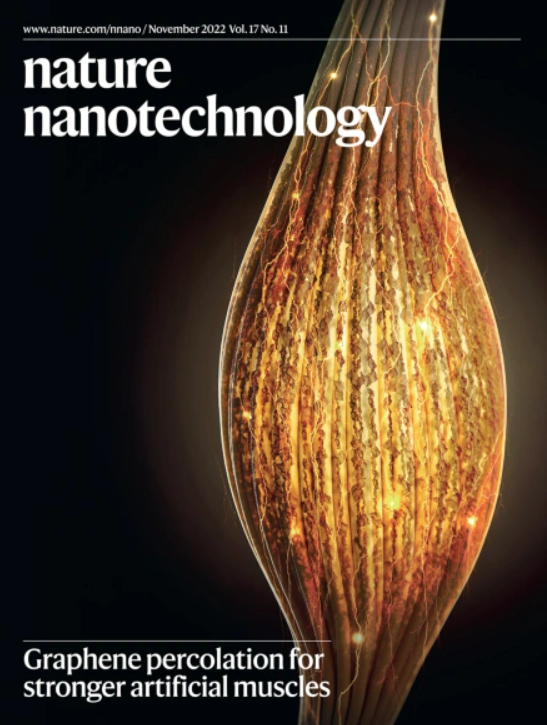 International journal Nature Nanotechnology October 27 issue featuring on the cover a paper on artificial muscles developed by the KAIST research team. Photo by KAIST.
[Asia Economy Reporter Kim Bong-su] Domestic researchers have developed a 'Hercules-class' artificial muscle capable of exerting more than 17 times the strength of a human muscle.
The Korea Advanced Institute of Science and Technology (KAIST) announced on the 5th that Professor Kim Sang-wook's research team from the Department of Materials Science and Engineering, in collaboration with Professor An Seok-gyun's team from Pusan National University, succeeded in developing a new artificial muscle using graphene-liquid crystal composite fibers. This artificial muscle is the most similar to human muscle reported in the scientific community to date and can exert up to 17 times stronger force.
Animal muscles are known to change their shape through nerve stimulation, causing mechanical movement. Technologies to induce movements similar to animal muscles have been developed in various fields such as robotics and artificial organs, but most have relied primarily on mechanical devices until now.
Recently, artificial muscles that are flexible like living muscles and can generate mechanical movement using flexible new materials have been researched. However, most of these have a limited range of motion compared to animal muscles, and to generate strong movement, they require an additional energy storage process similar to winding a clock spring.
The new material developed by the research team applies high-quality graphene to liquid crystal materials that contract significantly with temperature changes like animal muscles, enabling remote control using lasers. It demonstrated movement capabilities that greatly surpass human muscle performance (17 times) and power density (6 times). The team successfully lifted a 1 kg dumbbell using the artificial muscle and created an artificial silkworm that moved three times faster than a living silkworm.
Professor Kim said, "Although artificial muscles being actively developed worldwide recently have excellent properties in one or two aspects, none have possessed a balanced combination of various properties necessary for practical artificial muscle operation. This research marks a starting point for practical artificial muscle materials that can be utilized in the robotics industry and various wearable devices, and will significantly contribute to contactless science and technology in the Fourth Industrial Revolution."
The research results were published as the cover paper in the October 27 issue of the international journal Nature Nanotechnology.
© The Asia Business Daily(www.asiae.co.kr). All rights reserved.
![Clutching a Stolen Dior Bag, Saying "I Hate Being Poor but Real"... The Grotesque Con of a "Human Knockoff" [Slate]](https://cwcontent.asiae.co.kr/asiaresize/183/2026021902243444107_1771435474.jpg)















