IBS Reveals Through Mouse Observation Fear Model Experiment
That Specific Brain Region Activates to Empathize with Fear
[Asia Economy Reporter Kim Bong-su] Domestic researchers have uncovered the neural mechanisms in the brains of mammals that enable empathy for the emotions of other animals.
The Institute for Basic Science (IBS) announced on the 5th that the research team led by Honorary Research Fellow Shin Hee-seop of the Center for Cognition and Sociality revealed through mouse experiments that synchronization of brain waves in the right hemisphere induces empathetic functions. This discovery is expected to contribute to research on treatments for mental disorders such as autism, psychopathy, and schizophrenia, which exhibit impaired empathy.
Empathy is the ability to share and understand the emotional states of others, such as joy, sadness, or fear. Deficiency or abnormal elevation of empathy can cause problems in sociality and mental health. However, empathy is a highly complex higher cognitive domain, and there has been little research on the neural circuits or functional connections between brain regions that form empathy, or the mechanisms by which they are established.
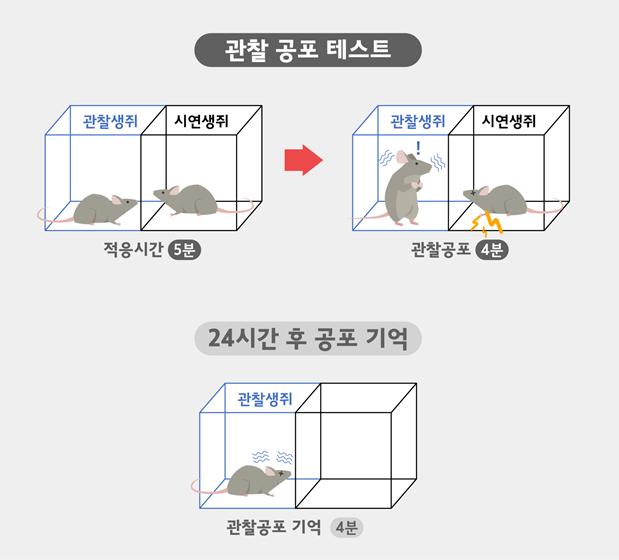
Mice clearly exhibit freezing behavior when they feel fear. The ‘observational fear’ behavioral model using mice involves delivering electric shocks to only one of two mice placed in a chamber (a box-shaped experimental apparatus), while the other mouse observes. This model measures how much the observing mouse imagines and empathizes with the fear experienced by the shocked mouse.
The mice’s empathetic fear ability is demonstrated by the degree to which they freeze upon observing the other’s pain and by how much they recall the fear memory after a certain period. The pattern of empathetic fear shown by mice in this model is known to be similar to the empathy patterns experienced by humans.
Based on the observational fear behavioral model in mice, the research team combined optogenetic techniques and brain wave measurement experiments to discover the right hemisphere neural circuits involved in empathy. They identified that brain waves in the 5?7 Hz frequency synchronize specific subregions of the right hemisphere, functionally connecting them to induce empathetic functions.
When the researchers inhibited the neural circuit connecting the cerebral cortex and amygdala in the right hemisphere of mice, the observational fear behavior decreased; conversely, strengthening this circuit increased the behavior. This confirmed that the neural circuit connecting the cerebral cortex and amygdala in the right hemisphere is involved in empathetic functions.
Interestingly, during the observational fear behavior in mice, synchronization of 5?7 Hz brain waves was observed in the right cerebral cortex-amygdala circuit. When the 5?7 Hz brain waves generated specifically in the right cerebral cortex were suppressed, both the right hemisphere brain wave synchronization and observational fear behavior were inhibited. Furthermore, the source of the cerebral cortex-amygdala brain waves was identified as hippocampal theta waves. Theta waves observed in the hippocampus are associated with various brain functions such as cognition, emotion, and innate fear anxiety disorders. When the research team used optogenetics to suppress hippocampal theta waves, synchronization of brain waves in the right cerebral cortex-amygdala region decreased, and observational fear behavior was suppressed. Conversely, enhancing theta waves increased brain wave synchronization and observational fear behavior. This demonstrated that the regulation of cerebral cortex-amygdala brain wave synchronization bidirectionally controls observational fear behavior.
Honorary Research Fellow Shin Hee-seop stated, “This is the first time that the mechanism regulating empathy has been elucidated at the level of neural circuits and brain waves,” adding, “We plan to continue research on genes and new neural circuits involved in empathetic functions and ultimately apply these findings to animal models of brain dysfunction such as autism and schizophrenia to contribute to the treatment of mental disorders.”
The research results were published online on the 2nd in Neuron (IF=18.688), a sister journal of Cell.
© The Asia Business Daily(www.asiae.co.kr). All rights reserved.
![Clutching a Stolen Dior Bag, Saying "I Hate Being Poor but Real"... The Grotesque Con of a "Human Knockoff" [Slate]](https://cwcontent.asiae.co.kr/asiaresize/183/2026021902243444107_1771435474.jpg)















