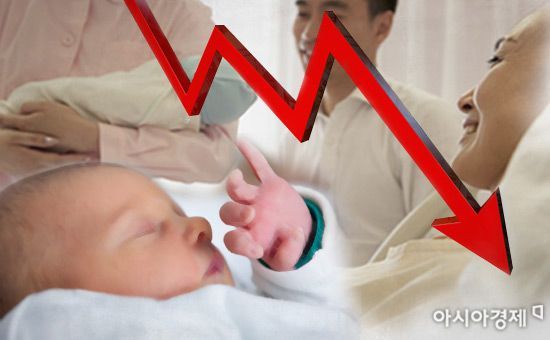
[Asia Economy Sejong=Reporter Son Seon-hee] A research analysis by a national research institute has confirmed that rising housing prices have a definite negative impact on childbirth. In particular, the negative effect was greater at the stage of considering childbirth rather than marriage. While the government's real estate policy is generally focused on 'newlyweds,' there is a suggestion that housing support for childbirth and child-rearing households is needed.
On the 5th, the Korea Institute of Public Finance (KIPF) published a tax and finance brief report titled "The Impact of Housing Price Changes on Marriage and Birth Rates and Policy Implications," containing these findings.
The report pointed out that low birth rates are the greatest threat facing the Korean economy. Despite successive governments implementing various low birth rate measures, visible results have not been achieved, and the birth rate has continued to decline.
Accordingly, KIPF analyzed the impact of housing price changes on marriage and birth rates through a survey conducted on 3,004 public institution employees. Public institutions began relocating to local areas sequentially from 2013. This is an exogenous variable rather than an individual choice, and since there is a large difference in housing prices between the metropolitan area and local regions, this was utilized to analyze the effect on marriage and childbirth among institution employees.
The analysis showed that an increase in housing prices definitely has a negative impact on childbirth, the report stated. When housing prices rose by 100%, the number of children born over eight years from 2013 to 2019 decreased by 0.1 to 0.29. In particular, the negative effect on households without housing was much greater than on those owning homes. For the homeless, the decrease in the number of births under the same conditions was even larger, ranging from 0.15 to 0.45.
On the other hand, the impact of housing price increases on marriage was found to be relatively small. However, for the homeless, when housing prices rose by 100%, the probability of marriage over eight years decreased by 4.1 to 5.7%.
Kang Dong-ik, a senior researcher at the Korea Institute of Public Finance, said, "The fact that behavioral changes due to the burden of housing prices appeared more significantly in households considering childbirth than in individuals deciding on marriage is an important implication." He added, "Support for newlyweds and small low-priced housing may be desirable from the perspective of supporting marriage, but housing support for households at the childbirth and child-rearing stages, where stronger support is needed, may currently be insufficient."
He continued, "Our society and government need to consider whether there is a need for in-depth review of support for these households and for relatively larger and higher-priced housing necessary for childbirth and child-rearing."
© The Asia Business Daily(www.asiae.co.kr). All rights reserved.
![Clutching a Stolen Dior Bag, Saying "I Hate Being Poor but Real"... The Grotesque Con of a "Human Knockoff" [Slate]](https://cwcontent.asiae.co.kr/asiaresize/183/2026021902243444107_1771435474.jpg)














