Qatar Rarely Uses Masks Except in Medical Facilities
With Increasing Overseas Travel, Mask Wearing in Korea Becomes a Hot Topic Again
[Asia Economy Reporter Byun Seon-jin] Mr. Park, a man in his 20s who arrived in Doha, Qatar at the end of last month to watch the Qatar World Cup, said, "The whole box of masks I stockpiled just in case was completely unnecessary." From the airport to buses, taxis, marts, restaurants, and hotels, and even at pre-match festivals and performances, there were no locals wearing masks.
Mr. Park said, "Here, wearing a mask can actually make you look like someone who did something wrong," adding, "Since Korea dramatically advanced to the round of 16, I plan to watch the Brazil match on-site even if I have to pay a 200,000 won flight cancellation fee," and "It might feel awkward to wear a mask again when I return to Korea after the event."
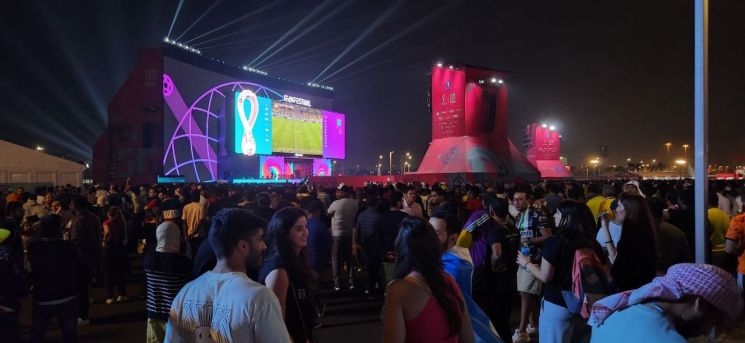 Mr. Park, in his 20s, who entered Doha, Qatar at the end of last month to watch the Qatar World Cup, said, "There were hardly any people wearing masks locally in Qatar." [Provided by Mr. Park]
In Korea, mask-wearing is mandatory indoors except in private spaces, but at global festivals and events like the Qatar World Cup held overseas, it is hard to find anyone wearing a mask. Because of this, Koreans who have consistently worn masks since COVID-19 say they feel awkward when visiting abroad. Mr. Lim (31), who returned on the 4th after the Portugal match, said, "If you wear a mask in Qatar, the vast majority will think you are Chinese, and in most cases, that is correct." China, which pursues a 'Zero COVID' policy, is a country strict about quarantine and health rules such as mask-wearing.
This winter, Qatar, the World Cup host, rarely restricts ordinary people for not wearing masks. According to Qatar health authorities on the 5th, unless you test positive for COVID-19 or visit public medical facilities, you do not have to wear a mask. If you test positive, you must quarantine for five days and then wear a mask for the following five days. However, Qatar does not require travelers to undergo COVID-19 testing. The Qatari government announced in early 2020 that failure to wear a mask could result in a maximum prison sentence due to a surge in cases, but with the introduction of vaccines and a decrease in fatality rates, the quarantine policy has shifted to voluntary.
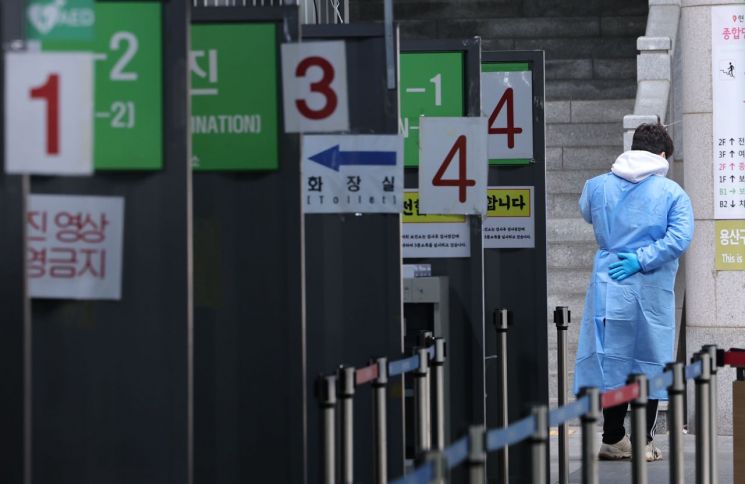
As we enter the endemic phase, Korea has effectively become the only OECD (Organization for Economic Cooperation and Development) country to mandate indoor mask-wearing. European countries like Italy and Germany only require masks in medical and social welfare facilities vulnerable to infection and do not enforce mask-wearing in private businesses such as marts and restaurants. However, some European countries are considering mask-wearing again as immunity from vaccination and COVID-19 infection wanes and cases rise.
In Korea, Daejeon City sent a letter to health authorities on the 30th of last month stating that mask-wearing would be voluntary starting January next year, making indoor mask-wearing a 'hot topic.' Health authorities believe that even 'pinpoint quarantine' measures mandating masks only in medical facilities and public transportation are impossible before winter ends. Although the seventh wave is subsiding, severe cases and deaths remain high, especially among high-risk groups, while vaccination rates fall short of the target 50-60%. As of midnight on the day, the winter vaccination rate is 22.0% for those aged 60 and over and 30.1% for residents of vulnerable facilities.
© The Asia Business Daily(www.asiae.co.kr). All rights reserved.
![Clutching a Stolen Dior Bag, Saying "I Hate Being Poor but Real"... The Grotesque Con of a "Human Knockoff" [Slate]](https://cwcontent.asiae.co.kr/asiaresize/183/2026021902243444107_1771435474.jpg)
















