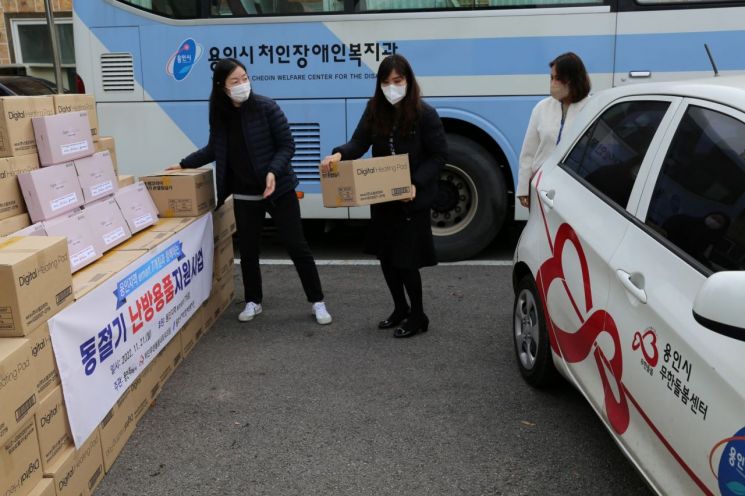
 Officials from the Yongin City Cheoin Disabled Welfare Center are organizing heating devices to be distributed to vulnerable groups. Photo by Yongin City Hall
[Asia Economy (Yongin) = Reporter Lee Young-gyu] Yongin City in Gyeonggi Province is launching a task force (TF) to intensively identify welfare blind spots during the winter season.
Yongin City announced that it has designated the period from December 5 this year to February 28 next year as the "Winter Crisis Household Intensive Discovery Period" and will operate a TF led by the Director of the Welfare and Women’s Affairs Bureau to find and support vulnerable groups such as seasonal unemployed, business suspension/closure workers, the unemployed, low-income households, elderly, disabled, and children.
For discovering crisis households, 39 types of public big data analysis materials such as power and water cutoffs and arrears in health insurance and electricity bills will be utilized. Private networks including gas and electricity meter readers, arrears management teams, and the Yongin City Social Welfare Council will also be activated.
A "Visiting Infinite Care Center" will be operated at rental apartment complexes and Yongin Light Rail Transit stations. The Yongin City Infinite Care Center, Yongin City Cheoin Disabled Welfare Center, Yongin City Giheung Senior Welfare Center, and Yongin City Suji Senior Welfare Center will conduct face-to-face counseling on-site to provide detailed guidance on welfare services available to crisis households.
The city will verify the crisis situations of households and strengthen emergency support including the National Basic Livelihood Security, and provide customized support such as housing stability, linkage to microfinance, and heating cost assistance.
Additionally, for crisis households in welfare blind spots who do not meet various welfare project selection criteria and thus do not receive welfare support, the city will provide neighbor-helping donations and, through cooperation with private organizations, offer housing environment improvements, moving support, and essential goods assistance.
Separately, the city will also manage the health of vulnerable groups in preparation for cold waves.
Until the end of February next year, an emergency room surveillance system for cold-related illnesses will be operated in five hospitals within the jurisdiction to strengthen care for cold illness patients, and special protection measures for the homeless will be established to prevent cold-related accidents in advance.
Twenty-one dedicated personnel will be assigned to strengthen visiting health management services for about 13,500 people including elderly living alone, chronic disease patients, and basic livelihood security recipients. They will provide guidance on cold wave behavior rules and how to respond to symptoms of cold-related illnesses, and check health status through basic tests such as blood pressure and blood sugar. Cold protection items such as thermal vests, blankets, warm socks, and scarves will be provided separately.
Lee Sang-il, Mayor of Yongin City, said, "Yongin City has formed a TF to proactively identify and assist welfare blind spots so that vulnerable groups do not face difficulties in maintaining their livelihood and health due to cold weather. We will do our best to create a warm Yongin City by providing practical help through customized support according to crisis situations and by cooperating between the public and private sectors so that crisis households and neighbors feel a sense of belonging as members of the community."
© The Asia Business Daily(www.asiae.co.kr). All rights reserved.
![Clutching a Stolen Dior Bag, Saying "I Hate Being Poor but Real"... The Grotesque Con of a "Human Knockoff" [Slate]](https://cwcontent.asiae.co.kr/asiaresize/183/2026021902243444107_1771435474.jpg)
















