"Endemic Boosts Department Stores, High Inflation Raises Value-for-Money"
2022 Price Hikes Amid High Inflation Highlighted
Domino Price Increases from Food to Dining, Cafes, and Chicken
Supermarkets and Convenience Stores See Popularity of Ultra-Low-Priced Items and Value-for-Money Lunchboxes
Consumption Polarization Leads to Solid Department Store Performance
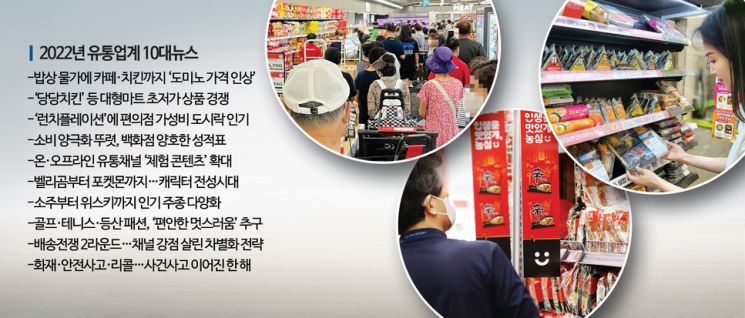
[Asia Economy Reporter Kim Yuri] The keyword that defined the retail industry this year was the domino effect of price hikes due to high inflation. With the Russia-Ukraine war, interest rate hikes, and high exchange rates overlapping, complaints of "everything except my salary has gone up" were heard throughout the year. The soaring prices of raw materials and energy fueled price increases across the products and services handled by the retail industry, giving rise to new terms such as "milkflation" (milk + inflation) and "lunchflation" (lunch + inflation). Here are the top 10 news stories in the retail industry in 2022.
◆ From dining table prices to cafes and chicken, "everything went up" = It was harder to find items that did not increase in price at least once this year, including ramen, snacks, coffee, tuna, and sesame oil, as food prices continued to rise. Starting with Starbucks, cafes such as Hollys, Twosome Place, Coffee Bean Korea, Tom N Toms, Paul Bassett, Angel-in-us, and Coffee Bean also raised their beverage prices. With recent moves to increase prices further, the era of 5,000 won Americanos is expected to become widespread. The price of chicken, the "soul food of the nation," was also unable to escape price hikes. At the end of last year, the industry’s top two players, Kyochon F&B and BHC, raised prices, leading to a wave of 20,000 won chicken this year. Genesis BBQ also raised prices in April.
◆ Competition in ultra-low-priced chicken products at supermarkets like 'Dangdang Chicken' = As inflation rose across the board and consumers’ wallets thinned, a craze for ultra-low-priced products swept large supermarkets. Homeplus’s "Dangdang Chicken," launched in June, was so popular that customers lined up hours before the product was released, causing an "open run." Following this, Emart’s "5-Minute Chicken" and Lotte Mart’s "One Whole Chicken" were launched one after another. Since its launch, Homeplus’s Dangdang Chicken has sold over one million units. The competition for ultra-low-priced products at supermarkets expanded to pizza, sushi, and sweet and sour pork.
◆ Popularity of value-for-money lunch boxes amid 'lunchflation' = With soaring dining-out prices and the emergence of the new term "lunchflation," office workers’ footsteps turned toward convenience store lunch boxes offering great value. Convenience stores revamped their menus to retain "Convenience Store Meal Tribe" (people who rely on convenience store meals), offering differentiated triangular kimbap, lunch boxes, cup noodles, rolled kimbap, and sandwiches, focusing not only on price but also on taste.
◆ Department stores celebrate with the endemic = As consumption polarization became more pronounced, the department store industry posted solid results through the third quarter. The sustained popularity of luxury goods and increased demand for high-margin fashion products contributed to this. The cumulative operating profits for the first three quarters of this year were 321.3 billion won, 351.8 billion won, and 284.2 billion won for Lotte, Shinsegae, and Hyundai Department Stores, respectively, marking increases of 124%, 58%, and 42%.
◆ Experiential shopping is the trend both online and offline = Department stores, large supermarkets, and shopping malls have been eager to provide experiences that cannot be found online, such as seeing, touching, and directly feeling products. The elaborate Christmas decorations recently created by department stores are part of this experiential marketing. E-commerce companies have also created offline spaces where customers can directly experience products to overcome the limitations of online shopping. These take the form of pop-up stores or showrooms, opening in trendy Seoul neighborhoods like Seongsu-dong and Hannam-dong, popular among young people.
◆ Character craze from Bellygom to Pok?mon = During the cherry blossom season, the giant Bellygom in front of Lotte World Tower in Jamsil, Seoul, became a popular "photo spot," sparking a trend of large-scale character exhibitions in department stores and shopping malls. "Pok?mon Bread" gained popularity with the sticker collection craze called "Ddibuddibusil," causing early morning convenience store "open runs." Following the character product boom, Shin-chan ramen, Cookie Run bread, and One Piece bread appeared one after another. Character collaborations in Pepero Day special products also sold out quickly, enjoying great popularity.
◆ Diversification of popular alcoholic beverages from Wonsoju to whiskey = Early this year, singer Park Jaebeom’s Wonsoju enjoyed huge popularity, selling out daily. Following this, GS25 partnered with One Spirits in July to launch Wonsoju Spirit, which sold out its initial 200,000 bottles within a week and has surpassed 3 million bottles in cumulative sales. Alongside wine, popular alcoholic beverages diversified to include whiskey and Makgeolli. Liquor specialty shops like Lotte Mart’s Bottle Bunker attracted customers with large-scale wine and whiskey discount events.
◆ Golf, tennis, and hiking fashion pursue 'comfortable stylishness' = The MZ generation’s (Millennials + Generation Z) outdoor and sports craze, spanning golf, tennis, and hiking, has changed young people’s fashion styles. Rejecting "rigid tackiness," sportswear that is "comfortable yet stylish" enough to be worn daily and showcased on social media (SNS) has become the trend. Fashion brands are releasing winter padding that is lightweight and easy to wear but still warm enough for a trip to the Himalayas, rather than heavy, battle-ready padding.
◆ Differentiated delivery = With the endemic (periodic resurgence of infectious diseases) and the e-commerce industry’s rapid growth slowing down, the delivery war entered its second round. Unlike the first round, where companies jumped into new delivery formats without hesitation, channels are now focusing on delivery methods they can do best. Lotte On and SSG.com have scaled back or discontinued dawn delivery and are focusing more on same-day delivery. Lotte plans to invest 1 trillion won to introduce the "Ocado Smart Platform," an integrated solution handling everything from ordering to delivery, in partnership with the UK’s Ocado.
◆ A year marked by incidents and accidents = Additionally, the year saw a series of incidents and accidents, including labor disputes at HiteJinro, the announcement and retraction of Purmil’s business closure, the Starbucks summer carry bag recall, a fire accident at Hyundai Premium Outlet Daejeon branch, and a fatal accident at SPC SPL Pyeongtaek factory.
© The Asia Business Daily(www.asiae.co.kr). All rights reserved.
![Clutching a Stolen Dior Bag, Saying "I Hate Being Poor but Real"... The Grotesque Con of a "Human Knockoff" [Slate]](https://cwcontent.asiae.co.kr/asiaresize/183/2026021902243444107_1771435474.jpg)
















