Emphasizing South Korea's Digital Technology and Taiwan's Semiconductor Manufacturing Capabilities
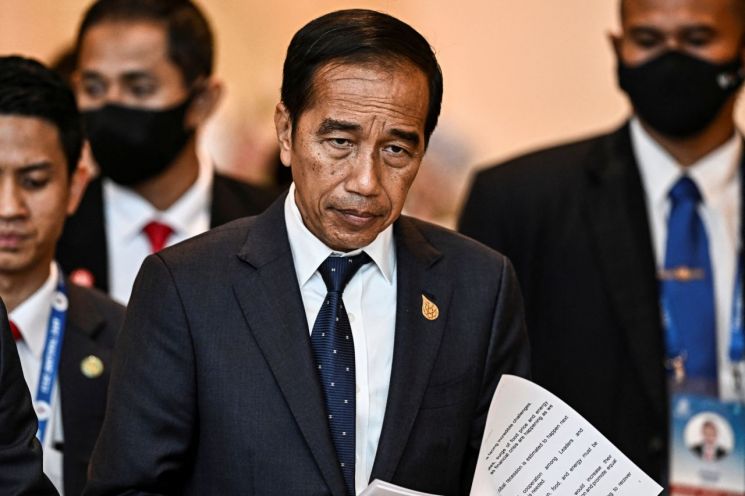
[Asia Economy Reporter Jo Yujin] Joko Widodo (Jokowi), President of Indonesia, cited South Korea and Taiwan as economic models to follow instead of the fully open economic models of South American countries.
According to Bloomberg on the 2nd (local time), President Jokowi said at a business forum held in Jakarta, Indonesia, "The model Indonesia should follow to become a high-income country is not the West, but South Korea and the United States."
He cited South Korea's digital technology and Taiwan's semiconductor production capabilities as examples, explaining that the global economy has come to depend on these two countries, which have grown from developing countries into high-income nations.
He added, "These countries are focused, strategic, and competitive," emphasizing, "This is a system we must continue to emulate."
On the other hand, he pointed out that South American countries, which have adopted fully open economic models, have remained developing countries for decades. He said, "South American countries will still remain developing countries even after 50, 60, or 70 years."
He noted that Indonesia does not want a closed economic model, but a purely fully open economic model would rely only on exporting low value-added products and would not achieve proper development.
President Jokowi emphasized, "We have raw materials such as nickel, copper, bauxite, and tin that many countries need," and stressed that Indonesia should develop its raw materials industry to produce products that other countries must depend on, becoming a key player in the global supply chain.
This statement aligns with Indonesia's raw material export regulation policy. Indonesia prohibits the export of major raw materials in their ore form and regulates exports to only processed products with higher added value within Indonesia.
Regarding this, the European Union (EU) filed a complaint with the World Trade Organization (WTO) in 2019, claiming Indonesia unfairly restricted access to raw materials such as nickel. The WTO recently sent a panel report to the Indonesian government judging that the export ban policy violates WTO agreements. However, Indonesia has stated it will appeal and has no plans to lift the export ban regulations for the time being.
In an interview with local media last month, President Jokowi said that after banning nickel ore exports, Indonesia directly refined nickel domestically, increasing the added value of products and boosting export volume by dozens of times. He stated, "To protect the nation's interests, we must be a little crazy. Instead of just exporting raw materials as before, we will fight with other countries."
On the same day, President Jokowi also said, "If we follow in the footsteps of Western countries, we will always fall behind and never catch up," emphasizing, "We must design an economic model that makes other countries depend on us."
© The Asia Business Daily(www.asiae.co.kr). All rights reserved.
![Clutching a Stolen Dior Bag, Saying "I Hate Being Poor but Real"... The Grotesque Con of a "Human Knockoff" [Slate]](https://cwcontent.asiae.co.kr/asiaresize/183/2026021902243444107_1771435474.jpg)















