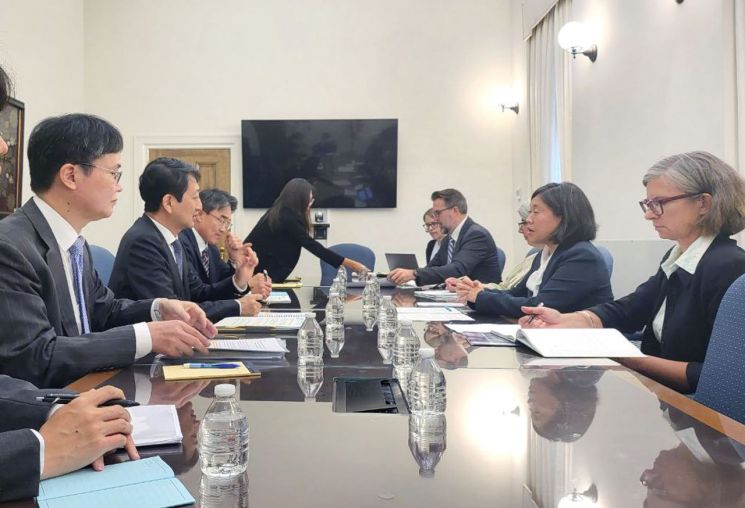
 Anduk Geun, Chief Negotiator for Trade, Attends Korea-US Trade Ministerial Meeting
(Seoul=Yonhap News) Anduk Geun, Chief Negotiator for Trade at the Ministry of Trade, Industry and Energy, attended the "Korea-US Trade Ministerial Meeting" held on the 7th (local time) at the USTR conference room in Washington D.C., USA, and met with Katherine Tai, USTR Representative. 2022.9.8 [Provided by Ministry of Trade, Industry and Energy. Redistribution and DB prohibited]
Photo by Yonhap News
(End)
<Copyright(c) Yonhap News Agency, Unauthorized reproduction and redistribution prohibited>
[Asia Economy Sejong=Reporter Dongwoo Lee] Our government has proposed to the U.S. side to expand the scope of tax credit benefits for commercial eco-friendly vehicles to include rental and lease vehicles, as well as ride-sharing vehicles such as Uber. Additionally, it requested that commercial eco-friendly vehicle tax credits be provided without a total cap for three years starting next year.
On the 2nd, the Ministry of Trade, Industry and Energy announced that it submitted the second government opinion letter containing these details to the U.S. government to maximize the benefits of the Inflation Reduction Act (IRA). Previously, the U.S. Treasury Department has been collecting stakeholder opinions for a month since the 4th of last month to prepare sub-regulations for IRA implementation.
The core of this government opinion letter covers three areas not addressed in the first round of consultations: ▲commercial eco-friendly vehicles and clean fuel charging facilities ▲carbon capture ▲clean hydrogen and clean fuel production.
Specifically, it requested a broad interpretation of the scope of commercial eco-friendly vehicles to provide focused tax credits. It proposed classifying rental and lease vehicles as commercial regardless of the period and including shared ride vehicles such as Uber and Lyft. This is to maximize the export effect of our companies by leveraging the fact that commercial eco-friendly vehicles are not subject to the North American final assembly and battery component/mineral requirements, the foreign entity of concern (FEoC) requirements, or the vehicle price limit (under $55,000) that apply to eco-friendly vehicle tax credits.
It also proposed providing carbon capture tax credits without a total cap but using the "substantial carbon reduction effect" as the standard for tax credit payment. Focusing tax credits on “carbon capture and storage (CCS),” which has a greater actual carbon reduction effect, rather than “carbon capture and utilization (CCU),” which has concerns about carbon re-release during use, is expected to have a positive effect for our companies.
Finally, it requested the application of production tax credits to clean hydrogen produced in the U.S. and then exported. According to the existing IRA, clean hydrogen produced in the U.S. (hydrogen emitting 4kg or less of CO2 per 1kg produced) is eligible for a tax credit of up to $3 per kg. In this regard, our government proposed clarifying the method for measuring CO2 emissions during clean hydrogen production to minimize the documentation burden companies must submit for tax credits.
The Ministry of Trade, Industry and Energy stated, "Based on opinions from related industries such as automobiles, charging stations, hydrogen, biofuels, and carbon capture, and after consultations with trade experts and legal advisors, we prepared the second government opinion letter on IRA sub-regulations."
© The Asia Business Daily(www.asiae.co.kr). All rights reserved.
![Clutching a Stolen Dior Bag, Saying "I Hate Being Poor but Real"... The Grotesque Con of a "Human Knockoff" [Slate]](https://cwcontent.asiae.co.kr/asiaresize/183/2026021902243444107_1771435474.jpg)















