Maximizing Effectiveness Through 'Overlapping Sanctions'
North Korea's Determination Not to Tolerate 'Nuclear Threats'
Additional Independent Sanctions Expected in Cyber Sector
Foreign Ministry: "Close Cooperation with Allies and International Community"
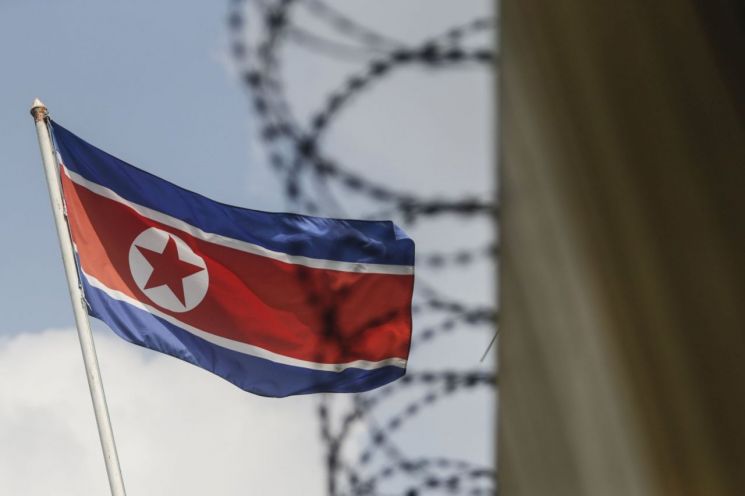
[Asia Economy Reporter Jang Hee-jun] South Korea, the United States, and Japan simultaneously unleashed independent sanctions, drawing their swords against North Korea.
Since the inauguration of the Yoon Seok-yeol administration, North Korea has carried out unprecedented military provocations, but the United Nations Security Council has failed to fulfill its role. This year alone, all 10 open Security Council meetings convened due to North Korean provocations were blocked by the excessive use of veto power by China and Russia. In this situation, the series of independent sanctions imposed by the three countries of South Korea, the United States, and Japan is interpreted as a strong will not to tolerate North Korea's nuclear and missile threats.
In the early morning of the 2nd, Korea time, the United States designated three North Korean Workers' Party officials involved in the development of weapons of mass destruction (WMD) and ballistic missiles as additional sanction targets.
Following this, South Korea added eight individuals and seven organizations involved in contributing to North Korea's nuclear and missile development or evading sanctions to its independent sanctions list, and immediately after, Japan also placed one individual and three organizations involved in North Korea's nuclear and missile development on its sanctions list.
The simultaneous announcement of North Korea sanctions by South Korea, the United States, and Japan is intended to maximize the effect of the sanctions by drawing international attention. It is also noteworthy that the lists of targeted individuals and organizations are not perfectly unified by country but are announced with time differences, overlapping and intersecting.
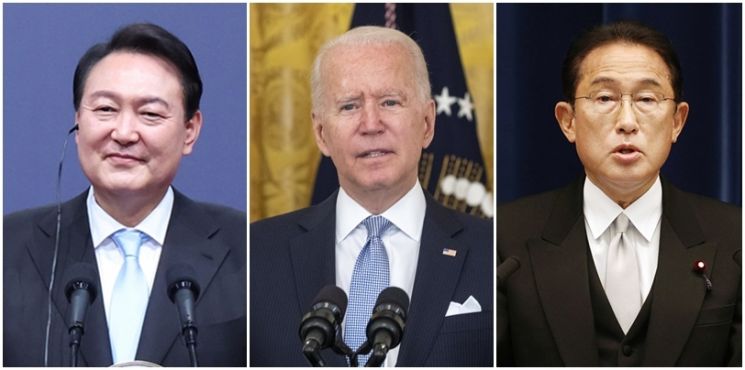 President Yoon Suk-yeol, U.S. President Joe Biden, and Japanese Prime Minister Fumio Kishida [Image source=Yonhap News]
The three North Korean Workers' Party officials announced as sanction targets by the U.S. Department of the Treasury on this day were already independently sanctioned by the European Union (EU) in April. Among them, Jeon Il-ho, chairman of the Party Committee of the National Defense Science Institute, and Yoo Jin, former head of the Party's Military Industry Department, were already included in South Korea's independent sanctions list in 2016.
Similarly, all eight individuals and seven organizations designated by South Korea are also targets sanctioned by the United States.
Through overlapping sanctions like a net, it appears they aim to suppress North Korea's attempts to evade Security Council-level sanctions as much as possible. The Ministry of Foreign Affairs explained in a statement that "it is meaningful in that countries with similar positions, including South Korea, the United States, and Japan, designate independent sanction targets in a cross-overlapping manner to enhance the effectiveness of the sanctions."
However, some argue that since South Korea, the United States, and Japan have already been implementing Security Council sanctions against North Korea and have almost no exchanges with North Korea, the sanctions are more symbolic to showcase trilateral cooperation rather than being effective.
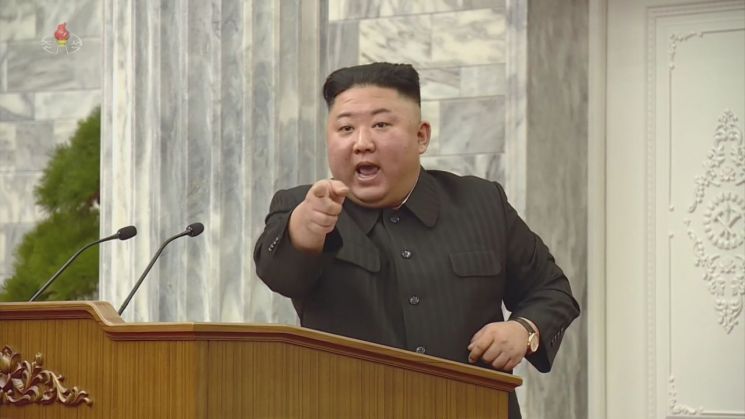
The independent North Korea sanctions by South Korea, the United States, and Japan are likely to continue. Sanctions targeting North Korea's shipping and cyber sectors, which can directly impact North Korea, are also under consideration. These are expected to be implemented if North Korea carries out strategic provocations such as nuclear tests.
South Korea and the United States have already begun countermeasures based on the judgment that North Korea is using funds earned from cyberattacks for nuclear and missile development. South Korea and the United States have held two working group meetings to devise measures to eradicate North Korea's cryptocurrency hacking. Additionally, on the 17th of last month, they held a public-private symposium attended by cyber officials and industry representatives from Southeast Asian countries to respond to North Korea's cryptocurrency theft.
An official from the Ministry of Foreign Affairs stated, "Our government has been steadily pursuing various measures to respond to the increasing cyber threats from North Korea, including cryptocurrency theft, in close cooperation with the U.S. side," adding, "The imposition of sanctions on illegal cyber activities is also under consideration."
He continued, "The government will continue unwavering efforts to create an environment where North Korea has no choice but to abandon nuclear development and return to denuclearization negotiations, in close cooperation with allies such as the United States and Japan and the international community."
© The Asia Business Daily(www.asiae.co.kr). All rights reserved.
![Clutching a Stolen Dior Bag, Saying "I Hate Being Poor but Real"... The Grotesque Con of a "Human Knockoff" [Slate]](https://cwcontent.asiae.co.kr/asiaresize/183/2026021902243444107_1771435474.jpg)

















