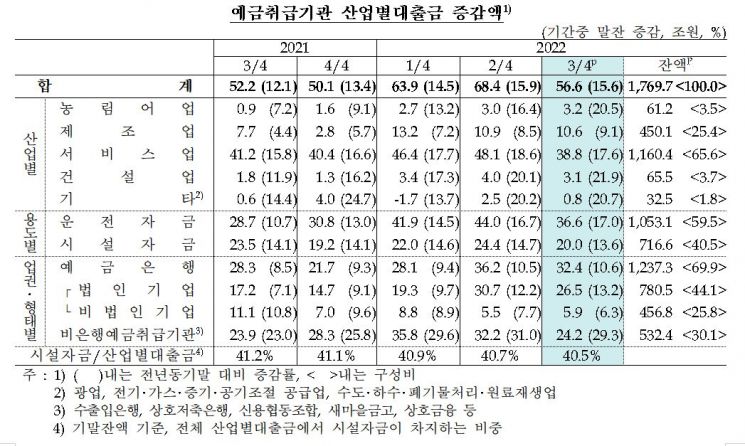
As raw material prices and exchange rates rise, increasing corporate funding demand, industrial loans in the third quarter grew to the largest scale ever compared to the same period last year. However, due to recent economic uncertainty, financial institutions have strengthened their corporate lending stance, resulting in a reduced increase compared to the previous quarter.
According to the '2022 Q3 Depository Institutions Industrial Loan by Industry' statistics released by the Bank of Korea on the 2nd, the total outstanding industrial loans amounted to 1,769.7 trillion KRW, an increase of 56.6 trillion KRW compared to the previous quarter. This increase is smaller than the 68.4 trillion KRW growth seen in the second quarter.
However, the year-on-year increase was 239 trillion KRW, marking a record high. The previous largest increase was 234.6 trillion KRW in the second quarter of this year.
Looking at the quarter-on-quarter increase, it shrank mainly in manufacturing and service industries.
In manufacturing, although working capital increased significantly due to exchange rate hikes and inflation, the growth in facility loans slowed down amid the global economic downturn, reducing the increase from 10.9 trillion KRW to 10.6 trillion KRW.
In the service sector, centered on real estate, the increase shrank significantly from 48.1 trillion KRW to 38.8 trillion KRW. The weakened loan demand due to the sluggish real estate market affected this decline.
On the other hand, the accommodation and food service industry saw an expanded increase, mainly in working capital, as liquidity demand grew.
By loan purpose, both working capital (from 44 trillion KRW to 36.6 trillion KRW) and facility funds (from 24.4 trillion KRW to 20 trillion KRW) saw reduced increases, mainly in the real estate sector.
By financial institution type, both deposit banks (from 36.2 trillion KRW to 32.4 trillion KRW) and non-bank depository institutions (from 32.2 trillion KRW to 24.2 trillion KRW) tightened their lending stance, slowing the growth.
Park Chang-hyun, head of the Bank of Korea's Financial Statistics Team, explained, "Until now, deposit banks and non-bank depository institutions expanded corporate loans, which are less regulated compared to household loans, and companies used financial institution loans as their main funding source amid a shrinking corporate bond market. However, from the third quarter, as domestic and international uncertainties increased, financial institutions strengthened their lending stance toward companies, which contributed to the reduced growth."
However, Park added, "The year-on-year increase recorded a historic high," and "Currently, industrial loans should be seen as continuing a high growth trend."
© The Asia Business Daily(www.asiae.co.kr). All rights reserved.
![Clutching a Stolen Dior Bag, Saying "I Hate Being Poor but Real"... The Grotesque Con of a "Human Knockoff" [Slate]](https://cwcontent.asiae.co.kr/asiaresize/183/2026021902243444107_1771435474.jpg)















