Equipped with New Long-Range Stand-Off (LRSO) Cruise Missiles and More
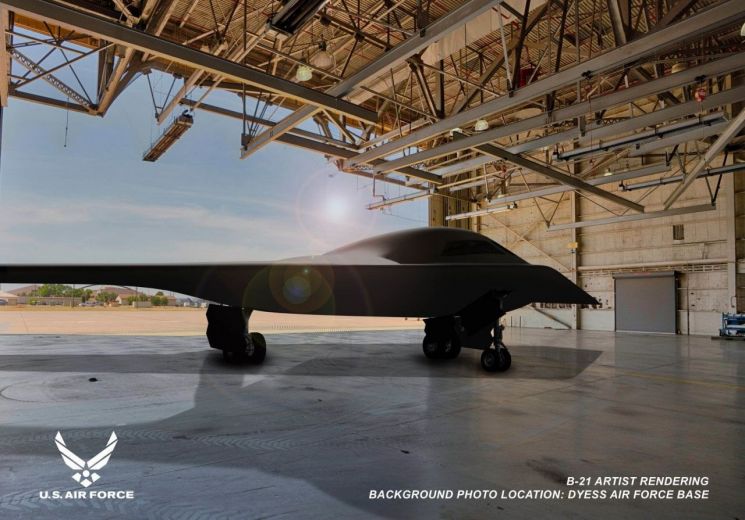
[Asia Economy Yang Nak-gyu, Military Specialist Reporter] The United States will unveil the next-generation strategic bomber, the B-21 Raider, on the 2nd.
The B-21 is a new bomber appearing for the first time in over 30 years since the B-2 ‘Spirit’ bomber, which began production in 1987 and made its first flight in 1989. The nickname Raider for the B-21 is derived from the ‘Doolittle Raiders’ who bombed the Japanese mainland on April 18, 1942, during World War II.
The B-21’s features can be summarized as digitalization, global reach, stealth capability, and nuclear weapon operation. It is known to carry new long-range stand-off (LRSO) cruise missiles and conventional bombs, and for self-defense, it will be equipped with advanced active electronically scanned array (AESA) radar and air-to-air missiles.
It combines the necessary elements required by the modern U.S. military from the aging but nuclear-capable B-52, the fastest current bomber B-1 which can deliver nearly 60 tons of conventional weapons at Mach 1.25, and the B-2 which adds stealth to nuclear capability, while incorporating the latest technology.
The B-21 is called the world’s first ‘digital bomber.’ By applying cloud computing and the latest data and sensor integration technologies, it can automatically and instantly respond to newly discovered targets and can also be remotely piloted. Furthermore, by integrating various systems, it can perform not only its primary bombing function but also intelligence, surveillance, reconnaissance, electronic attack, and multi-domain networking.
The B-21’s range, capable of striking anywhere worldwide after taking off from the U.S. mainland, will significantly expand the deployment range of U.S. strategic assets. Stealth and nuclear capability are the B-21’s core purposes. The U.S. Air Force has stated that stealth and nuclear operation are the B-21’s ‘primary functions,’ while it can also operate conventional weapons.
Regarding stealth performance, both the B-2 and B-21 are designed to maximize stealth with a unique manta ray-like shape. While the B-2 appears on radar as small as a bird, the B-21 is said to be only the size of a golf ball.
The U.S. Air Force’s plan to acquire 100 B-21s is driven by the relatively low production cost. The unit price of the B-21 is expected to be about $630 million (approximately 820 billion KRW), which is about 30% of the B-2’s $2.2 billion (approximately 2.8 trillion KRW) cost.
The B-21 is expected to operate with a reduced weapons payload compared to the B-2 to lower unit costs, aiming to improve survivability through mass acquisition and operation. Whiteman Air Force Base in Missouri was the sole operational base for the B-2, but on February 1, 2009, the operation of the B-2A was transferred to the Air Force’s latest command, the Global Strike Command.
After its first flight next year, the B-21 is expected to gradually take over the missions currently performed by existing strategic bombers from the mid-2020s. Accordingly, the roles of the B-1B and B-52H, which have been active as deterrent strategic assets against North Korea, are also expected to be replaced by the B-21.
© The Asia Business Daily(www.asiae.co.kr). All rights reserved.
![Clutching a Stolen Dior Bag, Saying "I Hate Being Poor but Real"... The Grotesque Con of a "Human Knockoff" [Slate]](https://cwcontent.asiae.co.kr/asiaresize/183/2026021902243444107_1771435474.jpg)
















