Contract Signing for KARI and Nuriho Launch Vehicle Upgrade Project
Establishing a Foothold for Commercialization of Space Transportation Technology
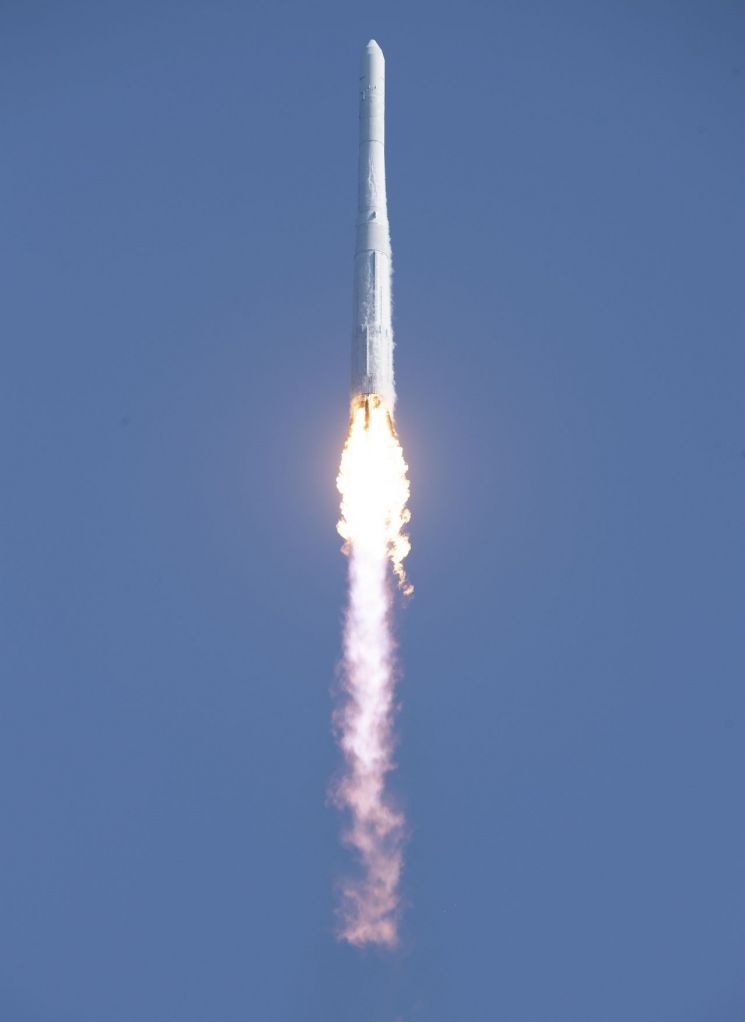
[Asia Economy Reporter Oh Hyung-gil] Hanwha Group's space business has entered a full-fledged orbit, leveraging its acquisition of launch vehicle technology.
Hanwha plans to secure capabilities by launching the Nuri rocket four additional times by 2027 in collaboration with the Korea Aerospace Research Institute (KARI), aiming to build a space business value chain ranging from space transportation services to various satellite utilization services and space exploration.
Hanwha Aerospace announced on the 2nd that it has won a contract worth 286 billion KRW from KARI for the "Korean Launch Vehicle (Nuri) Advancement Project ? Overall Launch Vehicle Production Management."
After being selected as the preferred negotiation partner last month and signing the main contract, Hanwha Aerospace plans to manufacture three Nuri rockets from next year through 2027 and conduct four additional launches.
The Nuri rocket advancement project is a government initiative led by the Ministry of Science and ICT with a budget of 687.3 billion KRW, aiming to secure space transportation capabilities by launching the Korean launch vehicle Nuri, led by KARI and private companies, and to foster and support private system integration companies.
Through this project, Hanwha Aerospace will sequentially acquire the Nuri rocket system integration technology and launch operation know-how possessed by KARI.
Starting with the third launch scheduled for next year, Hanwha plans to launch the Nuri rocket a total of four times by 2027 to deploy practical satellites that will carry out various missions such as space technology verification and ground observation. As the only domestic company capable of providing launch services, Hanwha aims to commercialize space transportation services in the future by sending private satellites, spacecraft, and various supplies into space.
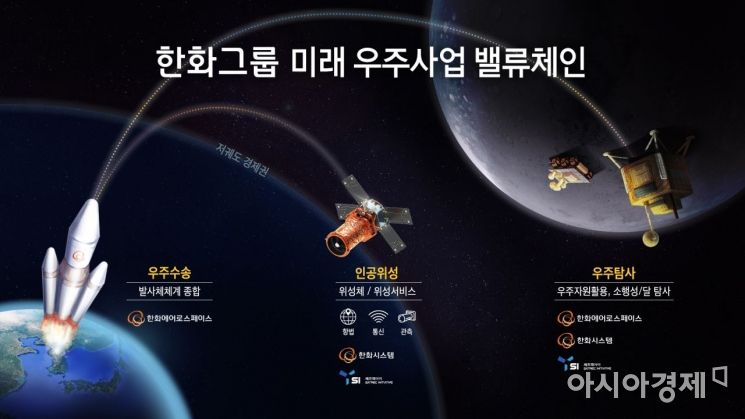
Last year, Hanwha Group launched the space business consortium 'Space Hub' and set ambitious mid- to long-term goals to venture into space exploration and resource acquisition, continuously investing in these areas.
Hanwha Systems expanded its space communication service business by acquiring the UK satellite communication antenna company Phasor (now Hanwha Phasor) in 2020, investing in the US satellite communication antenna company Kymeta, and securing about 9% stake in OneWeb, the world's first space internet company, in 2021.
Setrec-I, the only domestic company exporting satellites, has already entered the satellite data service business. Hanwha Aerospace, which merged with Hanwha Defense, plans to further diversify its launch vehicle capabilities by merging with Hanwha Defense (formerly Hanwha Defense Division) in March next year.
By establishing a value chain from satellite manufacturing to launch transportation and satellite services, and securing space exploration technology in the future, Hanwha is realizing its strategy to grow into Korea's first 'total solution provider for the space industry.'
A Hanwha Aerospace official said, "Additional launches of the Nuri rocket remain a challenging project with no guaranteed success," adding, "We will succeed in the additional launches with the accumulated capabilities of KARI, the technologies of over 300 domestic companies, and Hanwha's passion for the space business, taking Korea's space industry to the next level."
© The Asia Business Daily(www.asiae.co.kr). All rights reserved.
![Clutching a Stolen Dior Bag, Saying "I Hate Being Poor but Real"... The Grotesque Con of a "Human Knockoff" [Slate]](https://cwcontent.asiae.co.kr/asiaresize/183/2026021902243444107_1771435474.jpg)
















