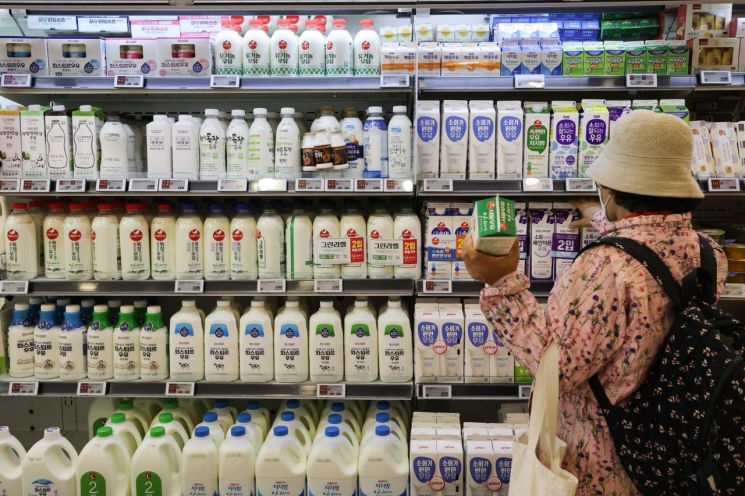
The Bank of Korea evaluated last month's consumer price inflation rate of 5% as being in line with expectations, but explained that the high upward trend at the 5% level is expected to continue until early next year.
On the 2nd, the Bank of Korea held a 'Price Situation Review Meeting' at 8:30 a.m. in the main building conference room in Seoul, chaired by Deputy Governor Lee Hwan-seok, to review the recent price situation and future trends.
According to the consumer price trends announced by Statistics Korea on the same day, the consumer price index last month rose 5.0% compared to the same month last year. This increase was slower compared to July (6.3%), August (5.7%), September (5.6%), and October (5.7%).
Deputy Governor Lee explained, "The November consumer price inflation rate significantly slowed due to base effects such as the sharp rise in agricultural and petroleum prices last year, which is in line with the forecast made last week."
Earlier, Bank of Korea Governor Lee Chang-yong also mentioned the base effect at a press conference held immediately after the Monetary Policy Committee meeting on the 24th, saying, "There is a possibility that the November consumer price inflation rate will be significantly lower compared to October's 5.7%."
However, the Bank of Korea explained that regarding core inflation, the high rise in personal service prices continues, while the upward trend has expanded mainly in industrial products excluding petroleum. The core inflation rates recorded were 4.1% in September, 4.2% in October, and 4.3% last month.
Considering the base effect and international energy prices, the Bank of Korea forecasted that consumer prices will continue the upward trend at the 5% level until early next year.
Deputy Governor Lee explained, "In the future inflation outlook, there are significant uncertainties related to the trends of raw material prices such as international oil prices. The possibility of an expanded economic slowdown is a downside risk, while the possibility of an increase in energy charges is an upside risk, both of which are latent."
© The Asia Business Daily(www.asiae.co.kr). All rights reserved.
![Clutching a Stolen Dior Bag, Saying "I Hate Being Poor but Real"... The Grotesque Con of a "Human Knockoff" [Slate]](https://cwcontent.asiae.co.kr/asiaresize/183/2026021902243444107_1771435474.jpg)
















