[Asia Economy Reporter Lee Seon-ae] Next year, the domestic stock market will remain a 'Boxpi (KOSPI + box range)'. As securities firms' expectations for the domestic stock market have dropped drastically, none are anticipating a recovery to 3000. The majority foresee a box range market around 2600. Compared to last year, when the KOSPI was expected to rise to a maximum of 3600, the outlook has shifted from 'optimism' to 'pessimism'.
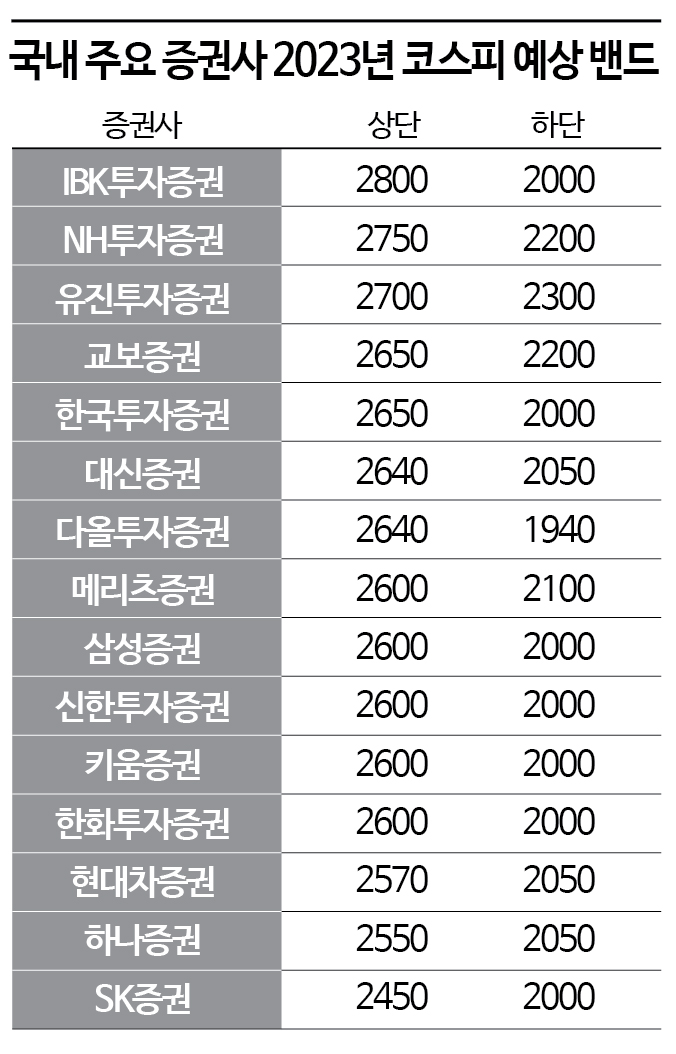
On the 3rd, most securities firms predicted that next year's KOSPI will move between 2000 and 2600. Only one firm expected it to fall below 2000, but the upper limit was considered capped. The most optimistic forecast for the maximum index was 2800.
The lower end of the KOSPI forecast band from 15 securities firms that released projections for next year averaged around 2000. Samsung Securities, Shinhan Investment Corp., Korea Investment & Securities, IBK Investment & Securities, and SK Securities took a conservative view. The highest upper limit was set by IBK Investment & Securities at 2800. Following that, Eugene Investment & Securities and NH Investment & Securities projected up to 2700 and 2750, respectively. All others were below 2650. Most expected the index to rise only up to around 2600 on average. The trend was weighted towards 'lower in the first half, higher in the second half,' based on the judgment that tightening would continue until the first half of next year, causing interest rates in the US and Korea to rise.
Lee Kyung-min, a researcher at Daishin Securities, said, "The KOSPI will pass its bottom in the first quarter of next year," adding, "From the second quarter, the easing of monetary policy will stabilize interest rates and the dollar, and the global economy, semiconductor industry conditions, and earnings turnaround will become visible, leading to a continued upward trend as the economy enters a recovery phase."
Additionally, the economic recession causing corporate profits to decline is expected to weigh on the KOSPI in the first half of next year. Labor Gil, a researcher at Shinhan Investment Corp., said, "KOSPI earnings estimates are expected to decline at least until the first half of next year," and forecasted, "Considering the downward trajectory of earnings per share (EPS), the KOSPI's trend rebound will be delayed."
However, there are also claims that the market will remain in a box range throughout the year. Heo Jae-hwan, a researcher at Eugene Investment & Securities, predicted, "Domestic companies' operating profits are expected to decrease by 10% compared to this year," and "The stock market will show a pattern closer to box range fluctuations rather than a trend rebound." Lee Jae-man, a researcher at Hana Securities, also analyzed, "As of November, the KOSPI's net profit growth rate for next year is -1.5%," and "Due to the Federal Reserve's rate hikes and low profit growth, the KOSPI is expected to remain in a box range."
IBK Investment & Securities, which presented the highest upper limit for next year's KOSPI forecast band, viewed the domestic stock market positively. Their market view changed from 'negative' to 'positive.' Jun-ho Byun, a researcher at IBK Investment & Securities, said, "Next year’s economy is expected to face a severe recession, and earnings will deteriorate, with the possibility of panic or crisis situations unfolding, but the stock market has already priced in much of these concerns," emphasizing, "Concerns will remain until early next year, and the stock market will continue to consolidate its bottom, but from March, a full-fledged bull market is expected to begin."
In contrast, Daol Investment & Securities took a pessimistic view, forecasting the KOSPI to fall below 2000. Daol Investment & Securities projected the KOSPI fluctuation range between 1940 and 2640, expecting it to stay below 2000 due to real economy contraction. Jo Byung-hyun, a researcher at Daol Investment & Securities, said, "The stock market will show a pattern of rising early and falling later next year," adding, "At the beginning of next year, the stock market will show an upward trend as price variables such as exchange rates stabilize and cycle indicators reach their lows." He continued, "It is difficult to say that a recovery in the real economy has been established, and it is not possible to rule out poor real economy indicators and the possibility of a recession," and noted, "The uncertainty regarding the occurrence of credit risk will act as a burden factor," expressing concern about the downside.
© The Asia Business Daily(www.asiae.co.kr). All rights reserved.
![Clutching a Stolen Dior Bag, Saying "I Hate Being Poor but Real"... The Grotesque Con of a "Human Knockoff" [Slate]](https://cwcontent.asiae.co.kr/asiaresize/183/2026021902243444107_1771435474.jpg)















