Development of 'Dr. Noon' for Predicting Cardiovascular Disease Risk
Results in 1 Minute Using Retinal Photography
Proven Non-Inferiority Compared to Conventional Cardiac CT
Domestic Commercialization Planned for Next Year... Preparing for FDA Approval
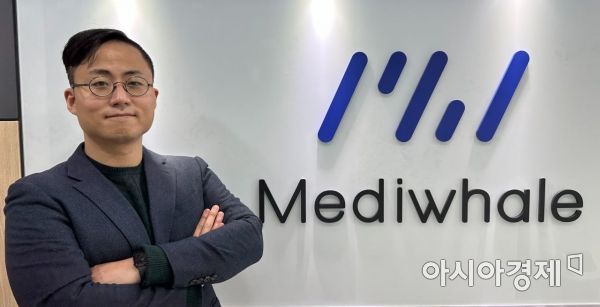
[Asia Economy Reporter Chunhee Lee] Six years ago, Choi Tae-geun, CEO of Mediwhale, who was twenty-six at the time, was diagnosed with glaucoma. Reflecting on that time, CEO Choi said, "It was a period when I never thought I would be sick anywhere," and recalled, "Every morning when I woke up, I would open my eyes alternately to see if my vision was still there." Although he lost nearly half of the vision in his right eye, CEO Choi said that over time, "I changed my mind to think that it was rather fortunate to have discovered it early."
This experience became the impetus for founding a company that develops technology to detect cardiovascular and ophthalmic diseases?often called 'silent killers' because they worsen without noticeable symptoms?at an early stage. CEO Choi partnered with the doctor who diagnosed his glaucoma to establish Mediwhale. The Chief Medical Officer (CMO) of Mediwhale is Im Hyung-taek, a former ophthalmology professor at Severance Hospital.

Mediwhale is developing the 'DrNoon' solution, which predicts the risk of cardiovascular diseases as well as ophthalmic diseases such as diabetic retinopathy and glaucoma using retinal images. Regarding the idea of looking into the heart's condition through the eyes, CEO Choi explained, "It's not a completely unfamiliar idea," adding, "Since the retina is the part of the body where blood vessels are most visible, if there is a problem with the vessels, the condition can be identified through retinal images."
The biomarker used is the coronary artery calcium score. Traditionally, this has been measured through cardiac computed tomography (CT). Although the coronary artery calcium score is recommended as a standard screening test for drug treatment in the US, Europe, and other regions, there is a significant concern about radiation exposure. Carotid ultrasound is also used but has the limitation of low accuracy.
On the other hand, DrNoon enables highly accurate calcium score assessment in just one minute from image capture to AI analysis and result confirmation. CEO Choi stated, "Non-inferiority of calcium score measurement compared to cardiac CT has been demonstrated," and added, "Earlier this year, our technology using AI and retinal images was mentioned as a major digital innovation case in the European Heart Journal."
The next step targets kidney disease. CEO Choi explained, "The parts of the body with many peripheral blood vessels are the eyes and kidneys," and added, "The currently used estimated glomerular filtration rate (eGFR) test for kidney disease only shows current function status and cannot predict future conditions, so we see high potential for its use as a proactive screening test."
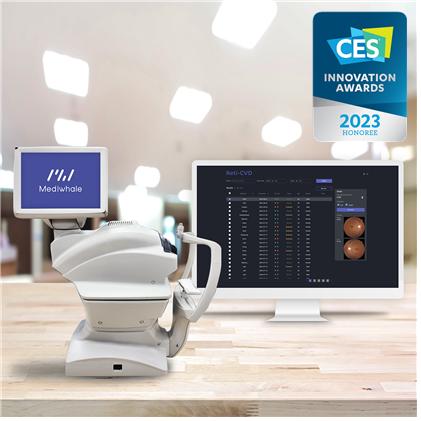 Mediwhale's cardiovascular risk assessment software medical device (SaMD) 'Leti-CVD' (domestic name Dr. Noon) also won the 'CES 2023' Innovation Award. (Photo by Mediwhale)
CEO Choi emphasized that DrNoon aims to be a solution for both patients and doctors. He said, "An 80-year-old patient with a history of cardiovascular disease who thought they were fully recovered changed their mind about taking medication again after seeing the DrNoon screening results," and added, "From a doctor's perspective, it will be very helpful to have data from a simple screening test to persuade patients."
DrNoon received medical device approval from the Ministry of Food and Drug Safety in August. It plans to enter the domestic market next year through the advanced medical technology system and aims to expand to the US by obtaining De Novo approval from the US Food and Drug Administration (FDA). The De Novo process is used by the FDA to review medical devices with new technologies that have not existed before. CEO Choi emphasized Mediwhale's technological capabilities, saying, "Although similar technology development attempts continue overseas, I understand that they have not yet reached the stage of publishing papers."
Currently, clinical trials are underway in Arkansas under the US name 'Reti-CVD' for US market entry. CEO Choi stated, "We will create a case where Korean-developed medical technology becomes number one in the world," and emphasized, "Because we started in Korea, we were able to collect excellent data, and based on this, we will succeed in the US market, which has great market potential."
© The Asia Business Daily(www.asiae.co.kr). All rights reserved.
![Clutching a Stolen Dior Bag, Saying "I Hate Being Poor but Real"... The Grotesque Con of a "Human Knockoff" [Slate]](https://cwcontent.asiae.co.kr/asiaresize/183/2026021902243444107_1771435474.jpg)













