Cargo Solidarity Union Refuses Work Commencement Order
Ministry of Land, Infrastructure and Transport Warns "Abolition of Safe Freight Rate System"
Second Negotiation Ends in Deadlock After 40 Minutes
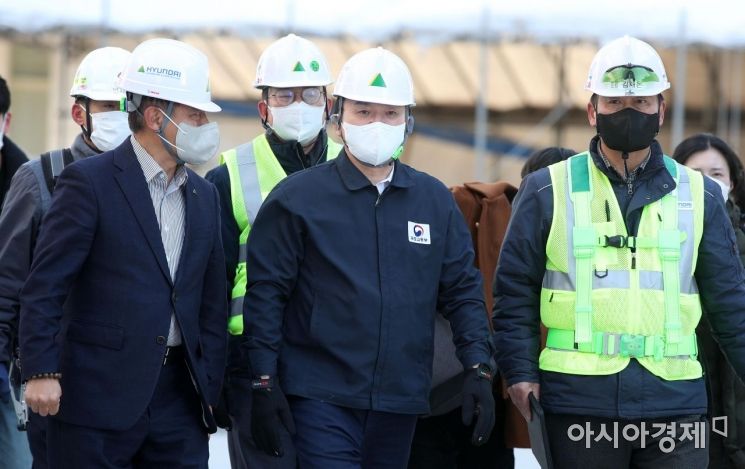 Minister of Land, Infrastructure and Transport Won Hee-ryong visited the Dunchon Jugong reconstruction construction site in Gangdong-gu, Seoul on the 30th to inspect disruptions in the supply of construction materials caused by the Cargo Solidarity Union's collective transportation refusal. Photo by Kim Hyun-min kimhyun81@
[Asia Economy Reporter Kim Min-young] As the total strike by the Cargo Solidarity of the Korean Confederation of Trade Unions Public Transport Workers' Union enters its eighth day, the conflict between the government and the labor union is escalating to an extreme level as the government counters the collective refusal to transport with an order to commence work. Despite the government's order to commence work, Cargo Solidarity's refusal has led Land, Infrastructure and Transport Minister Won Hee-ryong to issue a warning about the 'abolition of the Safe Freight Rate System,' deepening the cold war between the two sides. Given this atmosphere, it is highly likely that the strike will extend beyond the eighth day of the strike period in June, and even surpass the 10 days, which was the third longest in history in 2016. The government is also considering issuing additional orders to commence transportation in other sectors such as oil refining and steel, in addition to the cement industry, if the logistics paralysis causes significant damage to industrial sectors.
The Ministry of Land, Infrastructure and Transport and the Cargo Solidarity negotiation team held their second negotiation at the Government Sejong Complex at 2 p.m. on the 30th of last month, but the talks broke down after just 40 minutes. This was two days after the 28th and just one day after the order to commence work for cement transport workers was issued. Cargo Solidarity demanded the permanent implementation and expansion of the Safe Freight Rate System, while the government maintained its existing position that it could only accept a three-year extension of the system's sunset clause, ending the second round of negotiations.
Cargo Solidarity stated, "(We) came with a sincere negotiation proposal, but could not continue the dialogue due to the government's statement that negotiation was impossible." The government is increasing pressure as the union has not returned to work despite the order to commence work. Minister Won described the second negotiation as a meeting rather than a negotiation, emphasizing that the Safe Freight Rate System is a legislative matter for the National Assembly and a matter of public petition.
After the second meeting, Minister Won showed a tougher stance at a press conference held at the Government Sejong Complex. He said, "There are issues and reviews not only about the sunset of the Safe Freight Rate System but also about whether it is a proper system. It can be reviewed from multiple angles, including abolition," suggesting the possibility of excluding the fuel price-linked subsidy that supports the excess amount if the diesel price for cargo trucks exceeds the standard amount.
Cargo Solidarity is resisting by refusing the government's order to return to work and continuing the strike. On the 1st, Cargo Solidarity issued a statement saying, "The order to commence work was originally created to suppress the strike of cargo workers, and legal experts commonly agree that it violates the absolute principle of legality in criminal law," and added, "It is deeply concerning that such a problematic order to commence work is being used to suppress workers' strikes."
With neither side yielding an inch, concerns are growing that this strike could break the record for the longest strike in history. Given that the permanent implementation of the Safe Freight Rate System, which was the decisive trigger for the strike, is not only off the table but abolition is even being discussed, the government is unlikely to present a progressive agreement, and Cargo Solidarity lacks justification to back down now. The fact that many within Cargo Solidarity believe "the strike cannot end empty-handed" also points to a prolonged strike. Accordingly, there are predictions that the strike period could extend beyond June and possibly break the record of 14 days, the longest strike duration. The Cargo Solidarity strikes lasted 14 and 16 days in 2003 and 10 days in 2016.
The government has hinted at the possibility of issuing additional orders to commence work if Cargo Solidarity does not return to work. This reiterates the government's stance to resolve the situation based on principles rather than further negotiations. Minister Won said the previous day, "If it is judged that the crisis stage is imminent (in sectors other than cement), additional orders to commence transportation will be issued without hesitation at any time," adding, "After today (November 30), inventory will rapidly decrease and loading space will fill up day by day in the oil refining, steel, and container sectors, causing the national economy's overall crisis index to rise sharply."
© The Asia Business Daily(www.asiae.co.kr). All rights reserved.

















