Cargo Solidarity Strike Enters 8th Day... Hyundai Heavy Industries and Three Shipbuilders Also Launch Unprecedented Full-Scale Strike
National Assembly Struggles Over 'Yellow Envelope Act'... Astronomical Losses Inevitable for Industry
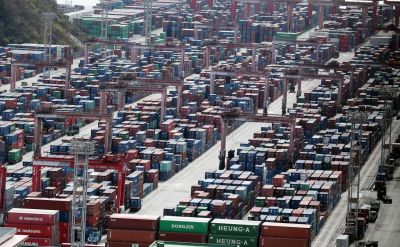 Containers are piling up at the yard of Sinsundae Pier in Nam-gu, Busan due to the general strike by the Cargo Solidarity. [Image source=Yonhap News]
[Asia Economy reporters Chawan-yong, Baek Kyun-hwan, and Koo Chae-eun] The strike is shaking the South Korean economy, which is already facing red alerts due to the ‘three highs’ of high interest rates, high inflation, and high exchange rates. On the 8th day of the Cargo Solidarity strike, no dramatic compromise has been reached, and the confrontation between the government and the labor union is escalating into an extreme conflict.
Moreover, even the National Assembly, which should play a mediating role, has entered a power struggle over the so-called ‘Yellow Envelope Act,’ making the absence of conflict resolution capabilities a reality with no way out. Coupled with the strike of the three shipbuilding companies under Hyundai Heavy Industries Group, concerns are growing that the industrial sector will inevitably suffer astronomical losses amounting to trillions of won.
According to the Presidential Office and government ministries on the 1st, President Yoon Suk-yeol ordered preparations for measures to address the damage to ordinary citizens caused by the Cargo Solidarity general strike. This is interpreted as his firm intention not to soften his stance on a tough response, having repeatedly stated that he will not compromise with illegal strikes. The government has already expanded the scope of work commencement orders and even brought out the option of abolishing the safe freight rate system. In response, the Korean Confederation of Trade Unions (KCTU) is continuing its full-scale offensive, including carrying out a head-shaving protest and simultaneous general strikes.
Even the National Assembly appears to be fueling the conflict further. The Democratic Party of Korea unilaterally submitted a bill to amend the Labor Union and Labor Relations Adjustment Act, which includes limiting the employer’s compensation for losses caused by union strikes. The People Power Party strongly criticized the opposition for pushing the bill through with majority power.
Joo Ho-young, floor leader of the People Power Party, said, "If illegal strikes are tolerated once, they will be claimed throughout the administration," and demanded, "We call for an immediate halt to the forced passage of the Yellow Envelope Act, which encourages illegal strikes."
Without any solutions, only competing claims are rampant, and the damage is spreading across industries such as construction, refining, automotive, and steel. A tangible economic impact by the end of this year is inevitable. According to the Korea Customs Service, exports from November 1 to 20 decreased by 16.7% compared to the previous year. Following a 5.7% decline in total exports in October, marking the first decrease in two years since October 2020 (-3.9%), there is a possibility of a consecutive two-month decline through November.
The domestic market is also in crisis. According to Statistics Korea, service industry production in October fell by 0.8%, the largest drop in 22 months since December 2020 (-1.0%). Retail sales, which indicate consumption trends, also decreased by 0.2%, marking a decline for two consecutive months following September. Amid this situation, logistics disruptions caused by the Cargo Solidarity strike are expected to lead to the worst decline in export volume by the end of this year.
© The Asia Business Daily(www.asiae.co.kr). All rights reserved.

















