Joint Statement of the Muhyeop Regional Business Association Released on the 1st
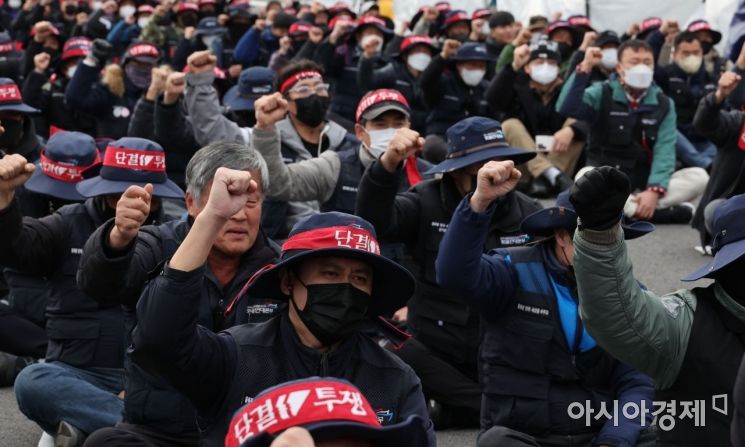 On the 29th of last month, when the government issued a work commencement order against the general strike by the Cargo Solidarity Headquarters of the Public Transport Union under the Korean Confederation of Trade Unions (KCTU), members of the Cargo Solidarity Seoul-Gyeonggi Regional Headquarters held a rally at the Inland Container Depot (ICD) in Uiwang, Gyeonggi Province, shouting slogans condemning the order.
 Uiwang=Photo by Kim Hyun-min kimhyun81@
[Asia Economy Reporter Moon Chaeseok] The "National Regional Enterprise Council," representing 13 regional organizations of over 70,000 member companies of the Korea International Trade Association, has strongly urged members of the Korean Confederation of Trade Unions Public Transport Workers' Union Cargo Solidarity to return to work immediately. Since products are not being delivered on time and shipments are stuck, even overseas buyers are severing transactions with Korean companies, so they demand an immediate return to the workplace.
On the 1st, the Trade Association announced that the National Regional Enterprise Council released a joint statement with this content. The council stated in the statement that following the Cargo Solidarity strike in June, local small and medium-sized enterprises and mid-sized companies are once again suffering severe damage.
Specifically, it was reported that major industrial complexes are blocked by Cargo Solidarity vehicles, causing delivery trucks to turn back from the complexes. Perishable goods requiring freshness maintenance, such as frozen fish and Kimchi, are being discarded. Even buyers are turning away.
The council lamented, "(Due to the strike) buyers who have maintained long-term trust are claiming compensation for failed timely shipments and are switching import sources to other countries," adding, "Raw materials cannot be shipped from ports, factories are at a standstill, and all costs arising from shipment delays are expected to be borne by companies."
According to the council, the Safe Freight Rate System is an unprecedented system worldwide. The implementation of this system caused container freight charges to soar. The council emphasized, "The additional freight costs borne by trading companies are ultimately passed on to consumers, weakening corporate competitiveness and leading to job losses, thereby negatively impacting the economy," and added, "Companies exhausted by excessive costs and repeated transport refusals are considering relocating production overseas, which will ultimately result in losses for the logistics industry."
The council urged the implementation of four measures: ▲abolition of the Safe Freight Rate System ▲abolition of systems that punish shippers ▲opposition to discussions on expanding applicable items ▲and securing traffic safety through scientific and empirical methods such as mandatory submission of Digital Tachograph (DTG) data instead of implementing the Safe Freight Rate System.
The council stated, "Trade companies have been struggling due to deteriorating business conditions over recent years, including minimum wage increases, serious accident punishments, the COVID-19 pandemic, and rising raw material prices, and are now working tirelessly to overcome the funding crisis caused by interest rate hikes and financial market instability," and added, "We earnestly appeal to Cargo Solidarity to join us in dialogue and seek reasonable alternatives for coexistence rather than ignoring companies' difficulties and adding to their pain."
© The Asia Business Daily(www.asiae.co.kr). All rights reserved.
![Clutching a Stolen Dior Bag, Saying "I Hate Being Poor but Real"... The Grotesque Con of a "Human Knockoff" [Slate]](https://cwcontent.asiae.co.kr/asiaresize/183/2026021902243444107_1771435474.jpg)















