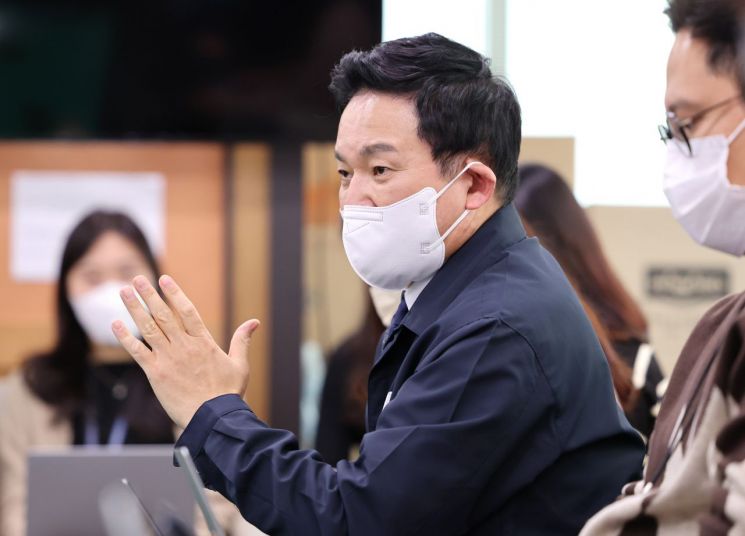
[Asia Economy Reporter Kwon Jae-hee] As the Cargo Solidarity strike entered its seventh day, the Cargo Solidarity and the government met face-to-face for the second time, but after a heated exchange, the negotiations ultimately broke down. Won Hee-ryong, Minister of Land, Infrastructure and Transport, effectively declared a halt to the dialogue, and the Cargo Solidarity responded with resistance, leading to a standoff.
At 2 p.m. on the 30th, the Ministry of Land, Infrastructure and Transport and the Cargo Solidarity sat at the negotiation table for the second time since the start of the general strike at the Government Complex Sejong.
An hour before the negotiations, Minister Won personally conducted an on-site inspection of a cement transportation company and made a tough statement, saying, "There will be no negotiations."
He told the Cargo Solidarity, "Do not fabricate false justifications such as refusing transportation due to no progress in talks with the Ministry of Land, Infrastructure and Transport," adding, "The issues raised by the Cargo Solidarity are to be discussed through legislative procedures in the National Assembly."
The dialogue between the Ministry and the Cargo Solidarity broke down 40 minutes after it began.
Gu Heon-sang, Director of Logistics Policy representing the Ministry, stated, "The Cargo Solidarity is holding the national economy and the public hostage by collectively refusing transportation, causing enormous damage, so we requested an immediate return to work."
Kim Tae-young, Senior Vice Chairman of the Cargo Solidarity, said, "We came with a sincere negotiation proposal, but we could not continue the dialogue as the government said negotiations were impossible."
Vice Chairman Kim urged, "The Ministry only emphasized returning quickly and resolving the issue in the National Assembly," adding, "Withdraw the work commencement order and have an authorized person come to the National Assembly to continue the dialogue."
Neither side set a date for the next negotiation.
After the breakdown, Minister Won declared a de facto suspension of talks, saying, "It is better not to have such conversations."
The government launched an all-out pressure campaign using every available means.
In response to the Cargo Solidarity strike, the government announced that it could expand the work commencement order, issued for the first time in the cement sector just a day ago, to other items such as petroleum, steel, and containers.
It also stated that fuel subsidies paid to transportation workers could be cut off.
Minister Won said, "Fuel subsidies are national subsidies provided when there is a legitimate contribution to cargo transportation," adding, "We can review whether there is any basis to provide subsidies to the Cargo Solidarity, which repeatedly refuses transportation for their own benefit."
He also said that civil damages claims against the Cargo Solidarity are under consideration.
Regarding the work commencement order, which labor groups oppose, he said it is not subject to injunctions. Minister Won told the Cargo Solidarity, "If you want to file for an injunction, go ahead," adding, "The public needs to know quickly whether this is possible or not."
The Ministry sent work commencement orders to 445 truck owners transporting cement through transportation companies, and among them, 165 received the orders by mail.
The Presidential Office pulled out a strong card, announcing a "comprehensive review of the Safe Freight Rate System."
A senior official from the Presidential Office said at a briefing that day, "The Safe Freight Rate System was established to prevent overwork accidents among freight transport operators, but we plan to conduct a full-scale investigation to see if it truly guarantees safety."
© The Asia Business Daily(www.asiae.co.kr). All rights reserved.
![Clutching a Stolen Dior Bag, Saying "I Hate Being Poor but Real"... The Grotesque Con of a "Human Knockoff" [Slate]](https://cwcontent.asiae.co.kr/asiaresize/183/2026021902243444107_1771435474.jpg)















