Government's Major Accident Reduction Roadmap
Industry Reactions Revealed
"Agree on Self-Regulation as Basic Principle"
Dissatisfaction with Risk Assessment System
"Increased Burden on Small and Medium-sized Workplaces"
Expanding Industrial Safety and Health Committee to 30 Workers
"Administrative Procedures Burden, No Effectiveness"
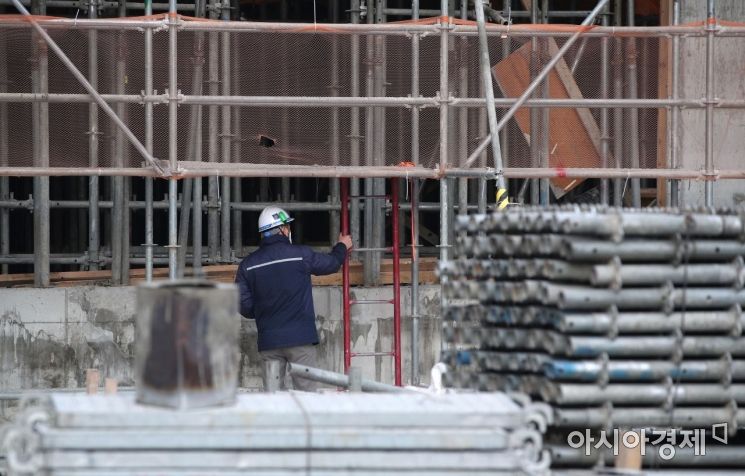 Managers are conducting a safety inspection at an apartment construction site in Gyeonggi-do. Photo by Hyunmin Kim kimhyun81@
Frontline workplaces expressed mixed dissatisfaction with the serious accident reduction roadmap announced by the government on the 30th, saying, "It only emphasizes autonomy in words, but in reality, regulations have only been strengthened." While the focus on corporate autonomy and the principle of 'autonomy and prevention over punishment' is appropriate, the general consensus is that the details do not reflect this.
The Korea Employers Federation stated in a press release that "while acknowledging the limits of mandatory regulations and adopting self-discipline and enhancement of preventive capabilities based on the responsibility of safety stakeholders as basic principles, which the business community also agrees with," it expressed concerns that "looking at the detailed tasks, 'autonomy' is nominal only, and rather, the content includes strengthened regulations such as punishment and supervision."
The Federation of Korean Industries also pointed out, "If mandatory risk assessments are introduced without reasonable improvements, there is concern that it will lead to an increase in redundant regulations on companies."
A representative example is the risk assessment system, which the government has promoted as the core of the autonomy and prevention system in this roadmap. This system was introduced domestically in 2013, but large companies conducted it uniformly, and small and medium-sized enterprises (SMEs) complained that it was complicated, leading to criticisms of its ineffectiveness. The government plans to refine this system and gradually make it mandatory, imposing penalties for non-compliance.
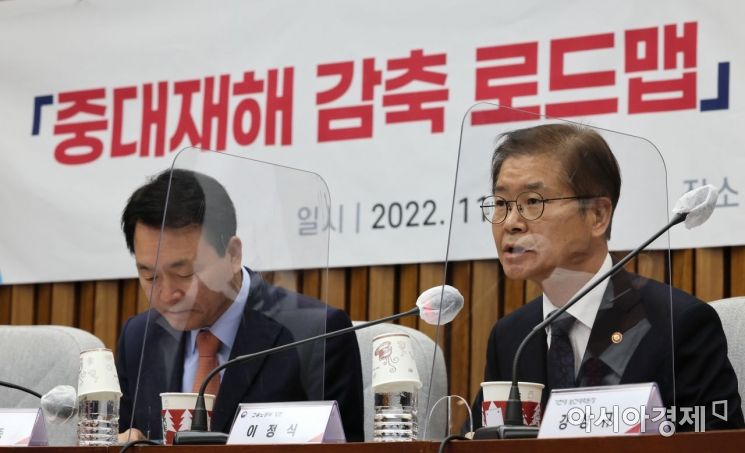 Minister of Employment and Labor Lee Jeong-sik is attending the 'Serious Accident Act Reduction Roadmap' party-government consultation held at the National Assembly on the 28th, delivering opening remarks. Photo by Yoon Dong-joo doso7@
The Korea Employers Federation predicted, "Continental law countries such as Germany and Japan do not have penalty provisions for not conducting risk assessments and mostly operate under voluntary management systems," adding, "Forcing evaluations on unprepared small and medium-sized workplaces will impose a significant burden on related companies." Yang Ok-seok, Director of Human Resources Policy at the Korea Federation of SMEs, emphasized the need for pace adjustment, saying, "The plan to gradually mandate risk assessments by industry and size for SMEs with fewer than 300 employees starting in 2024 could be seen as strengthening labor regulations."
There were also many complaints about the increased severity of various sanctions. Regarding the expansion of workplaces required to establish Industrial Safety and Health Committees from those with 100 or more employees to those with 30 or more, SMEs criticized that it would reduce effectiveness and increase administrative procedures. The Korea Employers Federation argued, "While claiming to 'shift the paradigm,' no concrete improvement measures are presented," and added, "Instead, many provisions include strengthening punishments or sanctions on business owners, such as 'expanding criminal penalties for habitual, repeated, or multiple fatal accidents,' 'strict measures applying a zero-tolerance principle for violations of core rules,' and 'increasing industrial accident insurance premiums in case of serious accidents.'
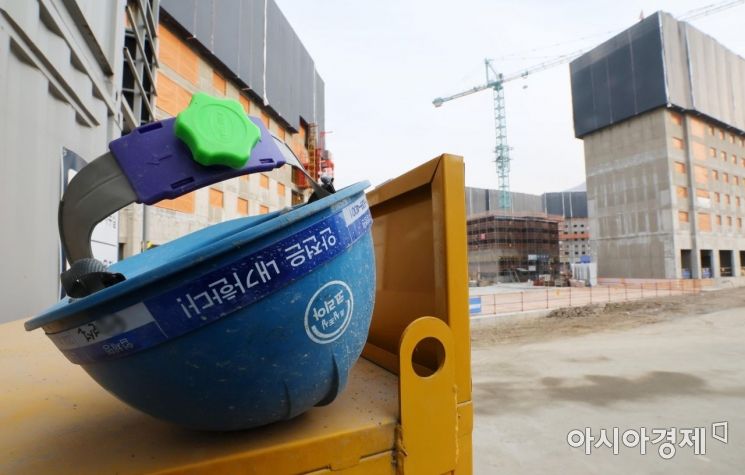
Given the criticism that the law has focused on punishment and has not significantly contributed to reducing actual workplace accidents, there is also an opinion that the direction toward prevention itself is appropriate. An industry insider said, "Because punishment has been the focus, companies have consulted law firms to check for legal issues rather than safety issues," adding, "Safety has not been concretely implemented in the field, so the change in direction this time is positive."
Regarding demands from the industry to clarify the causal relationship for punishment due to legal violations or the need for exemption provisions, the industry argues that these should be sufficiently reflected in the future legislative and institutional reform processes. A Korea Employers Federation official stated, "It should be reorganized to align with the new government's national agenda of establishing autonomous safety management," and added, "During the follow-up discussions for roadmap implementation, various measures that can help the early establishment of an autonomous prevention system should be explored, including fully collecting industry opinions."
© The Asia Business Daily(www.asiae.co.kr). All rights reserved.
![Clutching a Stolen Dior Bag, Saying "I Hate Being Poor but Real"... The Grotesque Con of a "Human Knockoff" [Slate]](https://cwcontent.asiae.co.kr/asiaresize/183/2026021902243444107_1771435474.jpg)

















