Yoon Administration's 'Serious Accident Reduction Roadmap'... Serious Accident Act Also Under Revision
"From Next Year, 'Legal Improvement TF' to Operate... Clarifying Punishment Criteria"
Stepwise Mandatory Risk Assessment... Large Companies to Implement from Next Year
Complete Overhaul of Industrial Safety Supervision System... Biannual Planned Inspections
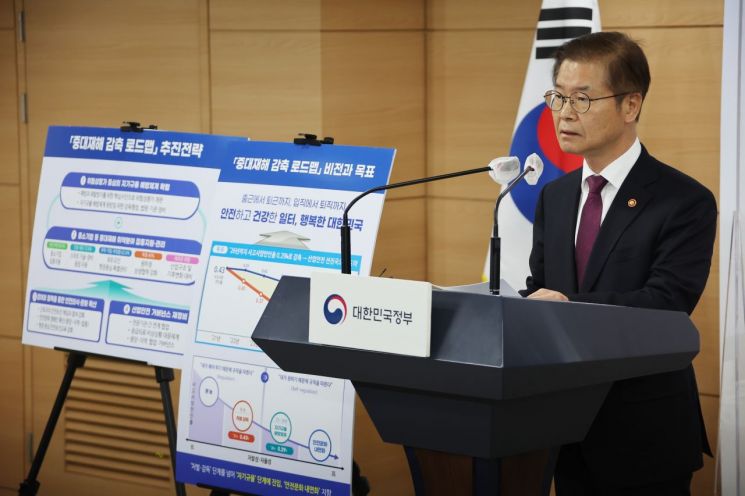 Minister Lee Jeong-sik Briefing on the Serious Accident Reduction Roadmap
(Seoul=Yonhap News) Photo by Kim Seung-doo = Minister Lee Jeong-sik of the Ministry of Employment and Labor is briefing on the Serious Accident Reduction Roadmap at the government Seoul office briefing room on the 30th of November, 2022.
kimsdoo@yna.co.kr
(End)
<Copyright(c) Yonhap News Agency, Unauthorized reproduction and redistribution prohibited>
The government has announced a ‘Major Accident Reduction Roadmap’ focusing on autonomy and prevention, and revisions to the Serious Accident Punishment Act are expected to be pursued in a similar direction. Since the government has concluded that punishment alone can no longer reduce fatal accidents, it is anticipated that the law will be amended to lower the level of punishment and clarify the scope of responsibility, partially reflecting the demands of the business community. However, since the Democratic Party of Korea and labor groups have expressed negative views on the government’s plan, future discussions are expected to be challenging.
Serious Accident Punishment Act Under Review... TF to Operate Next Year
On the 30th, the Ministry of Employment and Labor announced the Yoon Suk-yeol administration’s Major Accident Reduction Roadmap, stating, "The Serious Accident Punishment Act will clarify the requirements for punishment focusing on key matters for preventing serious accidents, such as risk assessments and violations of the establishment and implementation of recurrence prevention measures." It added, "To this end, in the first half of next year, a ‘Task Force (TF) for Improving Industrial Safety and Health Legislation’ composed of experts recommended by labor, management, and government will be operated to prepare improvement plans."
Initially, the labor sector expected that the government would weaken the Serious Accident Punishment Act through amendments to enforcement ordinances that do not require parliamentary discussion. However, the government has set a goal to fundamentally change the overall legislative framework, including the Industrial Safety and Health Act, rather than dealing only with enforcement ordinances. Ryu Kyung-hee, head of the Industrial Safety and Health Bureau at the Ministry of Employment and Labor, said, "The contents in the enforcement ordinances are difficult to exceed the scope of legislation, so modifying one or two items does not have much significance." She added, "We plan to reorganize not only the Serious Accident Punishment Act but also the Industrial Safety and Health Act and various regulations around risk assessment during this opportunity."
The government’s proposed revision of the Serious Accident Punishment Act is expected to strengthen criminal penalties for habitual or repetitive accidents or those with multiple fatalities, while refining the law to enhance the effectiveness of accident prevention through corporate autonomy in risk assessments. Referring to overseas legislation, the level of punishment may also be adjusted. For example, under U.S. federal law, if an employer violates regulations resulting in a serious accident, the penalty is imprisonment for less than six months, and in Germany, imprisonment is up to one year, both lower than South Korea’s punishment levels.
However, since the Democratic Party, which holds the majority in the National Assembly, has expressed a negative stance on the government’s plan, the path to revision remains difficult. Lee Jae-myung, leader of the Democratic Party, recently visited the Korean Confederation of Trade Unions and said, "There is a movement to regress the Serious Accident Punishment Act again," emphasizing, "Even at this moment, workers are dying at workplaces, and efforts to improve labor conditions must continue."

The Core of the Roadmap is Risk Assessment... Mandatory from Next Year
The core of the roadmap announced by the government that day is the mandatory implementation of risk assessments. A Ministry of Employment and Labor official explained, "During the introduction of risk assessments in 2013, related laws and systems were not properly organized," adding, "Regardless of whether risk assessments were conducted, violations of the Industrial Safety and Health Act were still applied, so there was no incentive for workplaces to conduct assessments."
According to the roadmap, large companies with 300 or more employees will be required to conduct risk assessments starting next year. Small and medium-sized enterprises with 50 to 299 employees will be subject to mandatory risk assessments from 2024. Except for workplaces with fewer than five employees, all companies will be required to conduct risk assessments from 2025. The roadmap also aims to strengthen labor-management cooperation during the risk assessment process to enhance on-site execution. The Ministry of Employment and Labor plans to expand worker participation in all stages of risk assessment, including identifying workplace hazards, establishing improvement measures, preparation, risk estimation, and decision-making.
The employer must also report quarterly to the in-house Industrial Safety and Health Committee, which includes workers, on improvements and recurrence prevention measures based on risk assessments. The Ministry plans to distribute a ‘Tool Box Meeting (TBM) Utilization Guide’ by industry and process from next year so that on-site workers can continuously receive risk assessment results.
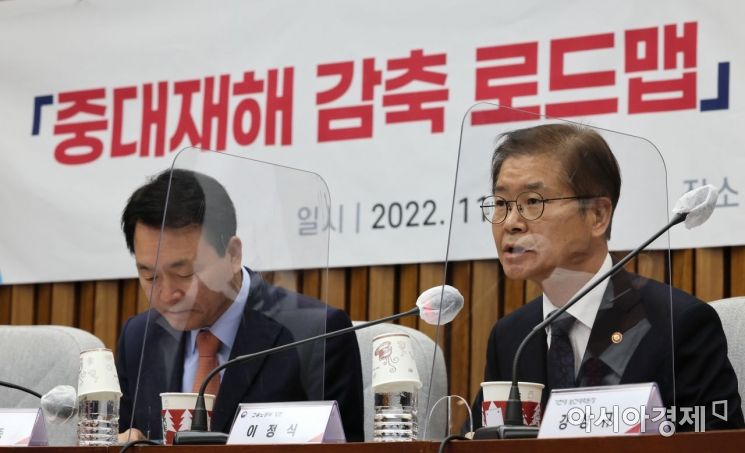 Minister of Employment and Labor Lee Jeong-sik is attending the 'Serious Accident Act Reduction Roadmap' party-government consultation held at the National Assembly on the 28th, delivering opening remarks. Photo by Yoon Dong-joo doso7@
Strengthening Supervisory Effectiveness... Planned Inspections on ‘Accident Concealment’
The industrial safety supervision system will also be completely revamped. A representative change is that the regular inspections conducted annually on about 11,000 workplaces by the Ministry of Employment and Labor will shift to focus on risk assessment checks. Starting next year, the ministry will mandatorily verify whether workplaces conduct and implement risk assessments and establish and maintain safety and health management systems during inspections. To enhance the effectiveness of accident recurrence prevention measures, planned inspections on industrial accident concealment and non-reporting will be conducted twice a year, in the first and second halves.
The ministry is also promoting a plan to reflect the occurrence of serious accidents in industrial accident insurance premium rates. In 2024, the ministry plans to amend the Insurance Premium Collection Act to impose surcharges on workplaces where serious accidents occur. If a serious accident occurs at a workplace not enrolled in industrial accident insurance, the maximum insurance premium collection limit will increase from five times to ten times.
Lee Jung-sik, Minister of Employment and Labor, said, "The paradigm shift in industrial safety will not be easy," but added, "However, if we proceed with confidence and without wavering, we expect the safety level of our workplaces to improve accordingly."
© The Asia Business Daily(www.asiae.co.kr). All rights reserved.
![Clutching a Stolen Dior Bag, Saying "I Hate Being Poor but Real"... The Grotesque Con of a "Human Knockoff" [Slate]](https://cwcontent.asiae.co.kr/asiaresize/183/2026021902243444107_1771435474.jpg)

















