S&P Lowers US Economic Growth Forecast for Next Year by 0.1% "Shallow Recession Expected in Q1"
[Asia Economy Reporter Park Byung-hee, New York=Special Correspondent Jo Seul-gi] As the inversion of short- and long-term interest rates intensifies in the global bond market, analyses suggest that a global economic recession is imminent. The inversion of short- and long-term bond yields is interpreted as a precursor to an economic downturn. In the United States, the inversion has persisted since July, and credit rating agency Standard & Poor's (S&P) released a report forecasting a mild recession in the U.S. economy in the first half of next year.
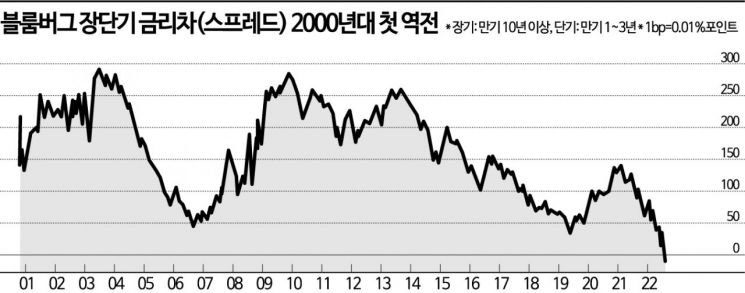
Bloomberg reported on the 28th (local time) that for the first time since the 2000s, an inversion of short- and long-term interest rates has occurred in the global bond market, increasing the risk of a worldwide economic recession.
Bloomberg aggregates interest rate trends of bonds traded in global financial markets and calculates various bond indices under the name ‘Bloomberg Global Aggregate.’ There are various bond indices with the name Bloomberg Global Aggregate, which comprehensively cover the interest rate trends of bonds traded worldwide.
Largest U.S. Interest Rate Inversion in 41 Years
Bloomberg reported that an analysis of long-term bonds with maturities of 10 years or more and short-term bonds with maturities of 1 to 3 years included in the Bloomberg Global Aggregate indices confirmed that recently short-term interest rates have been higher than long-term rates. Furthermore, Bloomberg added that this global inversion of short- and long-term bond yields is the first since at least 2000.
Typically, long-term interest rates are higher than short-term rates, and an inversion of these rates is interpreted as a sign of an impending recession. When central banks raise interest rates excessively to curb inflation and tighten market liquidity, it can lead to a recession. As recession fears grow, short-term interest rates?which are more sensitive to monetary policy?rise faster than long-term rates, narrowing the gap between short- and long-term rates. If recession fears become severe, an inversion like the current one can occur.
In the U.S. Treasury market, the inversion of short- and long-term interest rates has persisted since July. The Wall Street Journal (WSJ) reported last week that the yield on the 2-year U.S. Treasury was 0.78 percentage points higher than that of the 10-year Treasury, marking the most severe inversion since late 1981. It added that late 1981 was the start of a recession, and the unemployment rate at that time was higher than during the 2008 global financial crisis.
S&P warned in its report that high inflation has weakened U.S. consumers' purchasing power, and the Federal Reserve's (Fed) interest rate hikes have increased funding costs, weakening economic momentum. It forecast a mild recession in the U.S. economy in the first quarter of next year. Accordingly, S&P lowered its U.S. economic growth forecast for next year to a 0.1% decline. Previously, in September, S&P had expected 0.2% growth for the U.S. economy next year.
The Fed also sees a high possibility of recession next year. According to the minutes of the November Federal Open Market Committee (FOMC) released on the 23rd, Fed economists judged that the likelihood of the U.S. economy entering a recession next year is close to the baseline. Bloomberg interpreted this as Fed economists estimating a 50% chance of a U.S. recession next year.
Not only the U.S., but the Bank of England (BOE) also warned last summer that the U.K. economy has already entered a recession and that the recession could last up to two years. Germany’s largest bank, Deutsche Bank, diagnosed that the German economy may already be in recession.
"Reflecting Expectations of Inflation Easing" Analysis Also Emerges
Meanwhile, WSJ reported that a new interpretation has emerged that the recent inversion of short- and long-term interest rates reflects expectations that inflation will be controlled and the economy will normalize, rather than being a sign of recession. WSJ explained that bond yields reflect market expectations of central bank benchmark rates over the bond’s maturity period, so the current inversion can be interpreted as reflecting expectations that U.S. interest rates will decline in the long term.
In this regard, Jin Tanuzo, CEO of financial investment firm Columbia Threadneedle, explained, "The current inversion of short- and long-term interest rates indicates that the market believes inflation will stabilize." Tanuzo added, "Investors believe the Fed will ultimately win the fight against inflation and that they must endure the currently elevated short-term rates in the meantime."
© The Asia Business Daily(www.asiae.co.kr). All rights reserved.
![Clutching a Stolen Dior Bag, Saying "I Hate Being Poor but Real"... The Grotesque Con of a "Human Knockoff" [Slate]](https://cwcontent.asiae.co.kr/asiaresize/183/2026021902243444107_1771435474.jpg)















