'Battle of Baengmagoji' Comrade Private Byeon Gwi-man Discovered Together
Helmet, Sole, Rubber Ring... Personal Effects Found in Original Wearing Position
National Agency for Missing Soldiers Excavation Project Identifies 201 War Dead
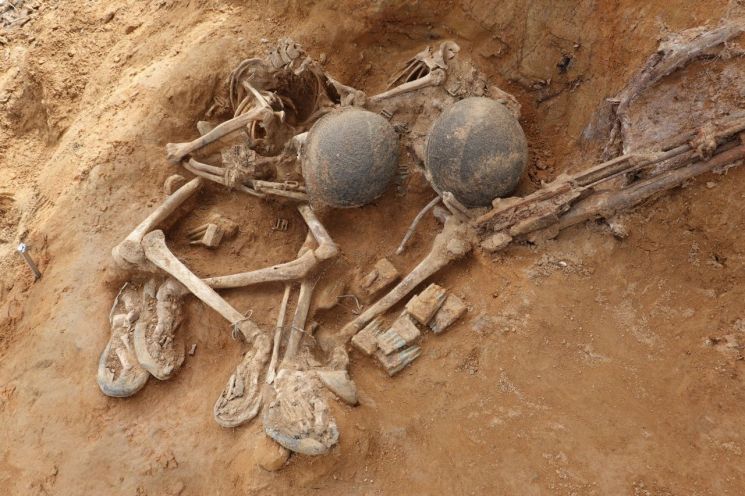 Sergeant Second Class Kim Yong-il (left) and Corporal Pyeon Gwi-man at the time of the remains excavation [Photo by Ministry of National Defense]
[Asia Economy Reporter Jang Hee-jun] The identity of a veteran who died in a trench alongside his comrades during the Korean War has been confirmed.
The Ministry of National Defense's Remains Recovery and Identification Team (hereafter, the National Recovery Team) announced on the 30th that the remains excavated last July at Baengmagoji were identified as those of the late Sergeant Second Class Kim Yong-il.
The late veteran's remains were found in the same trench as those of the late Corporal Pyeon Gwi-man, whose identity was confirmed on the 21st. The comrades who had been together for 70 years since the moment they closed their eyes were excavated, and their identities were consecutively identified.
At the time of excavation, the remains of the two soldiers were found side by side, and 91 personal effects, including an M1 rifle, were discovered nearby. Sergeant Second Class Kim's remains were found completely curled up in the trench with his arms folded over his chest. The personal effects maintained their original positions as worn during his lifetime, from the helmet on the skull to the soles of the combat boots on the foot bones, and rubber rings wrapped around the shin bones.
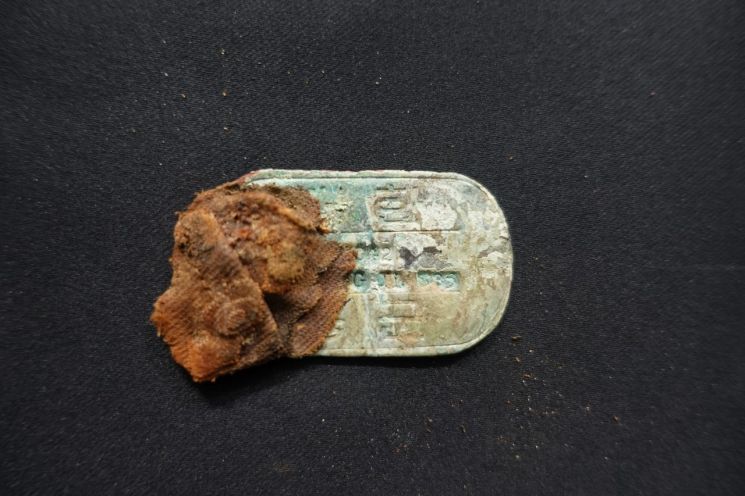
Inside the forearm bones folded over the chest, an identification tag with the veteran's three-name characters clearly engraved was found. Based on this identified identity, a genetic comparison was conducted with his biological grandson, confirming the family relationship. Previously, Corporal Pyeon's remains were also excavated in a sitting posture with his head and chest bent forward and legs bent. His identity was confirmed by the name engraved on a fountain pen found with him.
Sergeant Second Class Kim and Corporal Pyeon belonged to the 30th Regiment of the 9th Division of the Republic of Korea Army and participated in the Battle of Baengmagoji from October 6 to 15, 1952. At that time, the 9th Division and the Chinese People's Volunteer Army fought the fiercest battle in the history of the Korean War, changing control of the hill seven times. After 12 rounds of offensive and defensive battles, the 9th Division succeeded in securing the hill, but Sergeant Second Class Kim and Corporal Pyeon died in this battle.
Sergeant Second Class Kim was born as the eldest son among six sons and six daughters in Goesan County, Chungbuk Province. He met his wife and had one son and one daughter, but he enlisted in the army in March 1952, just one month after his youngest daughter was born, and left on a long journey. After 70 years, he has returned to his grandson's side.
His grandson, Kim Jeong-deok, said, "My father was three years old when my grandfather enlisted, so he probably has no memory of him, but he longed to see his grandfather desperately. I am happy to be able to fulfill my role as the eldest grandson."
The notification ceremony for Sergeant Second Class Kim's identity confirmation, titled "Return of the Hero of National Defense," will be held at the family home in Bucheon City, Gyeonggi Province, on the same day.
Meanwhile, since the Korean War remains excavation project began in April 2000, the identities of 201 war dead have been confirmed. The National Recovery Team emphasized the need for public participation in identifying remains and requested that people contact them by phone or visit nearby public health centers, veterans hospitals, or military hospitals. If individuals wish to provide genetic samples but have difficulty visiting due to mobility issues or livelihood reasons, the National Recovery Team can visit them directly.
© The Asia Business Daily(www.asiae.co.kr). All rights reserved.
![Clutching a Stolen Dior Bag, Saying "I Hate Being Poor but Real"... The Grotesque Con of a "Human Knockoff" [Slate]](https://cwcontent.asiae.co.kr/asiaresize/183/2026021902243444107_1771435474.jpg)
















