Harim's 'The Misikbap' Six Months After Launch
Market Share Around 1%, Presence Remains Minimal
Continuous Controversies Including Negative Marketing and Foreign Substances
Harim: "Please Watch from a Long-Term Perspective"
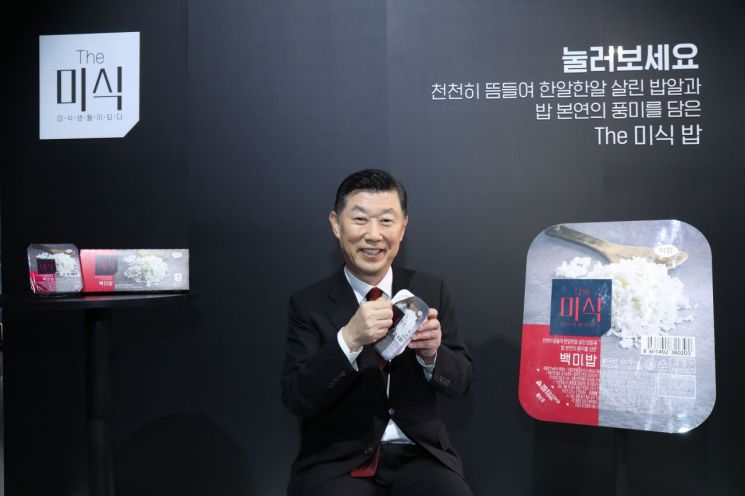 At the press conference for the launch of DummySik Bap last May, Kim Hong-guk, Chairman of Harim Group, is holding the DummySik Bap product. Photo by Harim
[Asia Economy Reporter Song Seung-yoon] Harim's instant rice product "The Misik Bap" under the ambitious "The Misik (The미식)" brand, launched to leap forward as a comprehensive food company, is facing difficulties. It has failed to establish a significant presence in the market and is struggling amid controversies over marketing and foreign substances.
According to the industry on the 1st, as of September this year, CJ CheilJedang's "Hetbahn" holds the top spot in the domestic instant rice market with a 66% market share. Ottogi's "Ottogi Bap" ranks second with 29%. The rest of the market is occupied by Dongwon F&B, Harim, and private brand products, with Harim's The Misik Bap reportedly holding around a 1% market share.
Earlier, Harim officially entered the instant rice market in May by launching 11 varieties of The Misik Bap. After its previous attempt with "Sunbap" in March last year failed to show significant results, the company changed its equipment and manufacturing methods to make a second attempt. They set an ambitious goal of capturing a 10% market share in the instant rice market with The Misik Bap.
However, The Misik Bap has been plagued by various controversies since its launch. Harim emphasizes a manufacturing process that uses no preservatives or additives, only water and rice, to enhance the taste of the rice, positioning this as a differentiation strategy. However, this is similar to the characteristics of the previously launched Sunbap. Dongwon F&B's "Ssen Cook" is also a 100% new rice product without preservatives or food additives. Because of this, there were criticisms that there is no clear distinction from existing products.
At the press conference held at the time of The Misik Bap launch, negative remarks targeting competitors' products also came under scrutiny. Heo Jun, CEO of Harim Industry, said at the press conference, "The reason instant rice had a distinctive sour smell was due to additives," seemingly referring to competitors, which sparked controversy over negative marketing. This could give the impression that existing instant rice products use additives. Existing competitors' instant rice contains rice bran extract and acidity regulators, but rice bran extract is a food derived from rice bran, not an additive. Acidity regulators are also used in many foods and are considered harmless to humans by the industry.
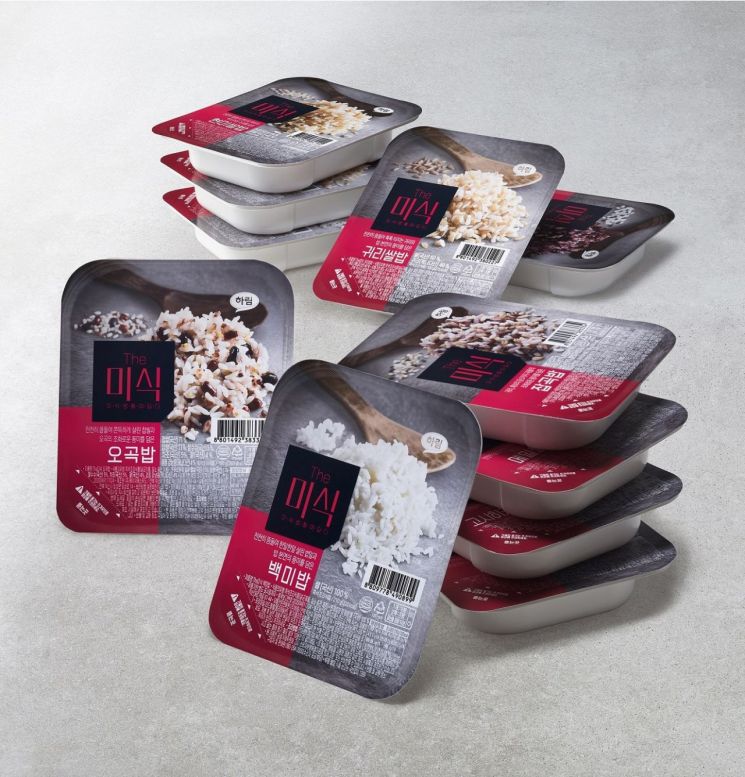
Although a latecomer with a lower market share compared to competitors, questions have also been raised about the relatively high price. Harim positions The Misik Bap as a premium product, pricing it at 2,300 KRW per unit (official mall price) at launch. This is significantly more expensive than CJ CheilJedang's Hetbahn (1,850 KRW) and Ottogi's Ottogi Bap (1,380 KRW).
Moreover, recently, a media report revealed that mold was found in The Misik Bap products, leading to a controversy over foreign substances. Harim explained that mold cannot occur during the manufacturing process and suggested that packaging film issues during transportation might be the cause. Such incidents happen occasionally every year in the instant rice industry. However, from the consumer's perspective, this can undermine product reliability.
Harim is expanding its investment in instant rice by increasing the production line at the First Kitchen rice factory (K3) in Iksan, Jeonbuk, doubling the maximum production capacity of The Misik Bap. However, given the ongoing negative evaluations, if this product also fails to establish itself in the market, it is expected to cause considerable damage. The plan to advance as a comprehensive food company could also be shaken. An industry insider said, "Despite significant investment in product promotion and consumer viral marketing, brand awareness remains low. Also, the product quality is not outstanding enough to encourage repurchases or voluntary consumer viral marketing, so its presence seems minimal."
A Harim representative stated, "The mold issue is impossible during the manufacturing process and is considered an unavoidable incident during distribution. Although the current market share is low, it has only been half a year since the launch. While it is difficult to disclose details now, meaningful data is being accumulated, and sales are steadily ongoing, so we ask for positive attention."
© The Asia Business Daily(www.asiae.co.kr). All rights reserved.


















