Severe Cold Wave Especially Hits Korean Companies
Impact on Samsung and SK Semiconductor Performance
Memory Sector Hit Causes Semiconductor Market Shift
Market Outlook Remains Bleak Through Next Year
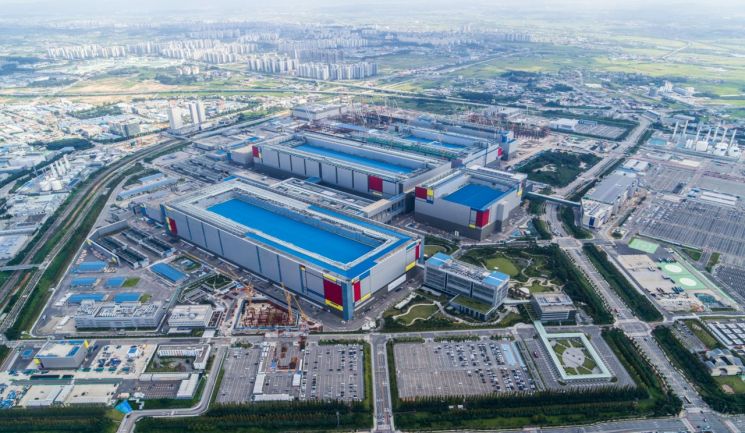
[Asia Economy Reporter Kim Pyeonghwa] As the semiconductor market enters a severe downturn, the memory sector is experiencing an unprecedented slump. This explains why South Korea's semiconductor industry, led by memory semiconductor giants Samsung Electronics and SK Hynix, is facing a particularly harsh winter compared to global competitors. While the market expects these conditions to persist through next year, opinions differ on when recovery might begin.
Korean Semiconductor Industry Stumbles Due to Memory Sector Focus
According to the semiconductor industry on the 30th, the global semiconductor market's down cycle has fully set in, with worsening conditions becoming evident in statistics during the second half of the year. Based on the latest data from the Semiconductor Industry Association (SIA), which relies on the World Semiconductor Trade Statistics (WSTS), global semiconductor sales in September reached $47.24 billion, a 0.5% decrease compared to the same period last year. Although sales grew by 26.8% in January this year, the decline accelerated after the first half, marking the first contraction since January 2020.
This downturn results from a combination of factors including economic recession, inflation, interest rate hikes, the Russia-Ukraine war, and China's COVID-19 lockdown measures. The memory semiconductor sector, which is highly sensitive to economic conditions, has been especially affected. Due to the nature of memory semiconductors?standardized, low-variety mass production aimed at cost reduction?excess inventory and falling product prices have occurred in a chain reaction as companies supply pre-manufactured products amid weak demand.
Indeed, South Korea's semiconductor industry, focused on memory semiconductors, suffered earnings declines in the third quarter of this year due to these factors. Samsung Electronics' semiconductor (DS division) operating profit for Q3 was 5.12 trillion KRW, down 49.16% year-over-year. SK Hynix's Q3 operating profit also plunged 60% to 1.6556 trillion KRW. As of the end of Q3, the total inventory assets for the two companies stood at 26.3652 trillion KRW (semiconductor division) and 14.665 trillion KRW, respectively, representing increases of 22.6% and 23.5% compared to the first half. SK Hynix CEO Noh Jong-won noted during last month's conference call that "this year's memory downturn is unprecedentedly severe."
As the memory sector experiences sales declines, the semiconductor market is undergoing significant shifts. Earlier, market research firm IC Insights projected in September that Samsung Electronics, which had held the top spot with $18.3 billion in Q3 sales, could be overtaken by Taiwan's TSMC ($20.2 billion) and drop to second place. After Q3 results were announced, market research firm Omdia recently released data showing Samsung Electronics fell to second place behind U.S. Intel. Since TSMC was excluded from this data, industry experts suggest that including TSMC would reorder the rankings to TSMC-Intel-Samsung Electronics. According to Omdia, SK Hynix slipped from third to fourth place behind U.S. Qualcomm in Q3. TSMC specializes in foundry (semiconductor contract manufacturing), while Intel and Qualcomm focus on fabless (semiconductor design).
Extended Cold Spell Through Next Year Also Impacts Server Market
Market concerns over the memory semiconductor industry are expected to continue for some time. Multiple market research firms including Omdia, IC Insights, and TrendForce predict negative growth for the memory market in the second half of this year. IC Insights noted that although the second half is typically a peak season, DRAM market sales are expected to drop 40% from $49 billion in the first half to $29.3 billion in the second half. TrendForce forecasts that NAND market sales in Q4 will decline 20% from the previous quarter due to surging inventory and falling prices.
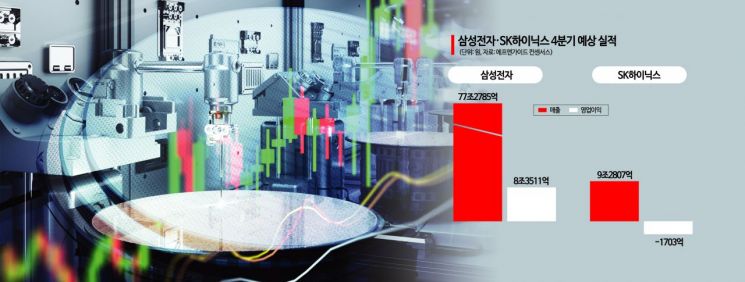
Consequently, Samsung Electronics and SK Hynix are expected to face further earnings deterioration. As of the 30th, the consensus for Q4 sales stands at 77.2785 trillion KRW and 9.2807 trillion KRW for Samsung Electronics and SK Hynix, respectively, continuing the downward trend from Q3. SK Hynix, with over 90% of its business in memory semiconductors, is anticipated to report an operating loss of 170.3 billion KRW.
The outlook for next year continues this trend. Market research firm Gartner projects global semiconductor sales will decline 3.6% year-over-year to $596 billion, with the memory market shrinking by 16.2%. The DRAM market is expected to generate $74.2 billion in sales, down 18% from this year, while the NAND market is forecasted to drop 13.7% to $59.4 billion. According to TrendForce, the server DRAM market?considered a cash cow for the memory semiconductor industry?is also expected to see slower growth next year at 2.8%, compared to 5.1% this year.
The semiconductor industry and securities analysts are closely watching whether this market downturn will reverse around the second half of next year. Choi Doyeon, a researcher at Shinhan Investment Corp., stated, "The memory semiconductor market is experiencing the fastest demand decline and the highest inventory burden in history. If inventory levels at downstream companies normalize and macroeconomic conditions improve during the first half of 2023, memory prices are expected to turn upward in the second half of 2023."
© The Asia Business Daily(www.asiae.co.kr). All rights reserved.
![Clutching a Stolen Dior Bag, Saying "I Hate Being Poor but Real"... The Grotesque Con of a "Human Knockoff" [Slate]](https://cwcontent.asiae.co.kr/asiaresize/183/2026021902243444107_1771435474.jpg)
















