3-term Lee Won-wook "Worried about the current Democratic Party becoming a factional party"
Debate continues over the introduction method of a multi-party system
Proposals include introducing regional parties and formalizing party membership rules
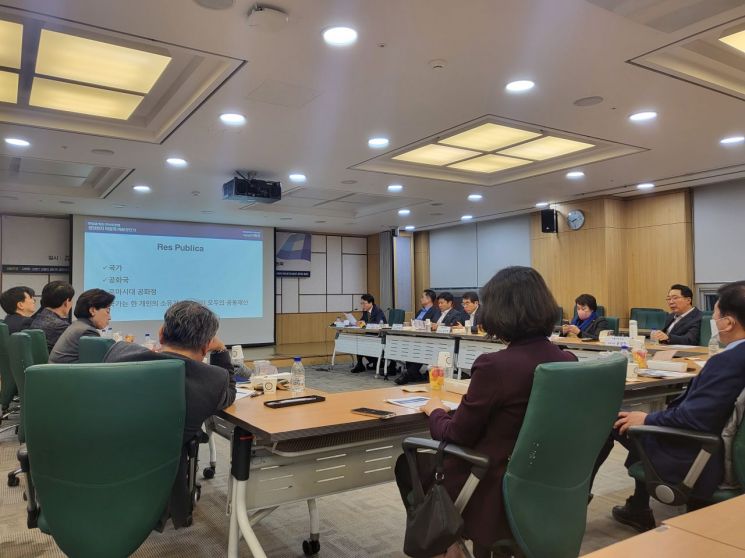 Members of the Democratic Party of Korea are holding a "Reflection and Innovation Forum" on the 29th at the National Assembly Members' Office Building.
 [Photo by Junyi Park]
[Asia Economy Reporter Park Jun-yi] The Democratic Party of Korea expressed concerns over the strengthening of fandom politics and party factionalism within the party, emphasizing the need for political reform. It was a reflection raised by the ruling party that the current conflict structure cannot be broken without institutional reform toward a multi-party system.
On the 29th, 16 lawmakers from the Democratic Party held a 'Reflection and Innovation Forum' at the National Assembly Members' Office Building to share opinions on innovation measures within the party. The three-term lawmaker Lee Won-wook, who presented at the forum, pointed to 'party factionalism' as the reason for the ongoing conflict structure in the National Assembly of South Korea. He said, "The reason for the endless confrontational structure in the National Assembly is that party factionalism is continuously intensifying," adding, "Even within parties, there are many cases where other factions are not recognized. In the case of the People Power Party, during the MB administration, the Park Geun-hye faction was purged, and during the Park Geun-hye government, the pro-Lee faction was purged." He also mentioned the Democratic Party, expressing concern, "What about the current Democratic Party? Factionalism is also a concern."
Lee explained that as factionalism continued, the absence of coalition and cooperation further strengthened each party's 'fandom politics.' He said, "The core supporters who criticized former President Roh Moo-hyun's grand coalition proposal in 2005 were the so-called 'Noppa' at the time," adding, "Since then, party issues have seen strengthened camp politics and fandom politics continuously." He further stated, "Under the Moon Jae-in administration, political alliances were completely abandoned, and the so-called pro-Moon faction government was formed," calling it "a regrettable point, wondering what would have happened if a political alliance had been formed when the Moon administration was born."
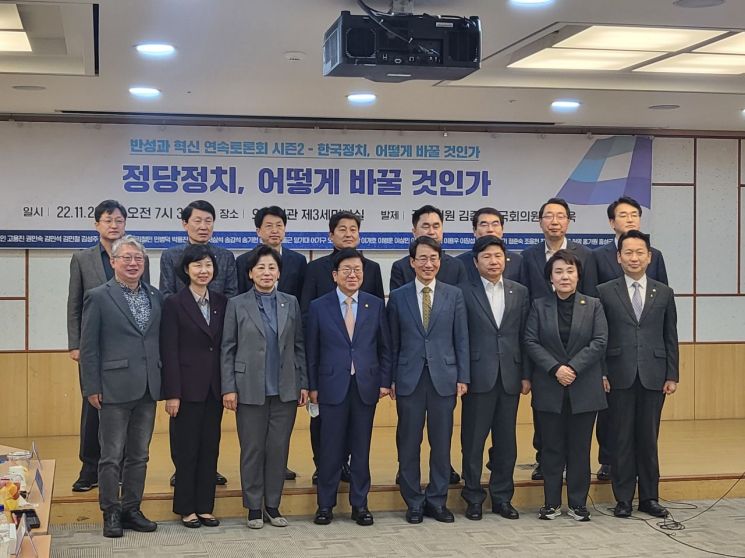 Members of the Democratic Party of Korea are holding a "Reflection and Innovation Forum" on the 29th at the National Assembly Members' Office Building.
 [Photo by Junyi Park]
The lawmakers unanimously agreed that to change the winner-takes-all political structure, a multi-party system is inevitable. Lee said, "I agree with creating a multi-party system, but I have not found an answer to what will create it," adding, "It may work effectively in local autonomy. I propose the establishment of regional parties."
Second-term lawmaker Kim Jong-min also agreed, saying, "If the party culture is strongly cohesive, a multi-party system must accompany it." He suggested considering changing the party's highest decision-making body from 'delegates' to 'party members.' However, he noted that this should be accompanied by considerations regarding the regulations on party members' rights. He pointed out, "Responsible party members who make decisions should be central, but if '1,000-won party members' (Democratic Party's registered members) become central, mobilization politics cannot be done, and the distinctiveness of exercising authority is not clear." He also proposed expanding policy expert committees in local councils and the National Assembly.
The necessity of constitutional amendment was also emphasized. Six-term lawmaker and former Speaker of the National Assembly Park Byeong-seok said, "Without simultaneously reforming the presidential system, the single-member district system, and the two-party system, there will be no politics of compromise and negotiation," adding, "The issue of how to disperse power is a matter of constitutional amendment." He explained, "Power has the nature of becoming oversized, strong, and perpetual on its own, so it must be institutionally blocked," calling for discussions on this matter.
On the other hand, some pointed out the practical impossibility of party reform. Three-term lawmaker Nam In-soon said, "Banning satellite parties does not solve the problem," adding, "It is important to set a direction on whether to increase diversity and proportionality or to introduce a large multi-member district system to bring about various political forces."
© The Asia Business Daily(www.asiae.co.kr). All rights reserved.
![Clutching a Stolen Dior Bag, Saying "I Hate Being Poor but Real"... The Grotesque Con of a "Human Knockoff" [Slate]](https://cwcontent.asiae.co.kr/asiaresize/183/2026021902243444107_1771435474.jpg)

















