Financial Structure Improvement Totaling 1.984 Trillion KRW
Reducing 1 Trillion KRW by Increasing Coal Power Share
Government Faces Criticism Over Decarbonization Policy
Minimal Savings Effect...Tariff Normalization Needed
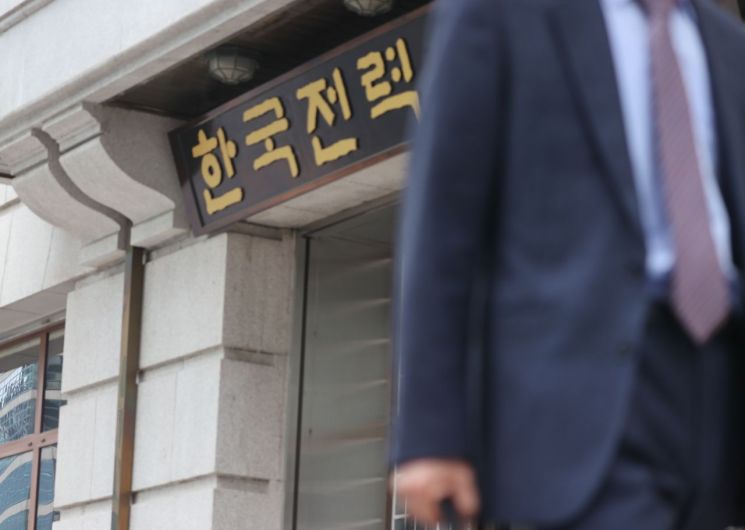
Korea Electric Power Corporation (KEPCO), which is undergoing high-intensity restructuring, has reportedly saved nearly 2 trillion won through asset sales and easing of the coal power generation cap system. However, there are criticisms that KEPCO’s approach of improving its financial structure by increasing the share of coal power generation to reduce costs for liquefied natural gas (LNG) power generation contradicts the Yoon Seok-yeol administration’s carbon neutrality policy.
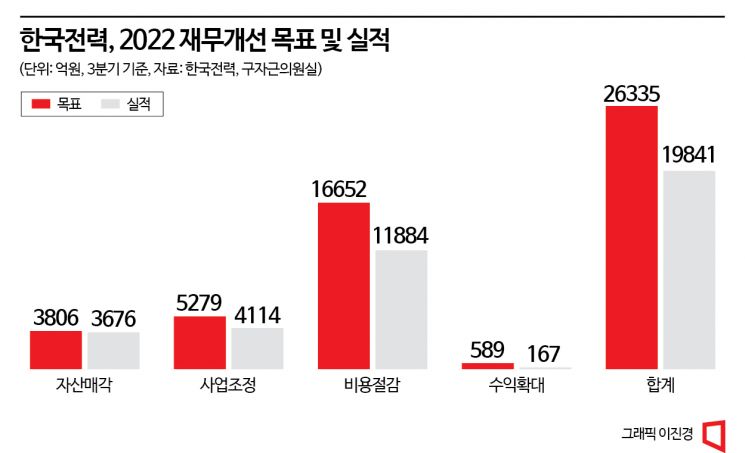
According to data submitted by KEPCO to Ku Ja-geun, a member of the People Power Party, on the 30th, KEPCO saved a total of 1.9841 trillion won through high-intensity financial structure improvement efforts as of the third quarter of this year. This is 75.3% of KEPCO’s financial improvement target of 2.6335 trillion won set for this year. Earlier in May, KEPCO announced a high-intensity austerity plan worth 6 trillion won to reduce the largest-ever deficit and presented detailed implementation plans including the sale of equity stakes and real estate.
Cost-saving Effect Enhanced by Coal Power Generation
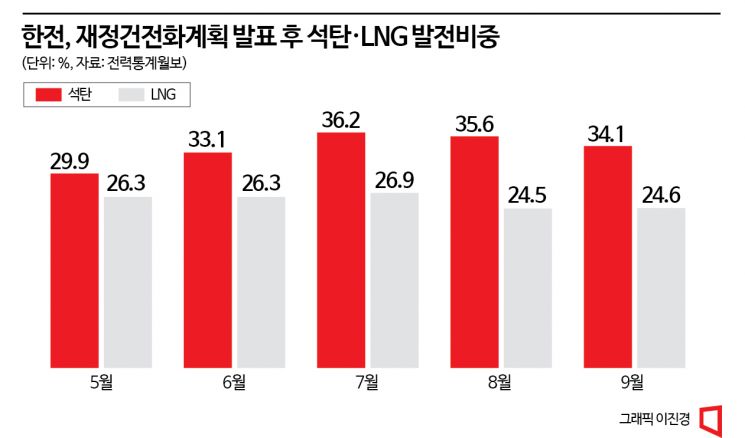
Specifically, KEPCO saved a total of 1.077 trillion won in fuel purchase costs by separating prices between mainland and Jeju areas and easing the coal power generation cap system. The coal power generation cap system sets a limit on coal power generation to reduce greenhouse gas emissions. Since last year, KEPCO and its five affiliated power generation companies have voluntarily set reduction caps, usually implemented during periods of low energy demand such as April to June and September to November. According to the Monthly Electricity Statistics Report, coal power generation increased from 29.9% in May to 34.1% in September this year, shortly after KEPCO announced its financial improvement efforts, while LNG’s share decreased from 26.3% to 24.6% during the same period. This indicates that KEPCO increased coal power generation to reduce costs for LNG power generation.
The problem is that the increased share of coal power generation leads to higher carbon dioxide emissions. Jang Hye-young, a member of the Justice Party, estimated that if KEPCO replaces a total of 12.8 TWh of LNG power generation targeted in its financial stabilization plan from this year to 2026 with coal power generation, carbon dioxide emissions would increase by approximately 5.67 million tons. This estimate is based on CO2 emissions per 1 kWh of electricity produced (LNG 549g, coal 992g), which is equivalent to building one 900 MW coal-fired power plant.
The Ministry of Trade, Industry and Energy and KEPCO maintain the stance that the operation ratio of public coal power plants should be maintained for the time being to ensure stable energy supply and cost reduction. KEPCO has set its financial improvement target for next year at 1.52 trillion won and plans to save an additional 130 billion won through cost reduction. Some critics argue that KEPCO continues to pursue cost-saving measures that conflict with the government’s carbon neutrality policy to alleviate deficit management. Professor Sung Tae-yoon of Yonsei University’s Department of Economics said, “Maintaining KEPCO’s coal power generation share fundamentally contradicts the carbon neutrality policy, but it is unavoidable due to the severely deteriorated current cost structure. However, KEPCO needs to consider and strive to reduce costs amid the global energy inflation situation.”
Savings Amount... Only About One Month’s Operating Cost
There is also an evaluation that KEPCO’s financial structure improvement efforts have limited effect on fundamentally normalizing management. KEPCO requires about 2.5 trillion won monthly for operating costs, so the annual cost-saving measures of around 2 trillion won have limited effectiveness. According to KEPCO’s “2022?2026 Financial Stabilization Plan” submitted earlier to the Ministry of Economy and Finance, the plan aims to save a total of 14.3 trillion won over five years. The savings amount averages about 2.86 trillion won annually, which is only about one month’s operating cost for KEPCO.
Looking at the details of cost-saving achievements implemented up to the third quarter of this year, despite relatively good performance compared to targets, the absolute savings amount is not large. Specifically, in asset sales, KEPCO disposed of the remaining site of Uijeongbu Substation for 294.5 billion won, office buildings including Jemulpo Branch and Jeju Power Branch for 60.2 billion won (4 locations), and company housing in Jeju and Gyeongnam Headquarters for 8.4 billion won (4 locations), achieving 96.5% (367.6 billion won) of this year’s target of 380.6 billion won. In business adjustments, KEPCO deferred investment projects within the scope that does not affect power supply, completing 77.9% (411.4 billion won) of the target (527.9 billion won) by saving 206 billion won in transmission and transformation, 150.4 billion won in distribution, and 55 billion won in information and communication costs.
The electricity wholesale price (SMP) cap system, scheduled to be implemented from next month, is also criticized as a mere stopgap measure. The SMP cap system sets an upper limit on the SMP price, which is the standard price KEPCO pays to power producers for electricity. The energy industry estimates that KEPCO will save about 400 billion won monthly through this system.
© The Asia Business Daily(www.asiae.co.kr). All rights reserved.
![Clutching a Stolen Dior Bag, Saying "I Hate Being Poor but Real"... The Grotesque Con of a "Human Knockoff" [Slate]](https://cwcontent.asiae.co.kr/asiaresize/183/2026021902243444107_1771435474.jpg)


















