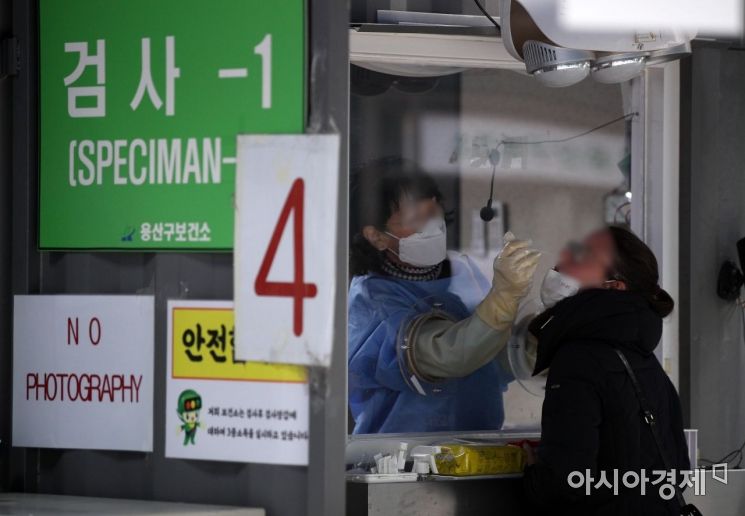
 As health authorities forecast that daily confirmed cases could reach up to 200,000 during the full-scale winter resurgence, citizens are undergoing PCR tests at the COVID-19 screening clinic in Yongsan-gu, Seoul on the 7th. The Central Disease Control Headquarters reported that as of midnight that day, confirmed cases increased by 18,671, bringing the total to 25,856,910. The Monday announcement marks the fourth consecutive week of rising trends. Photo by Kim Hyun-min kimhyun81@
[Asia Economy Reporter Kim Young-won] As the cumulative number of COVID-19 cases in South Korea surpassed 27 million, more than half of the domestic population has been confirmed positive through diagnostic testing. When accounting for the 'hidden infections' identified through antibody positivity surveys, it is estimated that two out of three citizens have been infected with COVID-19.
According to the Central Disease Control Headquarters on the 29th, as of midnight, 71,476 new COVID-19 cases were added, bringing the total cumulative cases to 27,031,319. This marks an increase of 1 million cases in 19 days since surpassing 26 million on the 10th.
With the seventh winter wave becoming apparent, the speed of increase by one million cases has accelerated. It took 29 days to rise from 25 million cumulative cases on October 12 to 26 million, but the time to add another million has shortened by 10 days. During the Omicron BA.1 wave last March, the increase of one million cases occurred within 2 to 3 days.
Even considering only the confirmed cases shown in statistics, more than half of the population is affected, but when including the 'hidden infections' who did not undergo diagnostic testing, the infection rate is expected to be higher. In the antibody positivity survey released last September, the cumulative confirmed case rate (38.15%) was 19.5 percentage points lower than the N-antibody positivity rate from natural infection (57.65%). This implies that about 19.5% of the population, approximately 10 million people, are hidden infections. Considering these roughly 10 million hidden infections, it is estimated that 37 million people (71.7% of the population) have been infected with COVID-19.
There are opinions that hidden infections are the underlying cause of the recent increase in critically ill patients and deaths. Although the increase in confirmed cases has slowed, the number of critically ill patients rose from 461 on the 22nd to 491 within a week. COVID-19 deaths are also occurring at a rate of 40 to 50 per day. Professor Baek Soon-young, emeritus at Catholic University Medical School, explained, “The numbers of critically ill patients and deaths reflect the total, including hidden infections who do not actively undergo diagnostic testing.”
According to the World Health Organization (WHO) COVID-19 dashboard, South Korea ranks 21st with 52,346 cumulative confirmed cases per 100,000 population. Among countries with populations over 1 million, it ranks 7th. The cumulative deaths, which surpassed 30,000 on the 20th, increased by 41 on this day to a total of 30,454. Of these, 24,891 deaths occurred this year. Since January 2020, 81.7% of all COVID-19 deaths have occurred in the past 11 months.
The proportion of reinfections among COVID-19 cases is also steadily increasing. During the week of the 6th to 12th, reinfection cases accounted for 10.69% of weekly confirmed cases, meaning about one in ten people were infected two or more times. The reinfection rate has risen for four consecutive weeks since the second week of October (8.64%). As of the 13th, the estimated reinfection rate among cumulative confirmed cases in South Korea is 2.62% (667,658 people). Among these, 99.68% were infected twice, and 0.32% were infected three times.
© The Asia Business Daily(www.asiae.co.kr). All rights reserved.
![Clutching a Stolen Dior Bag, Saying "I Hate Being Poor but Real"... The Grotesque Con of a "Human Knockoff" [Slate]](https://cwcontent.asiae.co.kr/asiaresize/183/2026021902243444107_1771435474.jpg)















