This Year's Ex-Dividend Date December 28
High Stock Return Validates Pre-Ex-Dividend Selling Strategy
KOSDAQ Dividend Stocks May Also Benefit from January Effect
[Asia Economy Reporter Minji Lee] As the year-end dividend season approaches, interest in dividend stocks is expanding. Although some view that the attractiveness of dividend stock investments has diminished due to rising government bond yields, approaching through high-dividend stocks or dividend growth stocks could yield returns exceeding 10% by capturing both dividend yields and stock price appreciation.
According to the Korea Exchange on the 29th, from the 1st of this month until yesterday, the KOSPI Dividend Growth 50 Index rose by 6.63%, and the KOSPI High Dividend 50 Index increased by 6.13%. Both indices outperformed the KOSPI return (5%), showing an upward trend as demand to receive dividends grew ahead of the December dividend record date. This year, the overall KOSPI dividend yield was recorded at 2.5%, while KOSPI high-dividend stocks and KOSPI dividend growth stocks are expected to achieve dividend yields in the 7% and 5% ranges, respectively. These yields are higher than the 3-year government bond yield of 3.7% as of the previous day.
When selecting dividend stocks, companies with stable dividend policies and a consistent increase in dividend yields should be targeted. However, purchasing dividend stocks does not guarantee receiving the stated dividend yield in full. Depending on the nature of the dividend stock, the timing of buying and selling should differ to maximize returns.
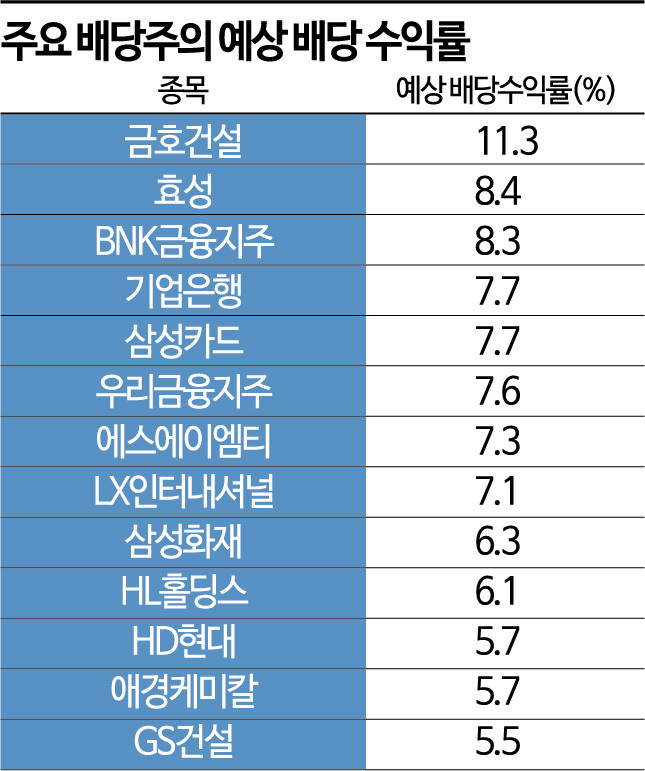
The optimal time to buy dividend stocks is before mid-December. As the dividend record date approaches, stocks with high dividend yields sometimes experience stock price increases that exceed the dividend yield. For high-dividend stocks, it is effective to sell the shares before the year-end ex-dividend date (when the right to receive dividends expires) without receiving the dividend. Most high-dividend stocks consist of banks, credit card companies, and financial holding companies. Looking at the expected dividend yields of major companies, BNK Financial Group (8.3%), Industrial Bank of Korea (7.7%), Woori Financial Group (7.6%), Korea Asset Trust (6.7%), and DB Insurance (6.6%) offer dividend yields approaching 9%.
If you have invested in high-dividend companies with solid sales growth rates, holding the stocks until early next year is a valid strategy. Although dividend stocks tend to have slow price recovery after the ex-dividend date, high-dividend stocks that performed better this year compared to last year are expected to recover quickly. Min-gyu Kim, a researcher at KB Securities, said, “Assuming investment continues until the first quarter of next year, among general high-dividend stocks that pay good dividends, those with high sales growth rates showed outstanding returns.” He added, “Major companies include holding companies such as HL Holdings (6.06%), Lotte Holdings (4.71%), and LG (3.65%).”
There is also analysis suggesting that investing in dividend stocks listed on the KOSDAQ market could benefit from the January effect next year. Jung-bin Lee, a researcher at Shinhan Financial Investment, said, “The KOSDAQ index tends to show an upward seasonal trend for one month after the ex-dividend date, supported by the January effect.” He added, “Since 2010, the average return of the KOSDAQ index after the ex-dividend date has reached 5.1%.”
Meanwhile, this year’s ex-dividend date is December 28. To receive dividends, stocks must be held until December 27. If you are listed on the year-end shareholder registry, you can expect to receive dividends in April next year.
© The Asia Business Daily(www.asiae.co.kr). All rights reserved.
![Clutching a Stolen Dior Bag, Saying "I Hate Being Poor but Real"... The Grotesque Con of a "Human Knockoff" [Slate]](https://cwcontent.asiae.co.kr/asiaresize/183/2026021902243444107_1771435474.jpg)















