 Schematic diagram of the Wakefield accelerator facility at the Argonne National Laboratory in the United States used in this demonstration experiment.
[Asia Economy Yeongnam Reporting Headquarters Reporter Hwang Duyul] A demonstration experiment of the technology necessary to commercialize the ‘next-generation accelerator’ has succeeded, bringing us one step closer to an accelerator that delivers higher performance on a smaller scale.
Professor Jeong Mose’s team from the Department of Physics at UNIST (High-Intensity Beam-Accelerator Laboratory) succeeded in demonstrating a new ‘particle beam phase space control technology’ that surpasses the limitations of existing technologies.
This demonstration experiment was conducted jointly with the Wakefield Accelerator research team at Argonne National Laboratory in the United States, and the research results were published in the prestigious physics journal Physical Review Letters.
An accelerator is a device that accelerates and supplies energy to charged particles such as electrons, protons, and ions that make up atoms.
Particles accelerated to very high speeds inside the accelerator flow in a certain direction, forming a beam. Scientists use the effects that occur when this beam collides with matter or the synchrotron radiation emitted as the beam passes through bending magnets.
The device is used to reveal physical laws of nature and structures of materials, as well as in new drug development and treatment of intractable cancers.
The next-generation accelerator must deliver much higher performance on a much smaller scale than existing accelerators.
For this, precise control technology of the beam’s phase space is essential. Currently, ‘phase space control in the transverse direction of the beam’ can be easily achieved using magnets and the technology is well established, but ‘phase space control in the beam propagation direction’ remains challenging.
Professor Jeong Mose said, “To control the phase space in the beam propagation direction, complex high-frequency systems or special vacuum structures must be used. Although such methods are known, freely controlling the beam in the shape desired by physicists has been a difficult task.”
In this study, to overcome these limitations, a ‘new concept of beam phase space control method’ was developed and successfully demonstrated.
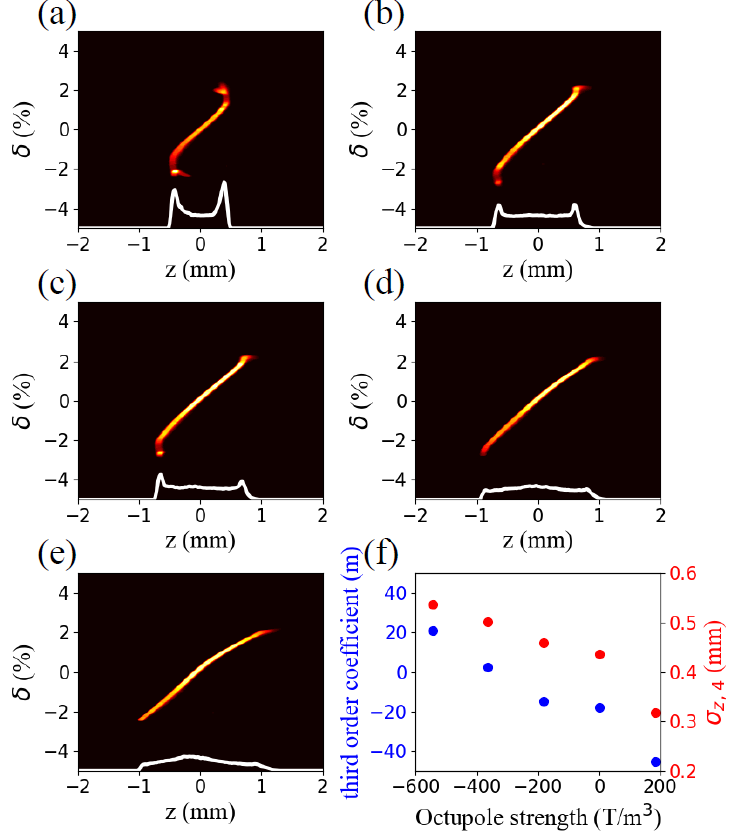 Experimental results of controlling the nonlinearity in the phase space of the beam propagation direction when changing the size of the 8-pole electromagnet.
The technology is based on ‘Emittance Exchange,’ which swaps the phase space of the beam’s transverse direction with that of the beam propagation direction.
In other words, the beam distribution in the propagation direction is first converted to the transverse direction, then its shape is controlled using magnets, and finally, it is converted back to the original beam propagation direction distribution.
Postdoctoral researcher Seok Jimin from the Pohang Accelerator Laboratory explained, “Simply put, by swapping the two directions, the beam’s shape can be freely controlled. Although this concept was proposed over ten years ago, there were several physical uncertainties and no suitable demonstration facilities, so its application to actual accelerators was delayed.”
The demonstration experiment was led by researcher Seok Jimin and Professor Ha Kwanghee from Northern Illinois University in the U.S., who built a ‘dual emittance exchange beamline’ at the Argonne Wakefield Accelerator (AWA) facility and conducted the research.
They optimized the beamline through prior simulations and analyzed various errors and limiting factors involved in the experiment. They also designed, manufactured, and installed an octupole electromagnet to control nonlinearity.
Professor Jeong Mose said, “Being able to freely control the phase space in the beam propagation direction will enable the practical use of compact next-generation accelerators. This is an important achievement that makes possible various physics research that was previously impossible.”
This research was supported by the Ministry of Science and ICT and the National Research Foundation of Korea through the Mid-Career Researcher Support Project and the Accelerator Workforce Training and Utilization Support Project (Future-Based Accelerator Professional Workforce Training Consortium).
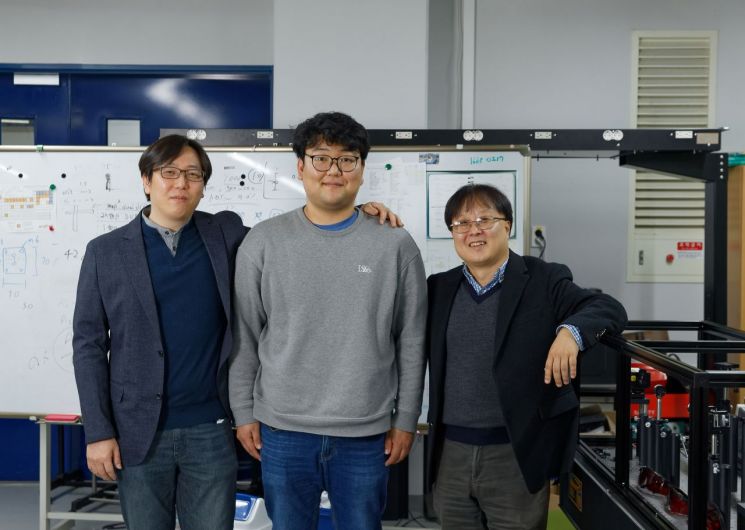 Dr. Ji-min Seok (center) of the Pohang Accelerator Laboratory, who led this research, Professor Mo-se Jeong (right) of UNIST, and Professor Kwang-hee Ha of Northern Illinois University, USA.
© The Asia Business Daily(www.asiae.co.kr). All rights reserved.
![Clutching a Stolen Dior Bag, Saying "I Hate Being Poor but Real"... The Grotesque Con of a "Human Knockoff" [Slate]](https://cwcontent.asiae.co.kr/asiaresize/183/2026021902243444107_1771435474.jpg)

















