About 2 Trillion Invested to Strengthen Defense in Indo-Pacific Region
Also Regulations on Chinese State-Owned Enterprise Investments
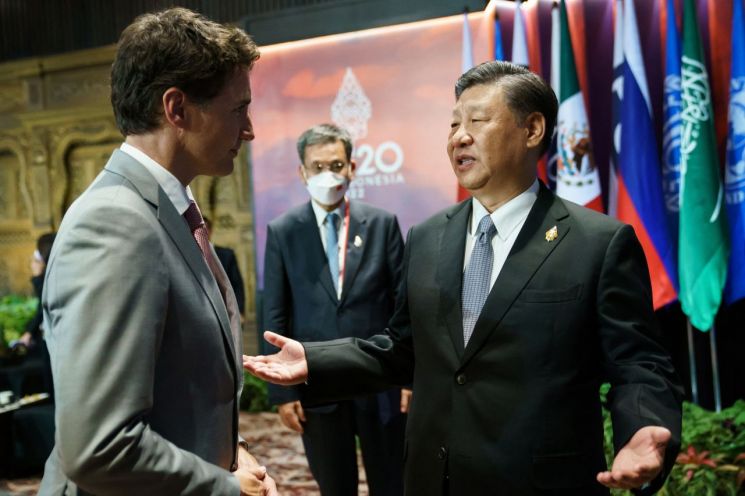
[Asia Economy Reporter Kwon Hyun-ji] On the 27th (local time), Canada announced that it will invest about 2 trillion won to strengthen defense capabilities in the Indo-Pacific region and tighten investment regulations on Chinese state-owned enterprises.
Foreign media such as Bloomberg reported that on the same day, Foreign Minister Melanie Joly announced a 26-page Indo-Pacific strategy containing these details. According to the report, Canada plans to increase naval patrol activities in the Indo-Pacific region, improve cybersecurity, and strengthen cooperation with partner countries in the East China Sea and South China Sea. To this end, it intends to spend 2.3 billion Canadian dollars (about 2.29 trillion won).
The report also includes strategies to increase trade and investment, support sustainable infrastructure funding, and strengthen international feminism support. Canada plans to amend foreign investment-related laws to protect infrastructure, resources, technology, supply chains, and intellectual property (IP). In particular, measures to prevent Chinese state-owned enterprises from securing key mineral supply chains in Canada and to protect IP are included. This aims to prevent China from encroaching on the Canadian economy.
In this regard, there is analysis that Canada has openly expressed its stance to check China. The report described China as an “increasingly destructive global power” and stated, “Our approach is based on a realistic assessment of the current China. We will confront China in areas of deep disagreement.” Foreign media reported that the report mentioned China more than 50 times, effectively targeting China.
Foreign Minister Joly also pointed out in an interview with a local media outlet, “The fundamental problem is that China currently does not respect international norms and tries to change or interpret them to its advantage.”
© The Asia Business Daily(www.asiae.co.kr). All rights reserved.