Operating the Second Largest Heavy Attack Helicopter Fleet After the US... Country Possessing 72 Units
Effective in Blocking North Korean Armored Forces and Special Forces' Maritime Infiltration
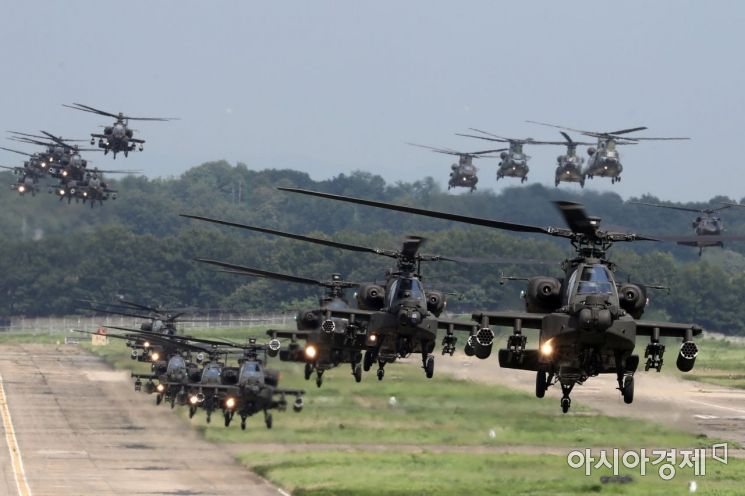 On the 25th, during a large-scale aerial operation training held at the Army Aviation Command in Icheon, Gyeonggi Province, AH-64E Apache Guardian attack helicopters, UH-60P Black Hawk, and CH-47D Chinook helicopters were hovering. Photo by Joint Press Corps
[Asia Economy Yang Nak-gyu, Military Specialist Reporter] As North Korea is known to have significantly strengthened its armored forces, our military has responded by reinforcing attack helicopters. North Korea has unveiled a new tank called the ‘Pokpung-ho,’ an upgraded version of the former Soviet T-62 tank produced since 2010, and is increasing its numbers. The military estimates that North Korea possesses more than 4,100 tanks. To counter this, our military has chosen to strengthen its attack helicopter capabilities.
Attack helicopters have traditionally been the domain of major powers. Tanks, equipped with firepower and mobility, are called the ‘princes of ground forces,’ while smaller nations counter them with inexpensive anti-tank missiles. In contrast, major powers use attack helicopters to halt tank advances.
Attack helicopters first appeared in the early 1960s. The U.S. military initially equipped Bell’s UH-1B helicopters with machine guns and rockets to escort transport helicopters during the Vietnam War. In the past, military helicopters had limited performance and could not conduct solo operations, but with advanced technology integration, they have become essential weapon systems and core forces in modern warfare.
In modern warfare, attack helicopters perform missions such as air strikes, air assaults, and air support. Air strikes involve attack helicopter units conducting solo operations to attack armored, mechanized, and fire support units. They also provide air cover for infantry during air assaults and support maneuver units from the air.
In 2013, to prevent the southward advance of North Korean armored forces and maritime infiltration by special forces, our military introduced Boeing’s Apache Guardian (AH-64E) attack helicopters. The name ‘Apache’ comes from the name of the Native American tribe. The Apache helicopter was developed in the 1980s. The AH-64E Apache Guardian is an upgraded version of the AH-64D Apache Longbow. As multiple countries, including the U.S. Army, decided to purchase and operate the upgraded AH-64E, its price decreased. So far, 14 countries including Egypt, the United Kingdom, Israel, and Japan have ordered or already introduced AH-64 Apache helicopters.
The Apache helicopter can carry up to 76 Hellfire missiles (air-to-ground guided missiles) and 2.75-inch (70mm) rockets to neutralize enemy tanks and bunkers at long range. It can also be equipped with up to 1,200 rounds of 30mm cannon ammunition capable of penetrating thick armor. The maximum range of the Hellfire missile is 8 to 10 km. Using a fire-and-forget system, the Apache can launch missiles and immediately exit the area. It can also carry Stinger air-to-air guided missiles to intercept enemy helicopters and fighter jets.
The Apache attack helicopter has a distinctive feature: the Longbow Radar, a dish-shaped radar mounted above the main rotor. Equipped with this radar, the Apache can detect 1,000 ground and air targets within an 8 km radius, track 256 of them, and simultaneously attack 16 targets identified as the highest threats. The target information detected by this radar can be shared in real-time with other Apache helicopters without Longbow Radar. This means that a single Apache Guardian armed only with Hellfire missiles can wait in the air behind a mountain ridge with its Longbow Radar deployed, detect enemy tanks, ascend the mountain, and destroy up to 16 tanks by firing missiles.
Its defense capabilities are also excellent. It has armor protection against 14.5mm anti-aircraft guns and internal armor capable of withstanding 23mm anti-aircraft rounds or shell impacts. Its maximum speed is 293 km/h, maximum range is 483 km, it has a crew of two, and a maximum takeoff weight of 10 tons. The engine output is outstanding, allowing rapid and agile maneuvering.
Last April, our military decided to invest approximately 3.17 trillion won by 2028 to procure an additional 36 Apache helicopters. Once these 36 are added, a total of 72 Apache helicopters will be operated across four battalions. This will make it the second strongest large-scale attack helicopter force after the United States. Including the 48 helicopters of the U.S. Forces Korea, a total of 120 Apache helicopters will be active on the Korean Peninsula. In the event of conflict, they will be deployed to destroy over 1,000 North Korean tanks such as the Seon-gun-ho and Pokpung-ho, as well as approximately 70 air-cushioned landing crafts.
© The Asia Business Daily(www.asiae.co.kr). All rights reserved.
![Clutching a Stolen Dior Bag, Saying "I Hate Being Poor but Real"... The Grotesque Con of a "Human Knockoff" [Slate]](https://cwcontent.asiae.co.kr/asiaresize/183/2026021902243444107_1771435474.jpg)















