Slight Fluctuations in Democratic Party Approval Ratings Across Various Polls
① President Yoon's Low Approval Brings Spillover Benefits
② Consolidation of Democratic Party Supporters
③ Public Support for Itaewon Disaster National Inquiry
④ Rising Distrust in Prosecutorial Investigations
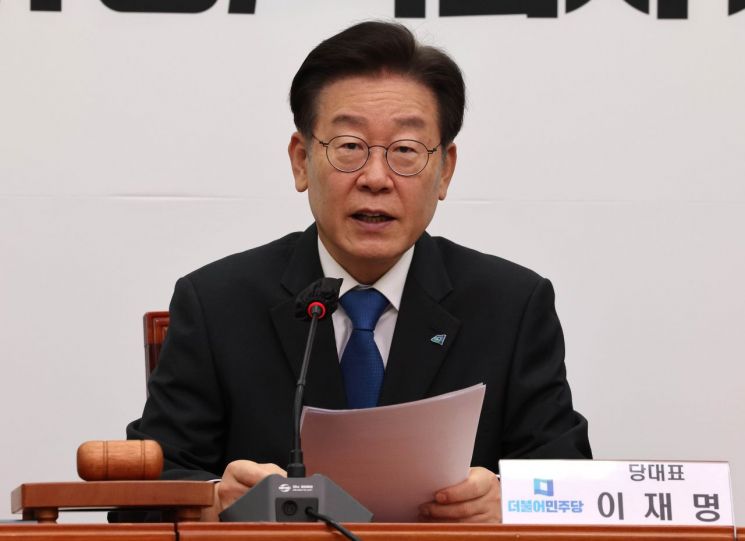
[Asia Economy Reporter Naju-seok] Despite the judicial risks faced by Lee Jae-myung, leader of the Democratic Party of Korea, ongoing prosecution investigations into party lawmakers, and various controversies, the Democratic Party's approval ratings are either rising or only slightly declining. Analysts suggest that the so-called "approval rating effect" plays a significant role in dispelling expectations that the party would show signs of division due to Lee's judicial risks.
According to a public opinion poll released on the 25th by Media Tomato (commissioned by News Tomato, conducted from the 21st to the 23rd over three days via wireless ARS method targeting 1,073 adults nationwide aged 18 and over), the Democratic Party's support increased by 2.2 percentage points from the previous week to 51.3%. The People Power Party fell by 4.4 percentage points to 31.7%.
In another poll commissioned by Polling Fairness and conducted by Dailyan from the 21st to 22nd over two days using wireless ARS targeting 1,004 adults nationwide aged 18 and over, the Democratic Party's approval rating rose by 4.8 percentage points compared to the survey two weeks prior. The People Power Party dropped by 8.2 percentage points.
According to Gallup's regular survey (conducted from the 22nd to 24th nationwide with 1,002 adults aged 18 and over via telephone interviewer interviews), the Democratic Party's approval rating decreased by 1 percentage point from the previous week to 33%. The People Power Party remained steady at 32%, the same as the previous week's result.
Considering the realization of judicial risks against Lee and the increasingly clear prosecution investigations into Democratic Party lawmakers, the Democratic Party's approval ratings are holding up well. Typically, during a crisis, a party's approval rating plummets, and if internal divisions become visible, the approval rating falls further, creating a vicious cycle. However, this time, despite the crisis, the approval ratings have not entered a steep decline phase.
Several factors can be cited for the Democratic Party's resilience in approval ratings. First is the reflection effect from President Yoon Seok-youl's low approval ratings.
Although there are differences in specific questions and survey methods, President Yoon's approval ratings in the Media Tomato and Gallup polls released on the 25th were 29.9% and 30%, respectively.
In most regularly conducted polls, President Yoon's approval rating has shown a downward trend since the local elections, fluctuating between the high 20s and low 30s percentage points. Given the unusually low approval rating for a first-year president, it can be seen that the Democratic Party has benefited from this reflection effect.
Another factor is the possibility of consolidation among the party's support base. In crisis situations such as prosecution investigations, the support base may rally. In fact, political circles have analyzed that the ARS automated response method in polls tends to reflect the opinions of politically highly engaged groups more strongly, whereas interview methods show less of this tendency. Coincidentally, many of the polls showing an increase in Democratic Party support used the ARS method, suggesting that the effect of support base consolidation may be reflected.
However, it is difficult to say that the Democratic Party's approval ratings are holding up solely due to the reflection effect despite a series of adverse factors. Therefore, it is possible that the party has attracted support from moderate voters during the handling of various issues.
For example, after the Itaewon tragedy, the opposition party's active demand for a thorough investigation gained public support. According to the National Barometer Survey (NBS), jointly conducted by four agencies?Embrain Public, K-Stat Research, Korea Research, and Hankook Research?from the 14th to 16th via telephone interviews targeting 1,007 adults aged 18 and over nationwide, 55% agreed that a national investigation into the Itaewon tragedy is necessary, while 41% felt it unnecessary as the police are already investigating. This supports the Democratic Party's calls for a national investigation.
Additionally, a lack of trust in the prosecution appears to play a certain role. According to the Media Tomato poll released on the 25th, when asked whom they trust more between Lee Jae-myung, who completely denies the prosecution's claim that part of the private development profits from Daejang-dong was used for Lee's presidential primary campaign funds, and the prosecution, 48.3% trusted Lee more, 39.8% trusted the prosecution more, and 11.8% were unsure. Except for those aged 60 and over (where 49.7% trusted the prosecution and 37.6% trusted Lee), trust in the prosecution was lower than trust in Lee. Notably, among those in their 40s, 62.2% trusted Lee, significantly outpacing the 29.4% who trusted the prosecution.
A Democratic Party official stated, "In the past, voices of division emerged when the party's approval ratings declined and concerns about upcoming elections grew," adding, "As long as the approval ratings hold, the party's unity will be maintained."
For detailed survey outlines and results related to the polls, please refer to the Central Election Poll Deliberation Commission website.
© The Asia Business Daily(www.asiae.co.kr). All rights reserved.

















