Korean Society of Digital Therapeutics Autumn Conference
Rowan and NewLive Present Tinnitus DTx 'SoriClear'
Share & Service Introduce COPD DTx 'EasyBreathe'
Metaverse VR and Biological Rhythm-Based
Anxiety and Mood Disorder DTx Also Showcased
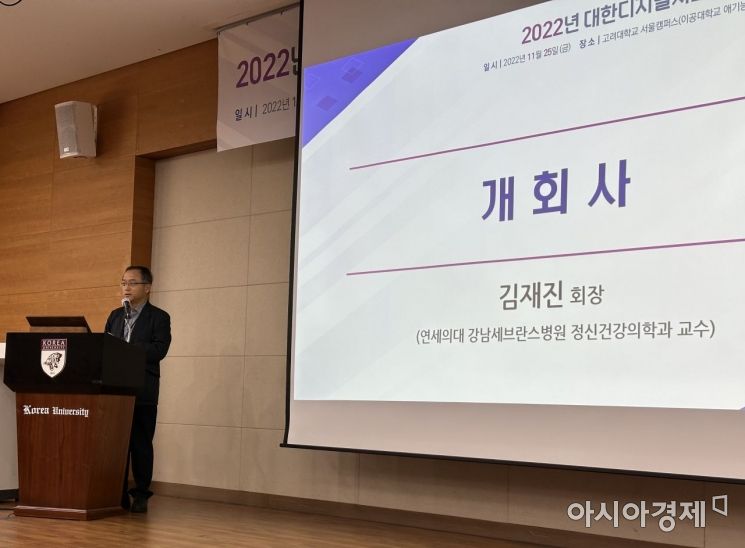 On the 25th, at Korea University Hana Square in Seongbuk-gu, Seoul, Kim Jae-jin, President of the Korean Digital Therapeutics Society (Professor of Psychiatry at Gangnam Severance Hospital), delivered the opening remarks at the "2022 Korean Digital Therapeutics Society Autumn Academic Conference." Photo by Lee Chun-hee
[Asia Economy Reporter Chunhee Lee] Although the first domestic 'digital therapeutic (DTx)' is expected to be launched soon, there are concerns that a supporting DTx ecosystem has yet to be established. Most pipelines are concentrated in central nervous system (CNS) disorders such as mental illnesses and anxiety disorders, highlighting the need for diverse pipelines to build a vibrant ecosystem.
At the '2022 Korean Digital Therapeutics Society Autumn Academic Conference' held on the 25th at Korea University Hanah Square in Seongbuk-gu, Seoul, various development attempts for pipelines including tinnitus and respiratory diseases were showcased, reflecting these concerns.
Tinnitus with No Suitable Treatment... Personalized Therapy Possible with DTx
Kang Sung-min, CEO of Rowan, which is developing the mild cognitive impairment (MCI) treatment DTx 'SuperBrain,' introduced 'SoriClear,' a tinnitus treatment DTx developed in partnership with NewLive. He explained, "Tinnitus is a common condition with 300,000 patients receiving treatment annually and a prevalence rate of 20%. Despite not being a mild condition that causes depression or extreme thoughts, 82% of patients are dissatisfied with current treatments, and medical institutions are seeking new therapeutic methods." This diagnosis stems from the fact that no tinnitus treatment drugs have been approved by the U.S. Food and Drug Administration (FDA), existing tinnitus retraining therapy is non-reimbursable, and cognitive behavioral therapy (CBT) requires a long time, presenting various limitations.
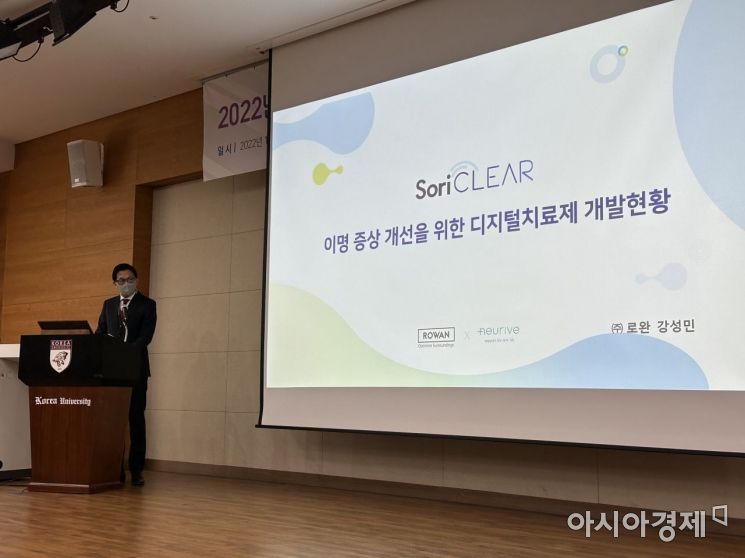 On the 25th, Kang Sung-min, CEO of Rowan, is giving a presentation at the '2022 Korean Digital Therapeutics Society Autumn Conference' held at Korea University Hana Square in Seongbuk-gu, Seoul. / Photo by Lee Chun-hee
Regarding the necessity of SoriClear, CEO Kang said, "Since effective tinnitus retraining and CBT need to be applied, we designed it so that personalized CBT can be conducted alone at home." SoriClear performs therapeutic functions through directive counseling, sound therapy, audio-video content, and interactive animations. He cited sound therapy as a representative example of personalized treatment. Kang added, "The frequency of tinnitus varies by patient. The patient's unique data is already stored within the app, and the goal is to enable treatment reflecting this data to be received daily at home rather than in a hospital."
CEO Kang also mentioned concerns about usability for the elderly, whose digital literacy tends to be low, as aging is one of the main causes of tinnitus. In response to questions about elderly usability, he said, "Although we tried to make it easy, many find it difficult," and added, "We have received feedback regarding the speed of the DTx and terminology commonly used by younger users, and we plan to make improvements accordingly."
Respiratory Diseases Also Addressed by DTx... Can Solve Weaknesses in Monitoring and Existing Treatments
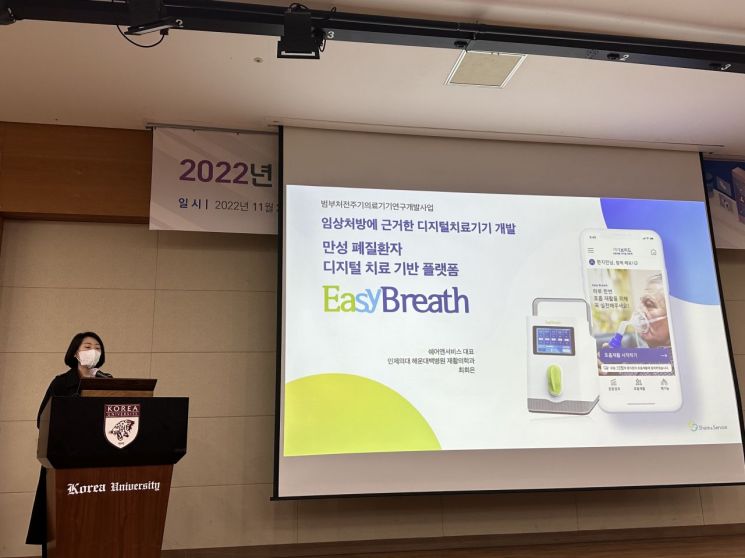 On the 25th, Choi Hee-eun, CEO of Share & Service, is giving a presentation at the '2022 Autumn Academic Conference of the Korean Digital Therapeutics Society' held at Korea University Hana Square in Seongbuk-gu, Seoul.
 Photo by Lee Chun-hee
Choi Hee-eun, CEO of Share & Service, is preparing the DTx 'EasyBreathe' for chronic obstructive pulmonary disease (COPD) patients. She explained, "The socioeconomic cost per COPD patient is 7.47 million KRW, which is 10 times that of hypertension and 5 times that of diabetes. Despite respiratory rehabilitation therapy being covered by health insurance, many people are unaware of it, and treatment is not well administered."
CEO Choi emphasized that the weaknesses of current respiratory rehabilitation therapy can be effectively addressed through DTx. She said, "The problem with respiratory rehabilitation therapy is the lack of individualized treatment and poor monitoring. From a DTx perspective, these issues can be very advantageously resolved."
She added, "We received approval for the investigational new drug (IND) clinical trial plan from the Ministry of Food and Drug Safety yesterday (the 24th)." Given that many patients are in their 50s and 60s, she is deeply considering how to maximize suitability for DTx users. For example, she mentioned efforts to enlarge text and make screen transitions easier.
Main Pipelines in Mental Disorders... Diversification through 'Metaverse' and 'Digital Phenotyping'
New approaches to anxiety disorders, depression, and other major DTx areas were also presented at the conference. Since most current DTx are limited to meditation, CBT-based approaches, coaching, and education delivered via apps or web, various development attempts using different approaches were introduced.
Professor Cho Cheol-hyun of Korea University Anam Hospital's Department of Psychiatry is developing a metaverse DTx for anxiety symptoms that integrates psychiatry and art. He explained, "Despite the rapid increase in people suffering from anxiety disorders socially, many avoid psychiatric treatment. We saw the need for metaverse-based digital therapy targeting 'subclinical anxiety symptom groups' and 'high-risk anxiety disorder groups' who either have not yet visited or do not need to visit hospitals."
Professor Cho plans to utilize the metaverse by providing VR videos that recreate panic disorder and social avoidance situations at varying difficulty levels, enabling stepwise training for situational awareness and coping. For social anxiety disorder, training will cover situations such as self-introduction, assertiveness, and interviews, allowing application to various anxiety disorders.
His ultimate goal is to enable real-time monitoring and intervention. A prototype is targeted for development in 2024. He stated, "We aim to use digital phenotyping to predict panic attack timings and help manage anxiety in daily life."
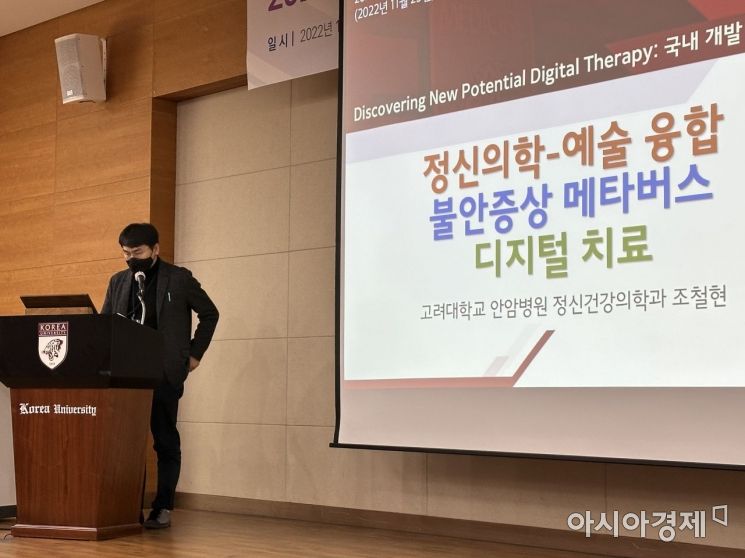 On the 25th, at Korea University Hana Square in Seongbuk-gu, Seoul, Professor Cho Cheol-hyun from the Department of Psychiatry at Korea University Anam Hospital is presenting at the "2022 Autumn Academic Conference of the Korean Digital Therapeutics Society." / Photo by Lee Chun-hee
Professor Lee Heon-jung of Korea University Anam Hospital's Department of Psychiatry (CEO of Husercadian) proposed a mood disorder DTx that actively utilizes digital phenotyping based on biological rhythms. He explained, "Using digital phenotyping from smartphones, smartwatches, tablets, etc., various changes can be objectively measured in real time. This allows detection of physiological and behavioral changes before individuals recognize or report them."
Professor Lee regards circadian rhythm as an important digital phenotype. Based on research findings that biological rhythms typically dip at dawn and become more active during the day, but differ significantly in patients with depression and bipolar disorder, he conceived the idea of developing 'CRM (Circadian Rhythm for Mood).' Using ICT technologies to collect activity levels, sleep status, and other digital phenotypes, the system monitors biological rhythms and issues warnings if conditions deteriorate. A clinical trial involving 96 participants is currently underway.
© The Asia Business Daily(www.asiae.co.kr). All rights reserved.
![Clutching a Stolen Dior Bag, Saying "I Hate Being Poor but Real"... The Grotesque Con of a "Human Knockoff" [Slate]](https://cwcontent.asiae.co.kr/asiaresize/183/2026021902243444107_1771435474.jpg)

















