Three Statements This Week... Building Justification for Provocation
Focus on 29th, 5th Anniversary of 'Completion of Nuclear Force' Declaration
Possibility of Additional ICBM Launch or 7th Nuclear Test
"Expectations for Shift to Dialogue Phase After Year-End"
[Asia Economy Reporter Jang Hee-jun] North Korea has raised the level of threats through three consecutive statements this week, following the launch of an intercontinental ballistic missile (ICBM) on the 18th. In particular, Kim Yo-jong, the Deputy Director of the Workers' Party who appeared for the first time in three months, directly targeted the United Nations Security Council and criticized the government's North Korea sanctions policy, even making harsh remarks toward President Yoon Suk-yeol.
Despite the recent strengthening of security cooperation among South Korea, the U.S., and Japan, North Korea proceeded with provocations without concern. Since it has maintained a pattern of 'statement first, provocation later,' there is speculation that this series of statements is building justification for high-intensity military demonstrations. Experts analyze that the 29th, the day North Korea declared the 'completion of nuclear force' five years ago, will be a turning point for a nuclear test within the year.
Experts: "North Korea's Nuclear Test, 29th Will Be a Crucial D-Day"
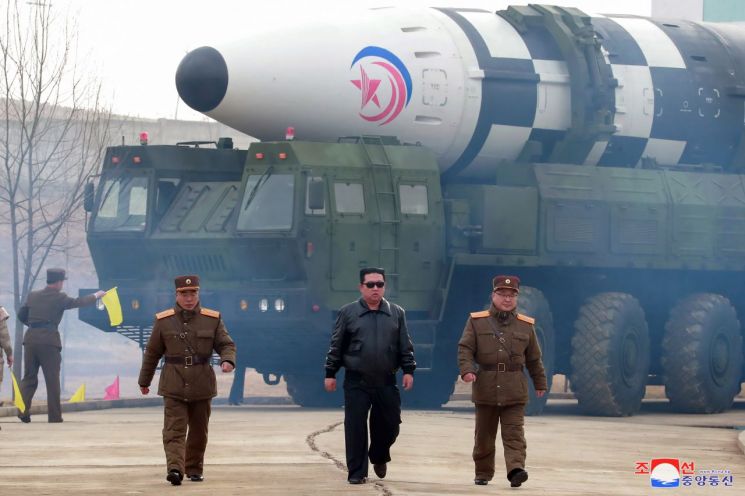 Kim Jong-un, General Secretary of the Workers' Party of Korea, walking in front of the new intercontinental ballistic missile (ICBM) 'Hwasong-17' [Image source=Yonhap News]
On the 26th, Moon Sung-mook, Director of the Unification Strategy Center at the Korea Institute for National Strategy, said in a phone interview with Asia Economy, "After Kim Jong-un launched the ICBM, he mentioned both domestically and internationally that 'we will clearly show our will for ultra-hard retaliation. We will respond to nuclear weapons with nuclear weapons, and to direct confrontation with direct confrontation.' This seems to imply additional ICBM launches or nuclear tests," adding, "All possibilities remain open in the near term, either on the 29th or by the end of the year."
With Kim Yo-jong, the younger sister of the supreme leader and Deputy Director of the Workers' Party, stepping forward, the prospect that North Korea will again engage in military provocations gains strength. Experts see a sufficient possibility of additional ICBM launches at normal trajectories or conducting a seventh nuclear test. Notably, the 29th pointed out by Director Moon marks the fifth anniversary of North Korea's declaration of 'completion of nuclear force' after the sixth nuclear test and ICBM launches in 2017.
Considering recent patterns of provocations and North Korea's precedent of observing political anniversaries every five or ten years, the 29th is evaluated as an appropriate time for 'North Korea's performance.' Earlier this month, Unification Minister Kwon Young-se also mentioned the possibility of North Korea conducting a nuclear test around this time during a plenary session of the National Assembly's Foreign Affairs and Unification Committee, based on 'expert opinions.'
Yang Moo-jin, President of the Graduate School of North Korean Studies, said, "Kim Yo-jong's statement emphasizes 'ultra-hard response,'" and analyzed, "Given that military actions have accelerated after recent North Korean statements, the 29th, marking the fifth anniversary of the declaration of 'completion of nuclear force,' is expected to be an important D-day." He added, "In particular, the ultra-hard response is expected to be an additional ICBM launch at a normal trajectory (not a high-angle launch) or a seventh nuclear test," and elaborated, "In the case of a nuclear test, considering China's position, the process will likely proceed through a Political Bureau Standing Committee decision, Kim Jong-un's signature, and then the nuclear test."
'China Ignoring 'Constructive Role'... Could Increase Misjudgment Risk'
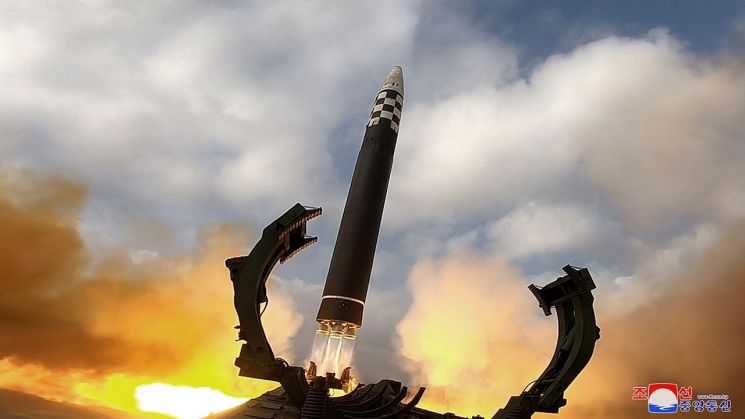 Kim Jong-un, General Secretary of the Workers' Party of North Korea, directed the test launch of the new intercontinental ballistic missile (ICBM) 'Hwasong-17' on the 18th, the party's official newspaper Rodong Sinmun reported on the 19th.
 [Image source=Yonhap News]
Concerns have also been raised that China's lukewarm attitude in this context could encourage North Korea's misjudgment. Although China was urged to play a 'constructive role' regarding North Korea's nuclear and missile threats through recent diplomacy between the South Korean and U.S. leaders, it has shown no significant change in stance.
On the contrary, at the United Nations Security Council open meeting on the 21st (local time), China again blamed the U.S. for North Korea's provocations and was uncooperative regarding sanction resolutions. Then, at the 9th ASEAN Defense Ministers' Meeting-Plus (ADMM-Plus) on the 23rd, Chinese Defense Minister Wei Fenghe, who met with South Korean Defense Minister Lee Jong-sup, reiterated the temperature gap by saying, "Efforts should be made to resolve issues through dialogue among the parties involved."
Professor Park Won-gon of Ewha Womans University’s Department of North Korean Studies said, "China has already supported North Korea's 'legitimate security' during the U.S.-China summit and shifted the blame for military tensions on the Korean Peninsula to China. North Korea launched an ICBM right after that summit," adding, "Given that there has been no response since, it seems China's position has long been settled (on North Korea's side)."
Regarding the change in stance of China and Russia, who did not oppose sanction resolutions during the sixth nuclear test, he pointed out, "The biggest issues are the intensified U.S.-China hegemony conflict since the second half of 2018 and Russia's invasion of Ukraine," and said, "In the future, China and Russia are unlikely to raise issues about North Korea's provocations. The problem is that North Korea is very well aware of this."
"Nuclear Test, No Gains"... If Passed Year-End, Dialogue Phase?
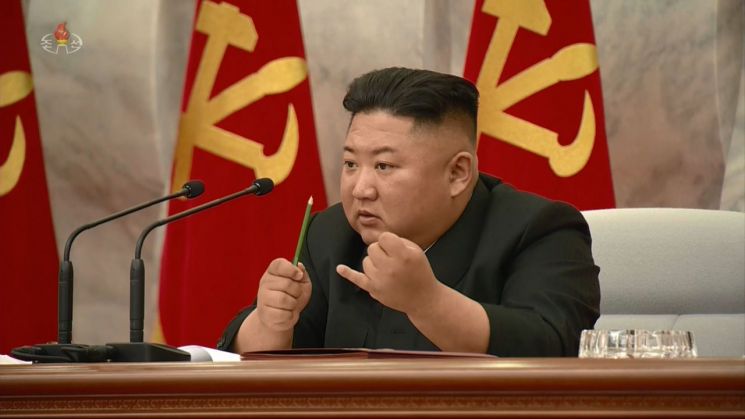
However, some view the possibility of a nuclear test itself as low. With international attention focused on Russia's invasion of Ukraine and the extended deterrence capabilities of South Korea, the U.S., and Japan strengthened, the backlash North Korea would have to endure outweighs what it could gain from a nuclear test. North Korea's goal is known to be recognized as a 'nuclear-armed state' and to negotiate directly with the U.S.
Kim Yong-hyun, Professor of North Korean Studies at Dongguk University, said, "The possibility of provocations, including intermittent missile launches, will always exist," but added, "However, a nuclear test is never a simple matter even from North Korea's perspective." He continued, "Technically, a nuclear test might be necessary, but from a diplomatic or political judgment standpoint, conducting a nuclear test right now offers no gains for North Korea," and analyzed, "North Korea would carry out a nuclear test based on U.S. movements in a very desperate situation, but currently, the U.S. does not have the capacity to pay much attention to the Korean Peninsula (due to issues like Ukraine and Taiwan)."
Meanwhile, within and outside security circles, there is also hope that if North Korea refrains from major provocations beyond the 29th, military tensions surrounding the Korean Peninsula could ease. Considering the usual schedule where efforts focus on producing results toward the end of the year and on consolidating the regime including preparing the New Year's address from early next year, there is speculation that North Korea might attempt to shift to a dialogue phase early next year.
© The Asia Business Daily(www.asiae.co.kr). All rights reserved.
![Clutching a Stolen Dior Bag, Saying "I Hate Being Poor but Real"... The Grotesque Con of a "Human Knockoff" [Slate]](https://cwcontent.asiae.co.kr/asiaresize/183/2026021902243444107_1771435474.jpg)

















