KISTI Report
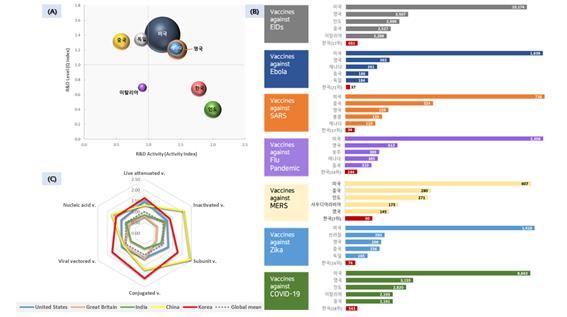 (A) Quality Index and Activity Index of New Infectious Disease Vaccine-Related Papers in Major Countries
 (B) National Research Status on Six New Infectious Disease Response Vaccines
(C) Relative Activity Index of Major Countries on New Infectious Disease Response Vaccine Platforms
(D) Knowledge Map Showing Research Fields of New Infectious Disease Response Vaccine-Related Papers by Country (Case of Korea)
(E) Research and Development Landscape of New Infectious Disease Response Vaccines
[Asia Economy Reporter Kim Bong-su] It has been revealed that South Korea is significantly lagging behind not only the United States but also India and China in research on vaccines for COVID-19 and other emerging infectious diseases.
The Korea Institute of Science and Technology Information (KISTI) announced on the 25th that it had published a "Data-Based Analytical Study for the Development of Vaccines to Combat Emerging and Mutant Infectious Diseases" containing these findings.
KISTI analyzed global research and investment trends on six notable emerging infectious diseases (COVID-19, Ebola, SARS, novel influenza, MERS, Zika) vaccines based on approximately 750,000 academic publications and 70,000 research funding data related to emerging infectious diseases and pathogens that pose significant threats to modern humanity, including COVID-19.
In particular, through analysis of Google Trends search volumes and academic literature data, a close correlation was confirmed between the timing of infectious disease outbreaks and vaccine research and development activities responding to them. It was also found that manufacturing technologies for emerging infectious disease vaccines are becoming more diversified and advanced, such as the mRNA vaccine platform, compared to conventional vaccines.
South Korea’s level of research on emerging infectious disease vaccines ranked 16th to 17th globally, indicating a need to strengthen global research competitiveness. It was found to be at the 16th to 17th level worldwide, lagging behind countries with active research activities such as the United States, the United Kingdom, India, and China. Based on the number of vaccine-related papers, Korea ranked 17th, and in vaccine platform technology competitiveness, 16th. Research on subunit (recombinant protein) vaccines, immunodiagnostics, natural products or artificial intelligence applications, and quarantine technologies was relatively active, but follow-up responsive research stood out. The qualitative outcomes of research and development competitiveness, as indicated by paper quality indices, were generally low.
Korea was also analyzed to have an absolute shortage of research funding support for emerging infectious disease vaccines, highlighting the need for systematic investment and policy support based on selection and concentration. An analysis of the global funding status for emerging infectious disease vaccine research showed that funding for COVID-19 accounted for nearly half with 2,372 cases. In terms of funding amounts, $8 billion accounted for 70%, demonstrating that COVID-19 was the largest global health issue and that research funds were concentrated on overcoming it. Both the number of projects and funding were highest in the United States and the United Kingdom, with advanced science and technology countries such as Canada, Germany, and Japan also showing high levels of research support. Funding support for vaccine research showed different characteristics and variations depending on the country or institution and the infectious disease outbreak country and target disease. Vaccine research support activities were active at U.S. institutions such as the National Institutes of Health (NIH), the National Institute of Allergy and Infectious Diseases (NIAID), and the National Library of Medicine (NLM). Outside the European Union, vaccine research support was also active from government departments and research institutions in Germany, the United Kingdom, Canada, and Japan. In particular, in COVID-19 and novel influenza vaccine research, large charitable donations and research support foundations such as the Bill & Melinda Gates Foundation (U.S.) and the Wellcome Trust (U.K.) were also found to provide substantial support.
Son Eun-su, lead researcher at KISTI’s Global R&D Analysis Center, said, “We attempted to analyze trends in emerging infectious disease vaccine development based on global academic literature and funding data,” adding, “Considering the importance of quarantine technologies for emerging infectious diseases that pose enormous threats to humanity, it is necessary to further strengthen South Korea’s research and development competitiveness.”
He also stated, “South Korea is a country that possesses both COVID-19 vaccines and therapeutics domestically, and by leveraging its technological strengths and potential, it can secure competitiveness in emerging infectious disease vaccine development. For this, systematic investment and policy support for vaccine research and development are urgently needed.”
© The Asia Business Daily(www.asiae.co.kr). All rights reserved.
![Clutching a Stolen Dior Bag, Saying "I Hate Being Poor but Real"... The Grotesque Con of a "Human Knockoff" [Slate]](https://cwcontent.asiae.co.kr/asiaresize/183/2026021902243444107_1771435474.jpg)















