The Bank of Korea, KDI Forecast South Korea's Growth Rate in the 1% Range for Next Year
Export Slowdown and Real Income Decline... Low Growth Inevitable
Uncertainties Remain High Next Year Due to War, Oil Prices, and Inflation
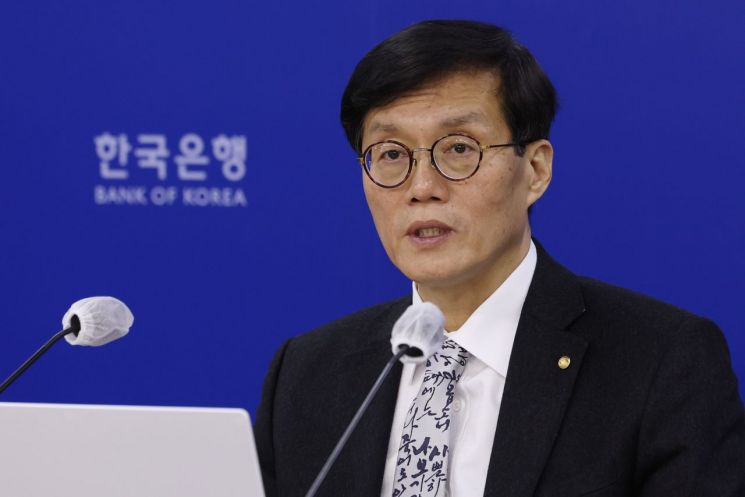 Lee Chang-yong, Governor of the Bank of Korea, is holding a press conference after the Monetary Policy Committee's plenary meeting held at the Bank of Korea in Jung-gu, Seoul on the 24th. [Image source=Yonhap News]
South Korea's economic growth rate is expected to drop significantly to the '1% range' next year. This is the result of a combination of factors including the base interest rate hikes that began in August last year, a decrease in real income due to rising prices, and economic slowdowns in the United States, China, and Europe. The Bank of Korea and the government expect the economy to recover after the second half of next year, but concerns remain that the recovery may be difficult to guarantee due to uncertainties such as the Russia-Ukraine war and international oil prices.
According to the Bank of Korea and research institutions on the 26th, South Korea's economy is likely to grow in the 1% range next year. On the 24th, the Bank of Korea significantly lowered its economic growth forecast for next year from 2.1% to 1.7% in its revised economic outlook. Previously, the Korea Development Institute (KDI) and the Organisation for Economic Co-operation and Development (OECD) projected South Korea's growth rate at 1.8% for next year, and other institutions such as the international credit rating agency Fitch (1.9%) and the Korea Institute of Finance (1.7%) also mostly expected growth in the 1% range.
The 1.7% growth rate presented by the Bank of Korea is an exceptionally low figure, rarely recorded except during major crises such as the COVID-19 pandemic, the global financial crisis, or the International Monetary Fund (IMF) foreign exchange crisis. However, this is only a median value, and there is a possibility of further downward revision. Lee Chang-yong, Governor of the Bank of Korea, said at a press conference following the monetary policy direction meeting, "1.7% corresponds roughly to the median among various global forecasts. It is not particularly high or low."
Looking at the growth rate in detail, the Bank of Korea expects 1.3% growth in the first half of next year and 2.1% growth in the second half. Accordingly, the GDP gap, which compares potential growth rate and real growth rate, is inevitably expected to turn negative next year. Kim Woong, Director of the Bank of Korea's Research Department, explained at a briefing on the 24th, "The GDP gap will be negative in the first half of next year, move toward balance in the second half, and turn slightly positive in 2024."
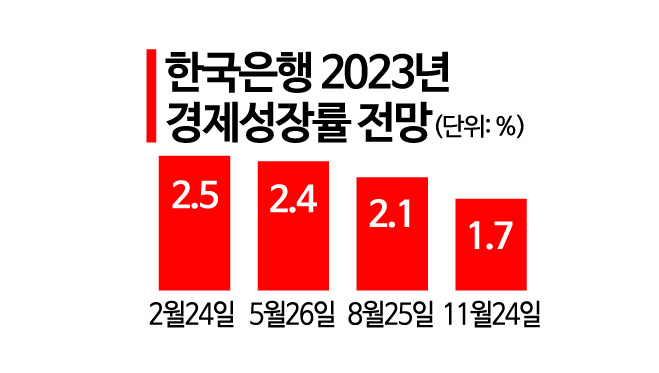
The weakening growth trend is mainly due to continued interest rate hikes and a slowdown in private consumption, facility investment, construction investment, and exports caused by the semiconductor market slump. Private consumption is showing an increase due to a rebound effect after the COVID-19 recovery, but downside risks are significant due to decreases in real income and asset price declines. Additionally, facility investment and construction investment are expected to shrink significantly next year due to interest rate hikes. Merchandise exports are also likely to weaken as global import demand, centered on China and IT products, declines.
In particular, the current account surplus forecast for next year has been sharply reduced from $34 billion predicted in August to $28 billion. This is because the service account is expected to record a $20 billion deficit due to increased overseas travel and a decrease in Chinese tourists, while the goods account is analyzed to shrink to $36.3 billion due to rising raw material prices.
The Bank of Korea expects economic growth to recover after the second half of next year. Director Kim said, "From the second half of next year, external uncertainties are expected to ease somewhat, and the IT sector including semiconductors is expected to improve. Since China's zero-COVID policy is also expected to be relaxed, the current account balance is expected to improve going forward." The Bank of Korea forecast merchandise exports to dip by -3.7% in the first half of next year before rising by 4.9% in the second half.
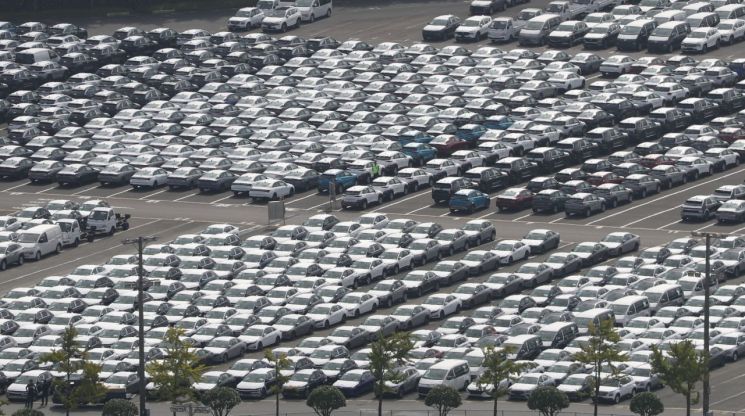 Finished vehicles are waiting in the storage yard next to the export shipment dock at Hyundai Motor Company's Ulsan plant. [Image source=Yonhap News]
However, concerns remain that it is difficult to be optimistic due to persistent uncertainties in the market. If international oil prices remain in the $90 range as assumed by the Bank of Korea and China's zero-COVID policy is relaxed after March next year, the recession could be limited. Otherwise, the forecast will likely have to be significantly revised downward again, as it was this year. In particular, inflationary pressures such as electricity and gas price hikes will persist next year, making contraction in consumption and investment inevitable.
Lee Jung-ik, head of the Bank of Korea's Price Trends Team, said, "Electricity and gas prices are decided almost at the last moment, taking into account international raw material prices and economic conditions at that time, and sometimes non-economic factors as well. The increase itself is inevitable, but there is great uncertainty about the extent of the increase." Lee Hwan-seok, Deputy Governor of the Bank of Korea, also said about international oil prices, "If prices fall lower than we expected, consumer price inflation will decrease, but if prices rise higher than expected, inflation will inevitably be higher."
© The Asia Business Daily(www.asiae.co.kr). All rights reserved.
![Clutching a Stolen Dior Bag, Saying "I Hate Being Poor but Real"... The Grotesque Con of a "Human Knockoff" [Slate]](https://cwcontent.asiae.co.kr/asiaresize/183/2026021902243444107_1771435474.jpg)

















