Anwar Inaugurated as New Prime Minister on 24th
Hope Alliance Forms Coalition with National Front
Challenges Including Weak Support Base Remain
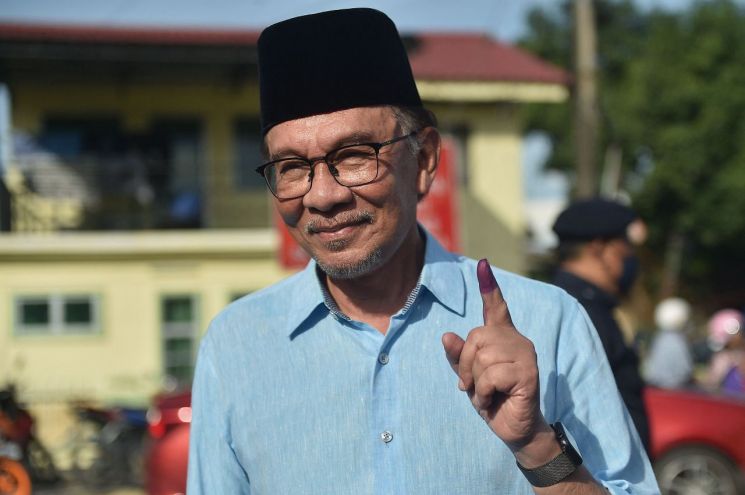 On the 24th (local time), Abdullah, the King of Malaysia, appointed former Deputy Prime Minister Anwar Ibrahim as the new Prime Minister. [Image source=Yonhap News]
[Asia Economy Reporter Lee Ji-eun] The political turmoil in Malaysia that persisted after the general election has come to an end with the nomination of former Deputy Prime Minister Anwar Ibrahim as the new Prime Minister. However, since the leading party, Pakatan Harapan (PH), failed to secure a majority of seats in this election, Anwar now faces the challenge of pursuing reforms on an unstable support base.
Major foreign media outlets such as Bloomberg reported on the 24th (local time) that Malaysia's King Abdullah held a meeting with the top leaders of each state and announced former Deputy Prime Minister Anwar as the 10th Prime Minister.
On the same day, Deputy Prime Minister Anwar received his appointment letter from King Abdullah and took the oath of office. He stated, "The winner of this election has not won in every aspect, and the loser has not lost everything," and added, "I ask for your cooperation for our beloved homeland" as his inaugural remarks.
Pakatan Harapan (PH), led by Deputy Prime Minister Anwar, secured the largest number of seats with 83 out of 220 in the lower house but failed to achieve a majority, placing them in a position where they must form a coalition government. Initially, there was speculation that the United Malays National Organisation (UMNO)-based Barisan Nasional (BN) and Perikatan Nasional (PN) might form an alliance, which raised doubts about Anwar's ability to become Prime Minister. However, against expectations, Barisan Nasional (BN) chose to cooperate with Pakatan Harapan (PH), enabling Anwar to assume the premiership.
Nevertheless, given the weak support base of the administration, Deputy Prime Minister Anwar faces the task of securing political stability while pursuing reforms. Barisan Nasional (BN), which is forming a coalition government with Pakatan Harapan (PH), is a conservative force that has long ruled Malaysia from independence in 1957 through the 14th general election. In contrast, Pakatan Harapan (PH) is a reform-oriented opposition coalition advocating the eradication of corruption under former Prime Minister Najib Razak, leading to concerns that the coalition between the two parties may result in future conflicts.
Additionally, while Pakatan Harapan (PH) tends to pursue integration rather than prioritizing any particular ethnicity, Barisan Nasional (BN) has a support base among the Malay and Islamic communities, raising the possibility of ethnic tensions.
Bloomberg reported, "This election has revealed various religious and ethnic fault lines across the political spectrum," and added, "The greatest task for newly appointed Prime Minister Anwar is to prevent these fault lines from erupting."
The economic recession is also cited as an immediate challenge. Bloomberg stated, "Malaysia is expected to record a slowed economic growth rate of 4-5% in 2023," and warned, "Inflation and recession may prompt Anwar to adopt populist policies."
Meanwhile, former Prime Minister Mahathir Mohamad, who joined forces with Deputy Prime Minister Anwar to achieve a regime change in the 14th general election, was defeated in this election. Anwar was once considered Mahathir's political prot?g? and a strong successor, but they had disagreements over responses to the Asian financial crisis, leading to Anwar's effective political purge. After being dismissed as Deputy Prime Minister, he led protests demanding Mahathir's resignation but was embroiled in allegations of having a sexual relationship with his driver in 1998, resulting in his arrest on charges of homosexuality and corruption.
Subsequently, Anwar transformed into an opposition leader but was imprisoned again in 2008 on charges of forcing homosexuality on an aide.
The two reunited in the last general election when Mahathir, expelled from UMNO while campaigning for the resignation of former Prime Minister Najib Razak amid a slush fund scandal, joined Pakatan Harapan (PH). However, after internal power struggles, Deputy Prime Minister Anwar ultimately did not inherit the premiership.
© The Asia Business Daily(www.asiae.co.kr). All rights reserved.
![Clutching a Stolen Dior Bag, Saying "I Hate Being Poor but Real"... The Grotesque Con of a "Human Knockoff" [Slate]](https://cwcontent.asiae.co.kr/asiaresize/183/2026021902243444107_1771435474.jpg)
















