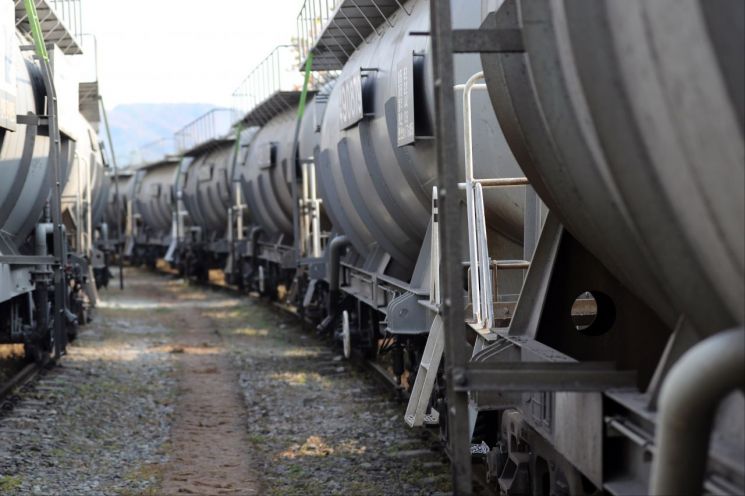
 A cement transport train stopped on the tracks at Obong Station, Uiwang-si, Gyeonggi-do.
 [Photo by Yonhap News]
[Asia Economy Reporter Kim Jong-hwa] On the 24th, as the Korea Public Service and Transport Workers' Union Cargo Solidarity Headquarters (Cargo Solidarity) began a full-scale transportation refusal, the cement and ready-mixed concrete industries are growing increasingly anxious.
Cement can be stored in silos (cement storage tanks) if it cannot be shipped, but the limit is about ten days. Ready-mixed concrete plants can operate using previously secured cement, but due to the suspension of train operations following the Obong Station fatal accident, they have not been able to secure as much inventory as during the previous strike, limiting their endurance to about two days.
The cement industry has halted shipments. In regions with large cement plants such as Danyang, Chungbuk, and Donghae, Gangwon, bulk cement trailer (BCT) operations completely stopped from 10 a.m. that day. It is estimated that there are about 3,000 BCTs transporting cement, of which about 1,000 belong to Cargo Solidarity. Some BCTs affiliated with Cargo Solidarity are parked near the main gates of cement plants, monitoring non-union vehicle operations. Drivers who visited cement plants with small trucks to secure cement were persuaded by Cargo Solidarity union members to turn back. A representative from a cement company in Danyang, Chungbuk, said, "Since cement plants have no choice but to continue operating, inventory will start to accumulate from today," adding, "During the last strike, after more than ten days, there was no place left to store inventory. If the strike prolongs, the plants will have no choice but to stop."
The ready-mixed concrete industry had been actively securing cement inventory even before the strike was announced, but due to the suspension of train operations following the Obong Station fatal accident, they were unable to secure sufficient quantities. It is reported that the inventory secured at large ready-mixed concrete plants in the metropolitan area is less than two days' worth. A representative from a major ready-mixed concrete company said, "We even visited cement plants in other regions to secure cement before the strike," adding, "Due to the Obong Station accident, the quantity secured is less than during the strike last June. At most, it will last two days, and the stock will be depleted after one day. If the strike continues, it will be a serious problem."
During the eight-day Cargo Solidarity strike last June, cement companies reportedly suffered losses averaging about 15 billion KRW per day, and ready-mixed concrete companies could not endure more than three days, causing plants nationwide to stop and incurring estimated losses of about 50 billion KRW per day.
© The Asia Business Daily(www.asiae.co.kr). All rights reserved.

















