Attachment of Satellite Sensors to Official Ball of Qatar World Cup
Collecting Data on 29 Player Body Parts and Ball Position During Matches for Video Review Room
Showcasing Presence in Every Game with Semi-Automatic Offside Review Technology

[Asia Economy Reporter Han Seung-gon] The official ball of the 2022 Qatar World Cup is the 'Al Rihla,' jointly produced by the German sports brand Adidas and FIFA. In Arabic, it means 'The Journey.' Al Rihla is composed of 8 triangular and 12 diamond-shaped pieces. The diamond-shaped pieces feature patterns inspired by the Qatar national flag.
Examining the features of Al Rihla reveals it as a culmination of advanced technology. According to FIFA, Al Rihla, tested in Adidas's wind tunnel laboratory, flies faster and more accurately than previous soccer balls.
The ball is made up of 20 square polyurethane pieces with special protrusions, a technology called 'Speedcell,' which is known to enhance accuracy and flight stability. Additionally, like a golf ball, its surface is textured to reduce air resistance. Adidas, the manufacturer, claims it is the fastest and most accurate official ball in history.
But that’s not all. A notable feature is the 'Inertial Measurement Unit (IMU)' sensor located at the center inside the ball. The IMU is an electronic device combining accelerometers, gyroscopes, and magnetometers to measure and report the magnetic field surrounding the body based on specific forces and angular rates. It is commonly used in navigation and control of unmanned aerial vehicles, guided weapons, projectiles, and satellites. The latest IT technology is embedded in this World Cup official ball.
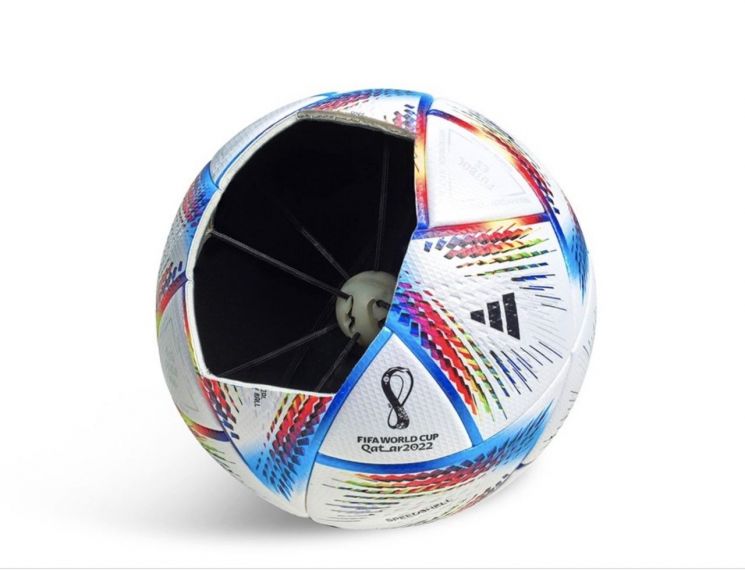 Internal view of the Al Rihla official ball for the 2022 Qatar World Cup. There is a sensor device in the center that exchanges players' physical data with the central control center to facilitate smooth game progress. Photo by Adidas
The IMU installed in Al Rihla floats at the ball’s internal center, and 12 cameras installed on the stadium roof collect position data of 29 body parts of players, including toes, knees, and shoulders, 50 times per second. Throughout the match, the ball’s position data is measured 500 times per second and transmitted to the video review room. Finally, artificial intelligence (AI) synthesizes all information to inform referees of any fouls. Compared to previous systems, which had potential errors due to camera angles, this system is more accurate and reduces decision time by about one-third.
These functions of Al Rihla were showcased from the opening day with FIFA’s developed 'Semi-Automated Offside Technology (SAOT).' SAOT utilizes camera tracking and human motion recognition technology.
In the opening match of the 2022 Qatar World Cup held on the 21st (Korean time), an Ecuador goal scored in just 3 minutes was disallowed. The Ecuadorian supporters’ cheers instantly turned to despair, drawing worldwide attention from football fans wondering what had happened.
During the match, Mikael Estrada headed the ball down in the penalty area, which Felix Torres connected with a scissors kick, and then Enner Valencia headed it into the goal. However, an offside call was immediately made, with the referee deciding that Estrada’s toes and thigh were slightly ahead of the Qatar defender. Without SAOT technology, this goal would have been allowed. Of course, SAOT alone does not make the final offside decision; it requires review by the Video Assistant Referee (VAR), hence the term 'semi-automated.'
Thus, Al Rihla not only assists in decisions but also helps monitor the match and delivers related statistical data to tournament officials. A total of 22,000 cameras are installed across all 8 stadiums, including Lusail Stadium where the opening ceremony and final are held, transmitting images in real time to the central control center. The center uses AI to monitor the received images and check match-related situations.
The integration of IT technology into World Cup official balls began with the 'Telstar 18' ball of the 2018 Russia World Cup. It was equipped with an NFC chip (an electronic device developed for near-field communication with other electronic devices) to measure ball speed and position. Compared to that, the 2022 Qatar World Cup official ball Al Rihla represents the forefront of AI technology.
The Al Rihla equipped with the inertial sensor is used only in the World Cup finals matches. The regular Al Rihla ball without the inertial sensor costs around 150,000 KRW each.
© The Asia Business Daily(www.asiae.co.kr). All rights reserved.
![Clutching a Stolen Dior Bag, Saying "I Hate Being Poor but Real"... The Grotesque Con of a "Human Knockoff" [Slate]](https://cwcontent.asiae.co.kr/asiaresize/183/2026021902243444107_1771435474.jpg)
















