Aging of Domestic Workers Intensifies and Construction Site Employment Avoidance
"Need to Train Skilled Domestic Workers and Increase Legal Foreign Workers"
[Asia Economy Reporter Noh Kyung-jo] Over the next three years, the construction industry is expected to face an annual shortage of 169,000 domestic workers. In response, there have been calls to estimate the appropriate scale of foreign workers needed.
On the 22nd, the Korea Construction Industry Research Institute published the "Mid-term (2022?2024) Study Report on the Appropriate Scale of Foreign Workers in the Construction Industry," which emphasizes the need to estimate the scale of foreign construction workers and provide policy support under the premise of not infringing on domestic jobs.
The report proposed annual training plans of ▲8,500 workers (about 5% of the domestic shortage, Plan 1), ▲16,000 workers (about 10%, Plan 2), which is twice Plan 1, and ▲25,000 workers (about 15%, Plan 3), considering settlement after entering the construction industry. Currently, the number of participants in the Ministry of Employment and Labor’s construction worker skill enhancement support program has been decreasing annually, reaching about 7,000 in 2020.
When supplying domestic workers through education and training, the estimated scale of foreign worker introduction was ▲approximately 160,000 for Plan 1, ▲approximately 150,000 for Plan 2, and ▲approximately 140,000 for Plan 3.
Earlier, in response to the worsening labor shortage in the industry, the Ministry of Employment increased the Employment Permit System quota from 59,000 to 69,000 at the end of August. The foreign worker quota for the construction industry was expanded by 360 to 2,760. However, labor shortages persist in civil engineering sites and occupations avoided by domestic workers.
Researcher Choi Eun-jung of the Korea Construction Industry Research Institute emphasized, "To prepare for the future decline in the working-age population and the influx of illegal foreign workers on sites, it is necessary to train skilled domestic workers and seek policy support measures to increase the number of legal foreign workers."
According to Statistics Korea’s "2021 Immigrant Residence Status and Employment Survey," as of May last year, there were 855,000 foreign workers across all industries. Among them, an estimated 102,000 (11.9% of the total) were employed in the construction industry.
By nationality, Asians accounted for 90.4%, with Korean-Chinese making up 39.8%, a majority. By age group, 30?39-year-olds accounted for 33.1%, and 15?29-year-olds for 22.1%. More than half of foreign workers were under 40 years old.
The report also forecasted the supply and demand of construction workers by occupation and region. The occupations with severe domestic worker shortages relative to demand, or "domestic shortage rates," were in order: formwork carpentry, rebar work, architectural carpentry, stonemasonry, concrete work, architectural plumbing, painting, tiling, masonry, and scaffolding.
By 2024, the demand for formwork carpenters is expected to average 206,000, with domestic and foreign supply at 137,000 and 60,000 respectively, totaling 196,000, leaving a domestic supply gap (shortage) of 69,000. Rebar worker demand is projected at 116,000, with domestic supply at 80,000, foreign supply at 31,000, total supply at 111,000, and a domestic supply gap of 36,000. In contrast, the scaffolding occupation showed a domestic shortage of less than 1,000.
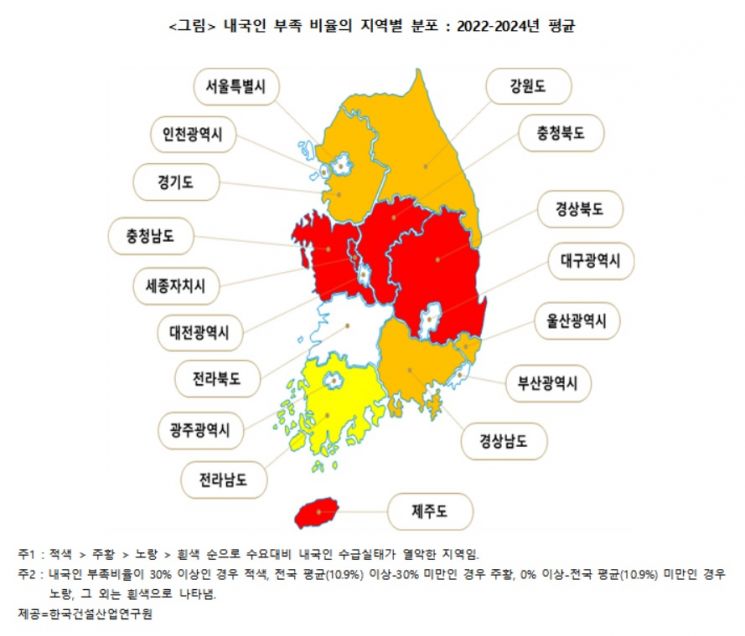
The regions with severe domestic shortages are expected to be, in order: Gyeonggi-do, Chungcheongnam-do, Gyeongsangbuk-do, Gyeongsangnam-do, Sejong City, Chungcheongbuk-do, Jeju City, Gangwon-do, Ulsan City, and Jeollanam-do.
For the mid-term average, Gyeonggi-do’s demand is 457,000, domestic supply 325,000, foreign supply 68,000, total supply 393,000, and domestic supply gap 132,000. In Sejong City, demand is 27,000, domestic supply 5,000, foreign supply 1,000, total supply 6,000, and domestic supply gap 22,000.
Researcher Choi said, "Due to the aging of domestic construction workers and the avoidance of construction site employment, foreign workers are increasingly required in labor-intensive occupations. Through mid- to long-term manpower supply and demand plans, the government should strategically analyze which occupations need to prioritize domestic worker development and which require more foreign workers." She added, "Specific policy support measures are needed, such as pardoning administrative sanctions on foreign employment restrictions, easing sanction criteria, unifying foreign worker allocation and sanction standards, and establishing mid- to long-term manpower supply and demand plans."
© The Asia Business Daily(www.asiae.co.kr). All rights reserved.
![Clutching a Stolen Dior Bag, Saying "I Hate Being Poor but Real"... The Grotesque Con of a "Human Knockoff" [Slate]](https://cwcontent.asiae.co.kr/asiaresize/183/2026021902243444107_1771435474.jpg)
















