BoK Likely to Raise Base Rate by 0.25%P
1. Will Next Year's Growth Rate Fall Below 1%?
2. Unanimous Decision by Committee on 7th?
3. Will Final Rate Rise to 3.75%?
Market More Alert to Monetary Policy Committee's Decision Background
[Asia Economy Reporter Seo So-jung] "Attention should be paid more to the Bank of Korea's growth rate forecast for next year than to the base interest rate."
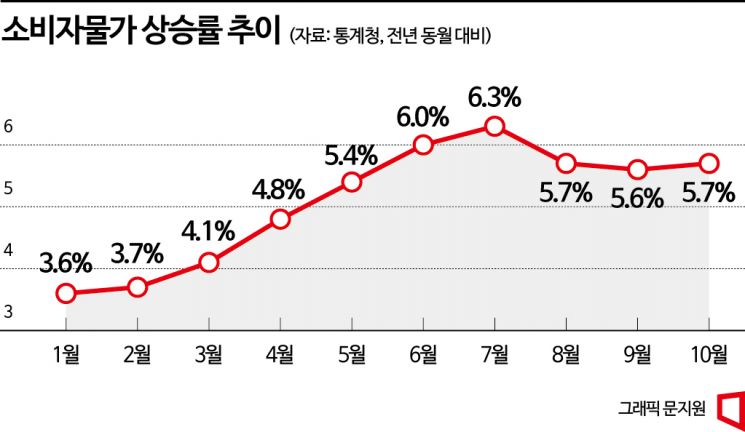
This is the perspective of the financial investment industry regarding the Bank of Korea's Monetary Policy Committee meeting scheduled for the 24th. As the meeting approaches in two days, the prevailing analysis is that the Bank of Korea will continue its sixth consecutive rate hike by taking a baby step (a 0.25 percentage point increase in the base rate). Initially, a tight contest between a big step (a 0.50 percentage point increase) and a baby step was expected, but recently, expectations for the U.S. Federal Reserve's (Fed) slowing pace of policy rate hikes have grown, calming the won-dollar exchange rate. The expected inflation rate, which reflects consumers' inflation expectations, fell by 0.1 percentage points to 4.2% this month from 4.3% in October. The short-term money market tightening caused by the Legoland incident has made securing financial stability a major task for the Bank of Korea, further solidifying the baby step forecast.
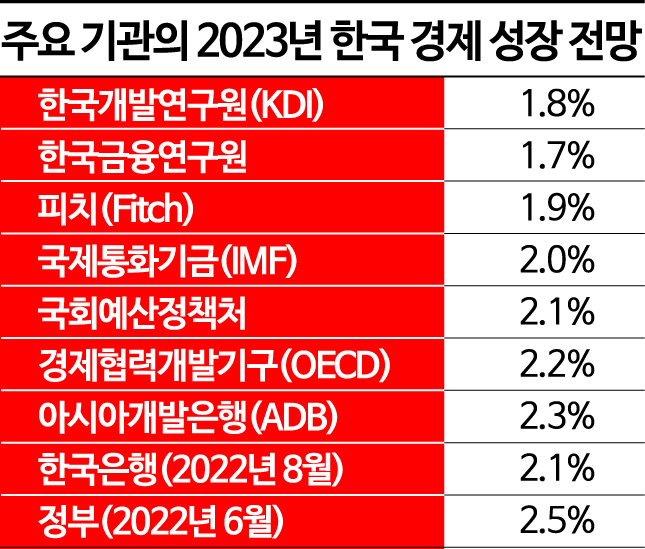
◆Will the 1% growth rate for next year be formalized?= Along with the monetary policy decision by the Monetary Policy Committee, the revised economic forecast to be announced by the Bank of Korea's Research Department has become the market's biggest focus. The financial investment industry sees that, given the challenging domestic and international economic conditions next year, the Bank of Korea is likely to lower its growth forecast to the 1% range, similar to other institutions. In August, the Bank of Korea projected next year's growth rate and consumer price index (CPI) at 2.1% and 3.7%, respectively. Since the Monetary Policy Committee meeting last month, it has hinted at lowering next year's forecast. The key issue is whether the Bank of Korea will officially set next year's growth forecast below the potential growth rate (2%) in the 1% range after the meeting on the 24th and judge the economy to be in recession. Since the committee's decision is based on the Bank of Korea's economic outlook, it is inevitably closely linked to the final interest rate level. Kang Min-joo, an economist at ING Bank, predicted, "Due to the decline in prices of major export items like semiconductors and the cumulative effect of rate hikes leading to high interest burdens and reduced consumption, the Bank of Korea will take a baby step this month and complete the rate hike cycle with an additional baby step in the first quarter of next year."
◆70% of bond experts expect a "baby step"= Whether the 0.25 percentage point base rate hike will be unanimously decided by the seven Monetary Policy Committee members at this meeting is also drawing market attention. Since April, during the five consecutive rate hikes, the only meeting without a unanimous decision was in October. At the October meeting, which decided on a 0.5 percentage point hike, four of the six committee members excluding the governor favored a big step, while two members (Joo Sang-young and Shin Sung-hwan) dissented with a baby step opinion. Even hawkish members (favoring monetary tightening) Seo Young-kyung and Park Ki-young have recently indicated the need to slow the pace of rate hikes. Bank of Korea Governor Lee Chang-yong also emphasized, "Maintaining financial stability, especially in the non-bank sector, has become an important issue." Moon Hong-chul, a researcher at DB Financial Investment, said, "Since many loans in Korea are linked to short-term interest rates, the need to slow the pace compared to advanced countries has increased, and due to concerns about the surge in household debt and real estate collapse, there is a high possibility of adjusting the magnitude of rate hikes." According to a survey conducted by the Korea Financial Investment Association from the 11th to the 16th among 100 bond holding and management professionals, 70% of respondents expected a 0.25 percentage point base rate hike at this month's Monetary Policy Committee meeting.
In particular, voices expressing concern over rapid rate hikes are spreading as South Korea's economic growth rate is revised downward due to the global economic slowdown next year. The International Financial Center recently forecasted, based on analyses from major investment banks (IBs) and the International Monetary Fund (IMF), that the global economic growth rate will be only 2.3% next year. This is the lowest level in 20 years, excluding 2009 (-0.1%) during the global financial crisis and 2020 (-3%) during the COVID-19 pandemic. Accordingly, some dovish (favoring monetary easing) minority opinions for a freeze may emerge, worried about the economic slowdown.
◆The gap between Korea and U.S. interest rates widens further= Market interest is also high regarding the final interest rate level that Governor Lee will announce after the Monetary Policy Committee meeting. Currently, major global investment banks' forecasts for the U.S. policy rate peak range from a minimum of 4.75% to a maximum of 5.75%, and the market expects the Bank of Korea's final rate to rise from the current 3.5% to around 3.75%. The Bank of Korea cited the Fed's tightening intensity, energy prices, won-dollar exchange rate, and domestic financial conditions as key variables influencing next year's monetary policy. International oil prices are expected to have increased volatility. Oh Jung-seok, a senior researcher at the International Financial Center, forecasted, "The five key factors in the international crude oil market next year are supply disruption concerns, petroleum product shortages, expectations of monetary policy and dollar pivot, crude oil inventory shortages, and geopolitical instability. All these factors will exert upward pressure, potentially pushing oil prices into triple digits by late first half or second half of next year."
© The Asia Business Daily(www.asiae.co.kr). All rights reserved.
![Clutching a Stolen Dior Bag, Saying "I Hate Being Poor but Real"... The Grotesque Con of a "Human Knockoff" [Slate]](https://cwcontent.asiae.co.kr/asiaresize/183/2026021902243444107_1771435474.jpg)

















