Until December 31, International Gallery Lee Kibong Solo Exhibition 'Where You Stand'
A Subtle Balance of Unconsciousness, Reality, and Illusion. Presenting a Timeless Landscape of Another Dimension
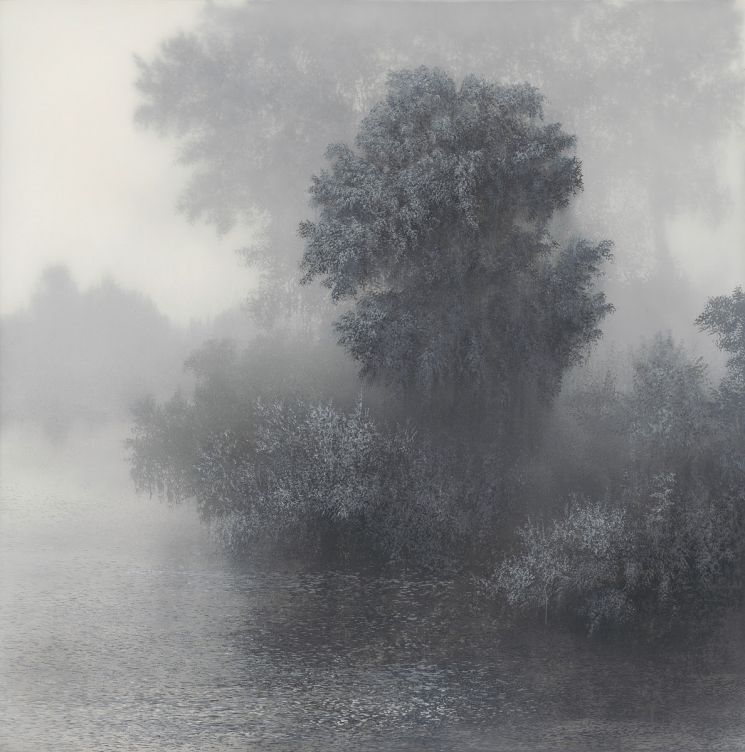 I Kibong, 'Where You Stand D-1', Acrylic and polyester fiber on canvas, 186 x 186 cm, 2022. Photo by Kukje Gallery
[Asia Economy Reporter Kim Heeyoon] “I believe we should enjoy ambiguity. Ambiguity itself is the essence of the world. I approach my work with this as the fundamental content and attitude.”
Artist Lee Gibong, who captures foggy natural landscapes in a dreamlike manner, has returned with his first solo exhibition in 14 years. The International Gallery in Samcheong-dong, Jongno-gu, Seoul, is hosting Lee Gibong’s solo exhibition “Where You Stand” until December 31.
The artist has continuously explored and experimented with the structures and flows that constitute the essence of the world, moving between painting and installation. His work has been praised for paradoxically evoking nostalgia for the past and a longing for fleeting moments. In his pieces, Lee creates a mysterious balance between the unconscious, reality, and fantasy. The landscapes depicted on his dreamlike canvases approach the audience as scenes from another dimension beyond time. In this exhibition, he presents over 50 new works titled “vanitas,” reflecting on the cycles and disappearances in nature.
He introduces, “The main motifs I am interested in are water and fog.” He continues, “They transform the appearance of objects or beings and bring us closer to a transcendental realm. It feels like discovering a spirit or soul in an aspect of things that is usually hidden.”
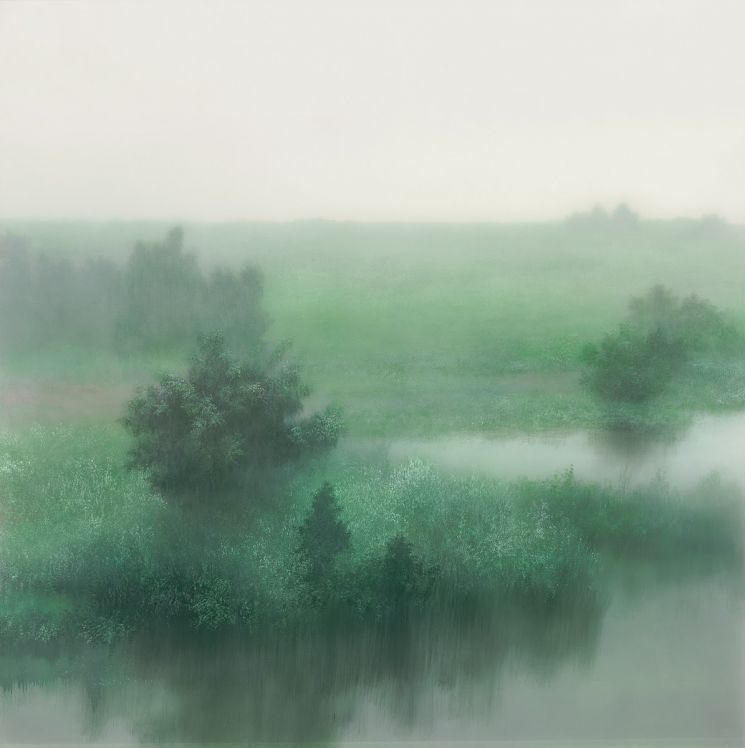 I Kibong, Where You Stand Green-1, Acrylic and polyester fiber on canvas, 186 x 186 cm, 2022. Photo by Kukje Gallery
Lee Gibong varies the “density of reality” to evoke a fresh experience of encountering the world in his work. Particularly notable is his approach to water, which inherently lacks an absolute form and gains shape and meaning through relationships with external objects. In his 2003 solo exhibition, he directly revealed the form of water by featuring aquariums filled with blue water. Since 2008, he has consistently worked with water in the form of fog and steam, emphasizing its transient and variable nature.
Fog, especially, has become a unique sculptural language for the artist, who has worked for over 30 years in a studio located on a humid mountainside. By revealing the relational nature of water that forms meaning through connections, fog transcends its visual effect of evoking a mysterious sensation on the canvas and serves as an element that visualizes the structure of relationships between humans, objects, and the world.
The blurred textures and boundaries in his works create the illusion of rising fog, but this effect results from layering thin sheets of plexiglass (acrylic panels) or polyester fibers at regular intervals on the canvas, overlaying two images. The artist focuses not on the trees or lakes appearing in the background as subjects of representation, but on the “water mist” surrounding them. The fog mixes the spatial distances of multiple planes placed on a flat surface, disrupts perceptual systems, and produces a fantastical atmosphere.
Regarding the message in his work, the artist presents a text excerpted from German philosopher Ludwig Wittgenstein’s “Tractatus Logico-Philosophicus.” Having read this book for over 20 years, he explains, “Humans cannot fully understand the world and can only vaguely perceive it through the ‘veil’ of language or senses. The cumbersome polyester fabric layered over the work is also a means to convey this thematic consciousness.”
Wittgenstein’s text is also exhibited as an installation piece. In this exhibition held simultaneously in Seoul and Busan, the new work “A Thousand Pages,” installed once in each location, features embossed text on one side pressed onto pigment powder on the other, evoking the sensation of viewing an open book.
Although invisible, the artist focuses on the flow that certainly exists as a tool operating the world. Recognizing that humans ultimately perceive the world reflected in themselves, he concentrates on visualizing the process of variation and awareness. The exhibition insists that depending on where one stands, different effects can be sensed and different worlds can be seen. Furthermore, the artist creates paintings as devices that allow one to rediscover something that is everywhere yet nowhere, proudly calling himself an “engineer” who produces art of dreamy images rather than a traditional artist. The exhibition runs until December 31.
© The Asia Business Daily(www.asiae.co.kr). All rights reserved.


















